
AI Automation12 min read
8-Step AI Workflow Automation Pilot for Technical Teams with AmmarAI
Technical playbook to design, pilot, and run AI workflow automation: architecture patterns, ops controls, and a two-week AmmarAI content pilot plan.

8-Step AI Workflow Automation Pilot for Technical Teams with AmmarAI
AI workflow automation orchestrates AI agents, data pipelines, and human review steps into one reliable process, going beyond basic automation by handling decisions, not just fixed steps. It fits workflows that span multiple systems, require judgment calls, and involve several sequential handoffs. Done right, it cuts manual coordination, speeds up cycle time, and scales without adding headcount to babysit every step.
TL;DR:
- Choosing the right orchestration pattern depends on your scale and control needs, with hybrid models offering a balance between security and resilience.
- Ensure your platform supports state persistence, automatic retries, and human review gates to handle failures and maintain reliability in production.
- Focus on workflows with multiple decisions across systems and sufficient volume, as simple, rule-based tasks do not require agentic orchestration.
- When piloting content automation, start with a small, high-impact process, instrument it thoroughly, and gather data before expanding.
- Compatibility with internal systems, observability tools, security features, and cost controls are critical factors to evaluate in any AI workflow automation platform.
Table of Contents
- What Are the Core Components of an AI Workflow Automation System?
- Which Orchestration Pattern Should You Choose?
- What Should You Look for When Evaluating AI Workflow Tools?
- How Do You Implement an AI Workflow Automation Pilot?
- How Do You Keep Agentic Workflows Reliable in Production?
- Where Does AI Workflow Automation Actually Pay Off?
- How Does AmmarAI Support Content Automation Pilots?
- What Pragmatic Advice Matters Most Before You Scale?
- Ready to Pilot a Content Automation Workflow?
- Sources
What Are the Core Components of an AI Workflow Automation System?
Before you pick a tool, you need to understand what you’re actually assembling. AI workflow orchestration coordinates multiple AI models, autonomous agents, data pipelines, and human review gates into a single automated process, and each piece has a distinct job.
Agents handle a narrow task well rather than a broad task poorly. A drafting agent shouldn’t also be your fact checker. Specialization makes testing and debugging tractable, because you can isolate exactly which agent produced a bad output instead of untangling one giant prompt doing five jobs at once.
The orchestrator is the traffic cop. It sequences tasks, tracks state across steps, retries failed calls, and manages handoffs between agents or between an agent and a human. This is the layer most teams underbuild, and it’s the layer that breaks first in production.
Everything else feeds the pipeline:
- Connectors and APIs that pull data from CRMs, ERPs, ticketing systems, and internal databases.
- Knowledge sources, including vector stores, that ground agent outputs in your actual documents instead of generic training data.
- Human approval gates placed at points where a wrong decision is expensive.
- Observability tooling that logs every step, so when something fails at 2 a.m. you can trace exactly where and why.
- Access controls that limit which agents can touch which systems and data.
Miss any of these and you don’t have automation. You have a demo that works until it doesn’t.
Which Orchestration Pattern Should You Choose?
There’s no single right architecture, but there is a right starting point for most teams. Four patterns dominate current practice, and each carries a different risk and scaling profile.
- Centralized orchestration routes every decision through one controller. It’s easy to monitor and easy to secure, but that controller becomes a bottleneck as workflow volume grows.
- Decentralized orchestration lets agents coordinate peer-to-peer with no single controller. It scales well and tolerates node failure, but debugging a decision trail across a dozen autonomous agents is genuinely hard.
- Hierarchical orchestration puts a supervisor agent over worker agents, giving you centralized oversight with distributed execution underneath.
- Hybrid orchestration blends centralized governance for high-risk steps with distributed execution for everything else. A hybrid approach that centralizes governance while distributing execution matches most enterprise risk profiles, letting teams lock down sensitive actions while scaling routine ones freely.
Whichever pattern you pick, durable execution isn’t optional. LLM calls are probabilistic and individual agent steps fail or return malformed output regularly, so your platform needs state persistence and automatic retries built in, not bolted on later.
The trade-off comes down to control versus resilience. Centralized systems give you tighter control and simpler audits; decentralized systems give you resilience and scale but cost you visibility. For a first production pilot, especially anything touching money, contracts, or customer data, start centralized or hierarchical. Earn the right to decentralize once you’ve proven the workflow behaves.
What Should You Look for When Evaluating AI Workflow Tools?
Procurement decisions here are easy to get wrong because demos rarely show what breaks in month three. Judge platforms on capability categories, not marketing copy.
- Hybrid interface. You want a visual builder for fast iteration and a code layer for the logic a drag-and-drop canvas can’t express. Langflow, for instance, lets teams prototype visually and then extend flows with Python to integrate internal systems before deploying them as APIs. Being locked into one workflow representation with no code escape hatch creates real migration risk down the line.
- Integration depth. Check connector coverage for your actual internal systems and vector databases, not just the popular SaaS tools every vendor demos.
- Observability and replay. You need execution logs and step-level tracing, and ideally the ability to replay a failed run against the exact input that broke it.
- Governance and security. Look for granular approval gates, data handling controls, and clear audit trails, since vendor product guidance consistently flags human-in-the-loop gates as a baseline enterprise requirement now, not a nice-to-have.
- Scale and cost controls. Ask about per-execution pricing, concurrency limits, and whether the platform enforces call-depth caps to stop a runaway agent loop from draining your budget overnight.
Industry guidance increasingly favors platforms that pair visual-first design with developer-level control precisely because teams outgrow pure no-code tools the moment a workflow touches a legacy system with a quirky API.
Pro Tip: Run your POC on your ugliest, most exception-heavy workflow, not your cleanest one. A tool that handles a tidy five-step process tells you almost nothing about how it behaves when step three throws an error it’s never seen.
How Do You Implement an AI Workflow Automation Pilot?
Skipping steps here is how teams end up with a flashy proof of concept that never survives contact with production data. Follow this sequence.
- Pick one bounded, high-impact workflow. Resist the urge to automate everything at once. A contained pilot on a single high-impact workflow proves ROI faster and fails smaller than a sprawling rollout.
- Map the workflow’s boundaries. Define exactly where it starts, where it ends, what triggers it, and what “done” looks like. Ambiguous boundaries are the most common reason pilots stall in review.
- Decompose into atomic actions. Break the workflow into the smallest testable units and define clear interfaces between agents, since engineering guidance strongly recommends this so each piece can be tested, monitored, and retried independently rather than debugged as one tangled process.
- Set success metrics before you build. Decide what “working” means in numbers, whether that’s cycle time, error rate, or cost per execution, and test against representative real data, not clean sample data.
- Instrument observability from day one. Add execution logging and step tracing before you need it, not after your first production incident.
- Add retries, checkpoints, and human approval gates. These aren’t hardening steps to add later. Build them into the first version.
- Roll out in stages. Shadow mode first, then a small live percentage, then full traffic once error rates hold steady.
- Measure ROI and expand deliberately. Multi-agent orchestration pays off most on workflows with multiple decision points spanning several systems, so use your pilot data to identify the next candidate rather than automating the next workflow just because it’s next in line.
How Do You Keep Agentic Workflows Reliable in Production?
Reliability is where most AI workflow projects quietly fail, not because the AI is wrong but because the operational scaffolding around it is missing. Durable execution needs checkpointing and a resume strategy so a failure doesn’t force you to restart an expensive multi-step process from scratch.
Build these controls in before your first production run, not after your first incident:
- Per-agent retry and backoff policies, so a transient API failure doesn’t cascade into a full workflow crash.
- Fallback agents or escalation paths that route to a human when an agent can’t complete a task confidently.
- Execution limits, including max call depth caps that stop a looping agent from racking up thousands of unnecessary calls.
- Cost tracking per agent, so you catch a runaway process by budget alarm, not by finance’s monthly invoice.
- Audit logs covering every decision and handoff, kept long enough to satisfy your compliance requirements.
On data privacy, be deliberate about which model providers touch sensitive data and under what retention terms; this matters more once agents start pulling from internal knowledge stores rather than public web content. A platform without cost caps is a platform where one bad loop can turn a $200 pilot into a $20,000 mistake, so treat execution limits as a launch requirement, not a future improvement.
Where Does AI Workflow Automation Actually Pay Off?
Not every process needs an agent. The workflows worth automating share a signature: multiple decisions, multiple systems, and enough volume that manual coordination is a real bottleneck.
- Order-to-cash processes, where an order touches inventory, billing, fulfillment, and customer communication in sequence.
- Contract review and generation, where clauses need extraction, comparison against policy, and routing to the right approver.
- Lead enrichment, pulling from multiple data sources and scoring before handoff to sales.
- IT incident triage, classifying, routing, and sometimes auto-resolving tickets before a human ever sees them.
- Document intake automation, extracting structured data from unstructured PDFs, emails, and scans.
Each of these involves judgment calls across systems that don’t talk to each other natively, which is exactly where orchestration earns its cost. A single, predictable task like “resize this image on upload” doesn’t need an agent. Rule-based automation is cheaper, faster, and easier to debug for anything with one clear decision path and no real branching. Save agentic orchestration for the messy, multi-step work that currently eats an analyst’s whole afternoon.
How Does AmmarAI Support Content Automation Pilots?
Content pipelines are a natural first pilot for AI workflow automation because the inputs and outputs are usually well defined: a brief comes in, a draft comes out, someone reviews it, it publishes. An integrated workspace that covers writing, image generation, video, and transcription in one place removes the toolchain overhead of stitching five separate subscriptions into one pipeline.
That matters for a pilot specifically because:
- Shared templates and brand voice settings keep automated outputs consistent across formats without a reviewer rewriting every draft.
- Collaboration features keep drafts, approvals, and revisions organized instead of scattered across email threads.
- File uploads let you feed source documents and brand assets directly into the generation step.
A sensible starting pipeline: ingest a brief, generate a draft, route it through an approval gate, publish. It mirrors the human-in-the-loop pattern any solid AI workflow automation needs, just scoped to content.
What Pragmatic Advice Matters Most Before You Scale?
Most failed pilots didn’t fail because the model was bad. They failed because someone skipped observability to hit a launch date, or scoped a pilot so broad that nobody could tell what actually went wrong when it did. Keep humans in the loop longer than feels necessary at first. Cost caps and execution limits belong in version one, not the “hardening sprint” that gets deprioritized every quarter.
If you take one thing from this: pick a single workflow, instrument it obsessively, and let the data tell you when it’s ready to expand. Resist the urge to automate three workflows at once just because the tooling makes it look easy.
— Ahmed
Ready to Pilot a Content Automation Workflow?
If you’re scoping a pilot workflow for content production, an all-in-one platform gives you the pieces without forcing you to stitch together separate tools for writing, images, video, and transcription.
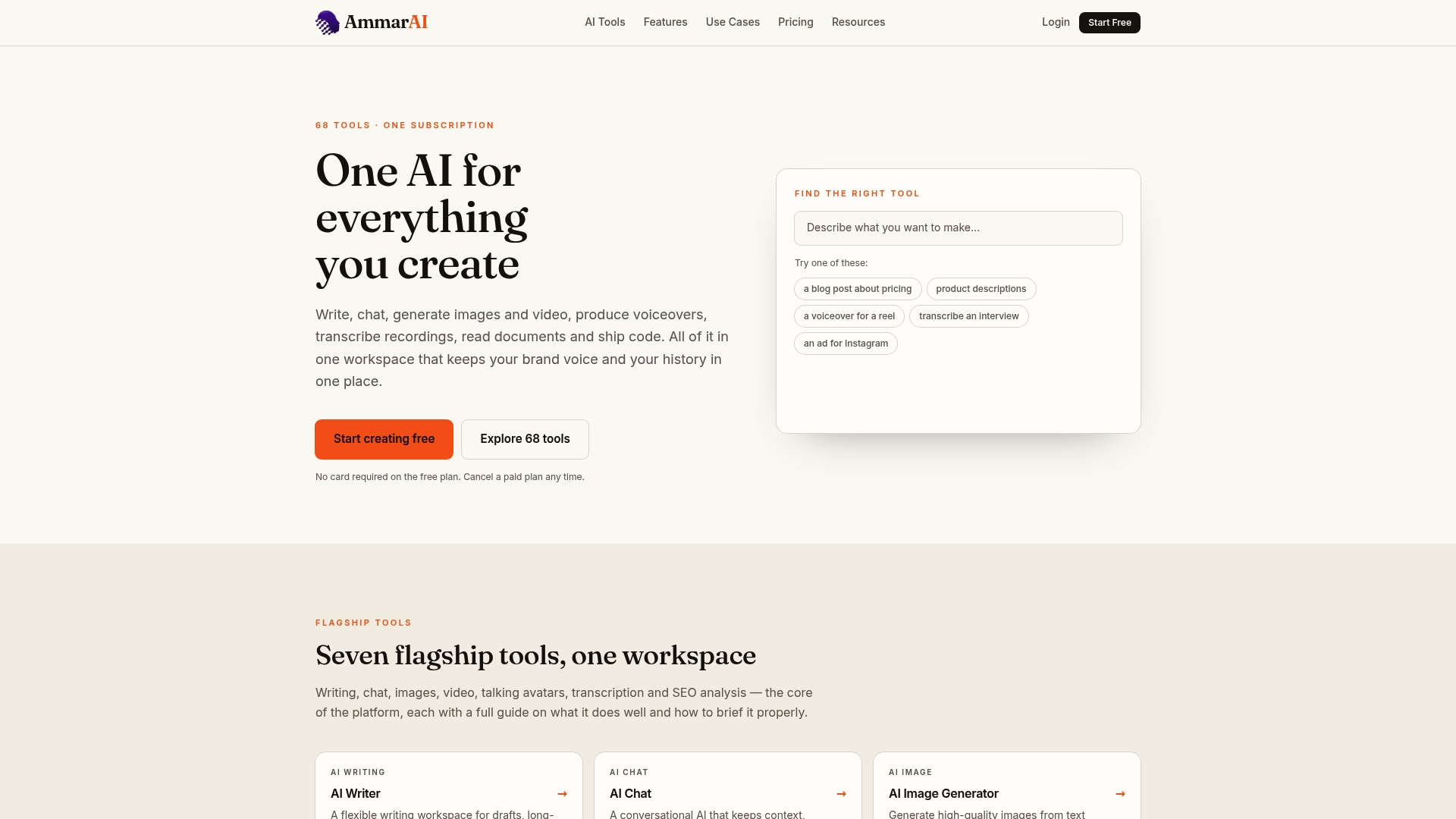
The relevant parts for a first pilot: templates that keep drafts consistent with your brand voice across every output, file uploads so source documents feed directly into generation, and custom AI assistants that can stay briefed on a specific task across a pipeline. Pair that with clear privacy controls over how your content and data get handled, and you have enough structure to run an ingest to draft to review to publish pipeline without adding new engineering overhead.
A practical way to start: pick one recurring content type, whether that’s a weekly ad or a batch of meta descriptions, and route it through Ammarai end to end for two weeks before deciding what to automate next. Start your first pipeline at Ammarai and see how far one workspace gets you before you add a second tool.
Sources
- AI Agent Orchestration: A Guide for Enterprise Systems | Databricks Blog
- Temporal: AI built on durable execution
- Langflow product documentation | IBM
- UiPath Maestro / Flow (product page)
Recommended
Recommended for you
- Best AI Video Generator: 7 Tools Compared
Find the best AI video generator for cinematic clips, avatars, editing and value. Compare quality, length limits, pricing and ideal users.
- AI Content Repurposing With AmmarAI in 7 Steps
Follow a practical AI content repurposing workflow in AmmarAI to turn one article into social posts, a newsletter, and a short video.
- AI Search Visibility: Gain 3–5 Points in 4–12 Weeks for Marketers
Measure and boost AI search visibility. Use prompt audits and a visibility score, prioritize answer-first pages and third-party mentions to earn citations.
Tools to try next
- AI Agent Builder
Build agents that run real workflows on a schedule or trigger — reading, deciding and acting without you.
- AI Writer
A flexible writing workspace for drafts, long-form articles, rewrites, and brand-consistent content. Includes templates, the Article Wizard, Smart Editor, and tone controls so every piece stays on-brand.
- AI Chat Pro
A multi-model chat with personas, reusable skills, smart memory, live web search, file uploads and organised folders — and it hands finished work to the rest of the platform.