
AI Templates9 min read
How to Use a Joke Generator for Better Jokes
Learn how to use a joke generator for speeches, captions, and one-liners, with practical prompts, editing checks, and fixes for weak AI humor before use.
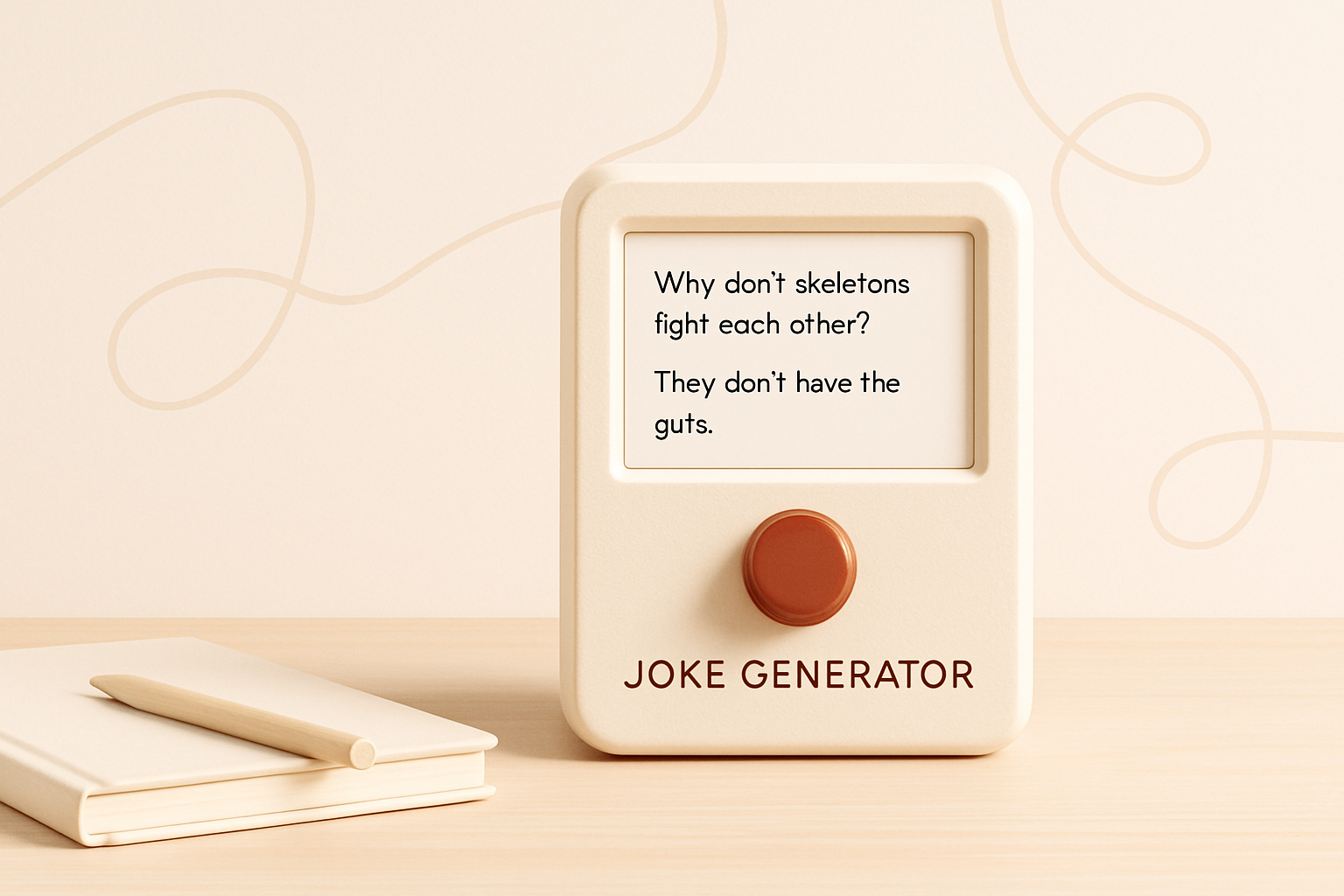
Use a joke generator by giving it a specific topic, audience, format, tone, and boundaries, then generate several options. Edit for timing, originality, and context before using any line. The tool supplies raw material; your judgment turns it into a joke that fits a speech, caption, or conversation.
Start with the job the joke needs to do
Before opening a joke generator, define where the joke will appear and who will hear it. A line for a conference speech needs a different rhythm and risk level from a private group-chat joke.
Write down five inputs: topic, audience, format, tone, and exclusions. For example: “Create short one-liners about delayed marketing approvals for an audience of in-house marketers. Keep the tone dry and workplace-safe. Avoid jokes about layoffs, clients, or specific people.”
A funny joke generator cannot infer sensitive context reliably. If the audience includes customers, executives, children, or people from different cultural backgrounds, state that explicitly.
- Topic: the specific subject, not a broad category such as “business.”
- Audience: who will hear or read the joke.
- Format: one-liner, pun, setup and punchline, dad joke, or knock-knock joke.
- Tone: dry, playful, absurd, understated, clean, or gently sarcastic.
- Boundaries: people, events, stereotypes, brands, and sensitive subjects to avoid.
| Format | Best for | Pros | Cons |
|---|---|---|---|
| One-liner | Captions, slides, short posts, and speech transitions | Fast to read and easy to test aloud | Often becomes generic without a narrow topic |
| Pun | Headlines, product captions, and light brand content | Compact and easy to connect to a keyword | Can feel forced or predictable |
| Setup and punchline | Speeches, scripts, and longer posts | Creates room for misdirection and stronger payoff | Requires careful timing and more editing |
| Dad joke | Family-safe posts and deliberately corny humor | Clear structure and usually low risk | The obviousness is part of the style, so it may not suit a sophisticated tone |
| Knock-knock joke | Children’s content and interactive delivery | Familiar call-and-response structure | Works poorly when the audience cannot participate |
Build a prompt that gives the model usable constraints
A practical prompt follows this order: task, topic, audience, format, tone, restrictions, and output count. Ask for 10 to 20 candidates rather than one “perfect” joke. Comedy is subjective, so selection is part of the workflow.
A useful prompt is: “Write 15 clean one-liners about a marketing team waiting for legal approval. The audience is digital marketers at an industry event. Use dry observational humor, keep each line under 20 words, and avoid insulting lawyers or clients. Do not explain the jokes.”
Add reference material when the joke depends on a speech, campaign, or article. Supply only the relevant excerpt and tell the AI which details it may use. This is the same context-first principle covered in AmmarAI’s guide to using AI for content creation.
- Request multiple candidates in one batch.
- Set a length limit that matches the placement.
- Describe the comic mechanism, such as misdirection or wordplay.
- List prohibited subjects instead of relying on “keep it appropriate.”
- Tell the model not to explain the punchline unless you need an analysis.
Generate, shortlist, and rewrite in separate passes
Do not publish directly from the first generation. First generate a broad batch, then remove lines that are confusing, familiar, off-tone, or dependent on a long explanation. Shortlist only the candidates with a clear premise and a recognizable turn.
In the second pass, ask the AI joke writer for targeted revisions. Instead of saying “make it funnier,” identify the problem: shorten the setup, move the surprise to the final word, replace a broad reference with a detail from the brief, or remove unnecessary explanation.
Keep the strongest fragment even when the complete joke fails. A useful premise with a weak punchline can be regenerated. A strong punchline with an overloaded setup can often be fixed by deleting words.
- Generate 10–20 candidates.
- Reject anything unclear, risky, or too familiar.
- Select two or three promising premises.
- Request specific rewrites of those premises.
- Read each version aloud and edit manually.
- Keep the version that fits the audience, not the one with the most elaborate wording.
Where generated jokes break and how to repair them
Generated humor commonly fails because the prompt is broad, the model explains the joke, or the line reproduces a familiar pattern without adding a specific observation. The fix should address the failure rather than asking for an undefined increase in humor.
Timing matters even in written content. Put the most surprising word or idea near the end, remove introductory filler, and avoid adding a sentence after the punchline. For a speech, mark a pause before the reveal and test whether the audience can understand the setup on first hearing.
| Failure | What it looks like | How to fix it | How to check |
|---|---|---|---|
| Generic premise | The joke could apply to any office, product, or profession | Add a concrete behavior, object, frustration, or phrase the audience recognizes | Remove the topic keyword; if the joke still works unchanged, it is probably too generic |
| Predictable punchline | The ending is obvious from the first few words | Ask for misdirection and move the expected idea away from the final position | Cover the ending and see whether a reader can guess it |
| Overwritten setup | The line takes too long to reach the turn | Delete background information that is not required to understand the punchline | Read it aloud once without pausing to explain |
| Explanation after the joke | The output states why the line is funny | Delete the explanation and regenerate if the punchline cannot stand alone | Stop reading at the punchline and check whether the meaning remains clear |
| Wrong tone | The joke mocks the audience or touches a sensitive issue | Restate the relationship between speaker, subject, and audience; add exclusions | Ask someone familiar with the audience to review it |
| Familiar wording | The line resembles a common joke, slogan, or meme | Keep the premise but request a new comic angle and phrasing | Search a distinctive phrase in quotation marks; treat this as a warning check, not proof of originality |
Choose the right joke generator workflow
The right tool depends on how much control you need. AmmarAI fits topic-based drafting and revision, while a simple random tool can be faster when context does not matter. Specialized generators are useful when the format itself is fixed.
You can try the AmmarAI joke-writing tool for tailored prompts or browse the broader collection of AI creation tools when the joke is one part of a larger caption, script, or campaign workflow. Tool availability and pricing can change, so check the relevant product page before making a decision.
| Option | Best for | Pros | Cons |
|---|---|---|---|
| AmmarAI Joke Generator | Creating topic-specific jokes, puns, and one-liners with audience and tone instructions | Supports a brief-driven workflow and makes it easy to generate material for speeches or captions | Still requires human selection, fact-checking, and tone review |
| General AI joke writer | Rewriting premises and exploring several comic angles | Can follow detailed context and revision instructions | May produce repetitive structures or confident explanations of weak jokes |
| Random joke maker | Getting a quick joke when subject and brand voice do not matter | Fast and requires little setup | Offers limited control over relevance, tone, and originality |
| Dad joke generator | Producing intentionally corny, family-friendly wordplay | Predictable format and usually easy to understand | Narrow style can become repetitive |
| Knock knock joke generator | Creating interactive jokes with a fixed call-and-response pattern | Useful for children’s activities and live participation | Limited flexibility and often dependent on simple puns |
| Manual writing | Handling sensitive, personal, or highly original comedy | Provides the most control over lived context and delivery | Takes more time and may still benefit from external feedback |
Final check before using a joke generator result
Treat every joke generator result as a draft. Check that the subject is recognizable, the setup contains only necessary information, and the final words deliver the turn. Then confirm that the line suits the audience and does not rely on a false claim or an unsupported stereotype.
For public content, search the most distinctive phrase to identify obvious overlap with existing jokes, slogans, or posts. This cannot prove originality, but it can reveal wording that should be revised. If the joke refers to a real person, event, product, or statistic, verify the underlying facts separately.
Finally, test delivery in the format where the joke will appear. Read speech material aloud, preview captions next to the image, and check line breaks on mobile. If a joke requires an explanation, remove it or return to the premise rather than defending the punchline.
- Can the intended audience understand the setup immediately?
- Is the punchline or turn placed near the end?
- Can any word be removed without losing meaning?
- Does the joke avoid protected traits, personal attacks, and sensitive events?
- Are factual references accurate?
- Does a phrase search reveal obvious duplication?
- Does the line still work aloud or in its final visual layout?
Frequently asked questions
how to get ai to tell jokes
Give the AI a topic, audience, format, tone, exclusions, and desired number of outputs. Ask for several candidates, then request specific changes such as a shorter setup or less predictable punchline instead of simply saying “make it funnier.”
best joke generator apps
The best choice depends on the assignment: AmmarAI suits prompt-based, topic-specific drafting; a random joke maker is faster for low-context entertainment; and specialized tools suit fixed formats such as dad jokes. Compare each option’s control, editing needs, and audience fit rather than choosing solely by output volume.
funny random jokes online
You can generate funny random jokes online with a random joke maker, but the results may not fit a specific speech, brand, or audience. For publishable material, add context and boundaries, generate several versions, and review each line for familiarity and tone.
can ai write comedy
AI can draft premises, puns, one-liners, and alternate punchlines, but it does not reliably judge timing or social context. Human review remains important because comedy depends on audience knowledge, delivery, originality, and the relationship between the speaker and the subject.
how can you check whether an AI joke is original
Search a distinctive portion of the joke in quotation marks and compare the premise against familiar jokes, memes, and slogans. A search cannot guarantee originality, so rewrite generic structures, add specific observations, and avoid publishing lines that closely resemble an existing work.
Recommended for you
- How to Learn to Code With AI: A Practical Workflow
Use AmmarAI to learn to code with ai through level-matched lessons, hands-on exercises, and code checks that explain errors without taking control.
- How to Use an FAQ Generator for Website Copy
Use an FAQ generator to turn business details into accurate website answers, then edit, verify, structure, and publish copy that helps visitors act.
- How Does an AI Resume Builder Work?
Use an AI resume builder to turn work history into a focused, ATS-readable resume. Follow a practical workflow for drafting, editing, and checking it.
Tools to try next
- Blog Ideas Generator
Turn a topic or niche into a list of fresh, specific blog post ideas.
- Blog Outline Generator
Turn a topic into a clear section-by-section outline before you write a word of prose.
- Blog Section Writer
Write one section of a blog post at a time, in context with the rest of the piece.