
AI for Business17 min read
6 to 8 Week AI Market Research Pilot: Procurement Ready Playbook
Run a procurement ready AI market research pilot in 6 to 8 weeks. Includes a vendor checklist, ROI guidance, validation steps, and a trial workspace...

6 to 8 Week AI Market Research Pilot: Procurement Ready Playbook
Yes, AI can deliver market research that is faster, cheaper, and often good enough for the decision at hand, provided a human stays in the loop to define the problem and check the output. The gains show up in speed, scale, and cost, not in flawless accuracy. Start with a narrow, time-boxed pilot inside an integrated AI workspace rather than a company-wide rollout, and measure it against a real business question before you scale it further.
TL;DR:
- AI-driven market research offers substantial speed and cost advantages, but its accuracy remains limited, especially for high-stakes decisions or detailed insights.
- Most effective AI use cases involve adaptive surveys, automated qualitative interviews, social trend analysis, and synthetic personas, with humans overseeing judgment and framing.
- Running a pilot requires clear hypothesis and KPIs, validated data, precise task design, and human checkpoints to prevent overreliance on unverified outputs.
- Validating the source and provenance of data, ensuring privacy safeguards, and integrating with existing marketing systems are crucial before scaling AI tools.
- A small, focused pilot on a single decision, using an integrated workspace, offers a low-risk way to evaluate whether AI fits your research workflow.
Table of Contents
- Where AI Adds the Most Value in Market Research
- How AI Techniques Actually Work in Research
- How Do You Run an AI-Powered Market Research Pilot?
- What to Look for When Evaluating an AI Research Tool
- What ROI Should You Actually Expect?
- Checklist and Vendor Questions Before You Commit
- How an Integrated AI Workspace Fits This Workflow
- AI Research vs. Traditional Methods: What Actually Changes
- Connecting AI Research Tools to Your Existing Marketing Stack
- Where AI Market Research Projects Go Wrong
- Ethics and Data Privacy in AI-Driven Research
- The Line Between Augmentation and Replacement
- Try a Focused AI Research Pilot
- Sources
- FAQ
Where AI Adds the Most Value in Market Research
Marketing research AI earns its keep in a handful of specific jobs, not as a blanket replacement for every research method a team runs. The pattern across current deployments is narrow and repeatable: AI handles the volume and speed problem, humans handle judgment and framing.
The strongest use cases right now:
- Rapid, adaptive surveys that adjust follow-up questions based on prior answers instead of running a static questionnaire.
- AI-moderated qualitative interviews with automated transcript coding, cutting weeks of manual analysis into hours.
- Social listening and trend synthesis that pulls signal out of thousands of posts, reviews, and forum threads at once.
- Synthetic personas and digital twins for early concept testing before a product or ad exists in market-ready form.
- Competitive and opportunity scans that summarize pricing, positioning, and feature gaps across a category.
Columbia Business School describes this shift as firms moving from one-off studies to “always-on intelligent engines” that feed continuous insight into product, marketing, and sales teams simultaneously, rather than producing a single report that goes stale in a quarter.
How AI Techniques Actually Work in Research
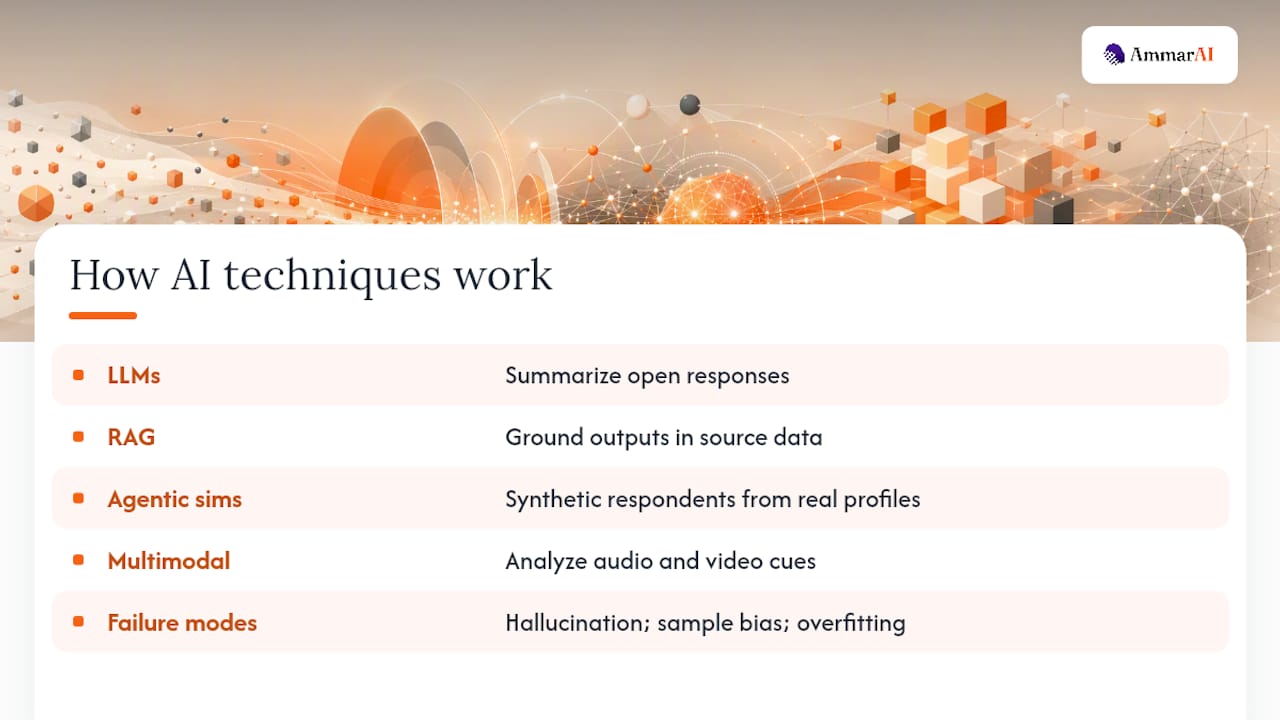
Most marketing research AI tools run on a small set of underlying techniques, and understanding them helps you cut through vendor marketing language. Large language models (LLMs) handle synthesis: summarizing open-ended survey responses, clustering themes, drafting persona narratives. On their own, LLMs can drift or invent details, so serious tools pair them with retrieval-augmented generation (RAG), which grounds outputs in your actual survey data, transcripts, or documents instead of the model’s general training knowledge.
Agentic simulations and digital twins go a step further. These systems seed a population of synthetic respondents with real demographic and behavioral data, then let AI agents “answer” as those personas would, based on patterns learned from prior human research. Andreessen Horowitz’s analysis notes these simulations depend on persistent memory, RAG, agent chaining, and fine-tuned multimodal models working together, not any single technology.
Multimodal models extend this to audio and video, transcribing and analyzing tone, facial expression, or hesitation in recorded interviews, something text-only tools miss entirely.
The failure modes matter as much as the capabilities. Hallucination remains real: a model can generate a plausible-sounding but fabricated quote or statistic. Sample bias creeps in when synthetic respondents are trained on scraped web data that skews toward whoever posts online most. And models can overfit to whatever data they were built on, producing confident answers that do not generalize to your actual customer base. None of these are reasons to avoid the tools. They are reasons to build validation into the workflow from day one.
How Do You Run an AI-Powered Market Research Pilot?
A working pilot follows a consistent sequence, and skipping steps is where most projects go sideways.
- Define the hypothesis and KPIs first. Decide what decision the research needs to inform and what “good enough” accuracy looks like before you touch a tool.
- Assemble your data. Pull together first-party survey data, CRM records, review data, and social listening feeds, and map which connectors your platform actually supports.
- Design the AI tasks. Break the work into discrete jobs: survey generation, interview moderation, synthesis prompts, persona construction.
- Build in human-in-the-loop checkpoints. Validate a sample of AI outputs against known human answers, run adversarial “red-team” tests to probe for bias, and document where the model’s interpretation diverges from a researcher’s.
- Translate outputs into action. Turn the synthesis into campaign briefs, product specs, or an executive summary, not just a raw data dump.
MIT Sloan’s research on generative AI in consumer insight work is explicit on this point: AI scales the processing, but human researchers still define the problem and validate the interpretation. Skip that validation step and you are trusting a black box with decisions that carry real budget behind them.
Pro Tip: Run your first pilot on a question you already have partial human-research data for. That gives you a built-in accuracy check instead of trusting the AI output on faith.
What to Look for When Evaluating an AI Research Tool
Vendor pitches in this category tend to sound similar. The differences that matter show up in five areas:
- Data sources and provenance. Ask exactly where synthetic respondent training data comes from and whether the sample skews toward any demographic, region, or platform.
- Privacy safeguards. Confirm how customer and respondent data is stored, whether it trains shared models, and what deletion controls exist.
- Synthetic respondent controls. Look for the ability to weight, filter, or exclude persona segments, not just a black-box “average consumer” output.
- Explainability and exportable deliverables. You need to see the reasoning behind a synthesized insight, not just a polished slide, and you need to get that data out in a usable format.
- Collaboration features. Shared workspaces, consistent brand voice across outputs, and reusable templates cut the friction of getting a whole marketing team using the same tool the same way.
Integration matters just as much as raw capability. A tool that cannot connect to your CRM, your BI dashboard, or your campaign platform turns every insight into a manual copy-paste job, which quietly kills adoption within a few months no matter how good the underlying model is.
What ROI Should You Actually Expect?
The honest answer is: real gains in speed and cost, real limits on precision. HBR’s coverage of generative AI market research tools points to research timelines compressing from months to days when synthetic personas replace early-stage panel recruitment. That is the headline benefit, and it is genuine.
The accuracy gap is measurable, not hypothetical. In one MIT Sloan-cited study, a hybrid LLM approach recovered about 77% of the themes that human analysts identified in the same qualitative data set. That’s a strong result for a first pass, and it also means roughly a quarter of the human-identified themes were missed entirely.
That gap sets a practical threshold: AI output is well suited to early concept testing, message screening, and directional trend work, where being mostly right, fast, beats being fully right, slow. It is a poor fit for regulatory submissions, safety claims, or any research where a missed theme carries legal or clinical weight. a16z’s research notes that many CMOs now accept accuracy levels that balance speed and cost savings against some loss of precision for lower-stakes decisions. For anything higher-stakes, keep a human panel or mixed-methods approach in the loop rather than replacing it outright.
Checklist and Vendor Questions Before You Commit
Before signing anything, walk through this list with your team:
- Team roles. Who owns prompt design, who validates outputs, and who signs off before insights reach stakeholders?
- Data readiness. Is your first-party data clean enough to feed a RAG-based system, or does it need cleanup first?
- Timeline and KPIs. What decision needs an answer, and by when?
- Pilot acceptance criteria. What accuracy threshold, compared against a human baseline, counts as a pass?
Ask any vendor directly: where does your training and respondent data come from? How do you handle data privacy and deletion? Can you explain why the model produced a given insight, not just show the output? And what does human oversight look like inside your platform, versus bolted on afterward?
A reasonable pilot runs six to eight weeks: two weeks to scope and connect data, three to four weeks running the AI tasks alongside a smaller human-validated sample, and the remainder comparing results before deciding whether to scale.
How an Integrated AI Workspace Fits This Workflow
The workflow above breaks down fastest when research, writing, and campaign production live in separate tools with separate logins and separate histories. An integrated workspace like Ammarai addresses that specific friction: one brand voice setting across every tool, bulk generation for testing multiple message variants at once, and shared workspaces so a researcher’s synthesis and a marketer’s draft campaign live in the same place instead of getting lost in a Slack thread. That does not replace the human-in-the-loop steps above. It just removes the tool-switching overhead that usually stalls a pilot before it produces anything useful. Evaluate it the way this guide recommends evaluating any platform: with a small, time-boxed pilot.
AI Research vs. Traditional Methods: What Actually Changes
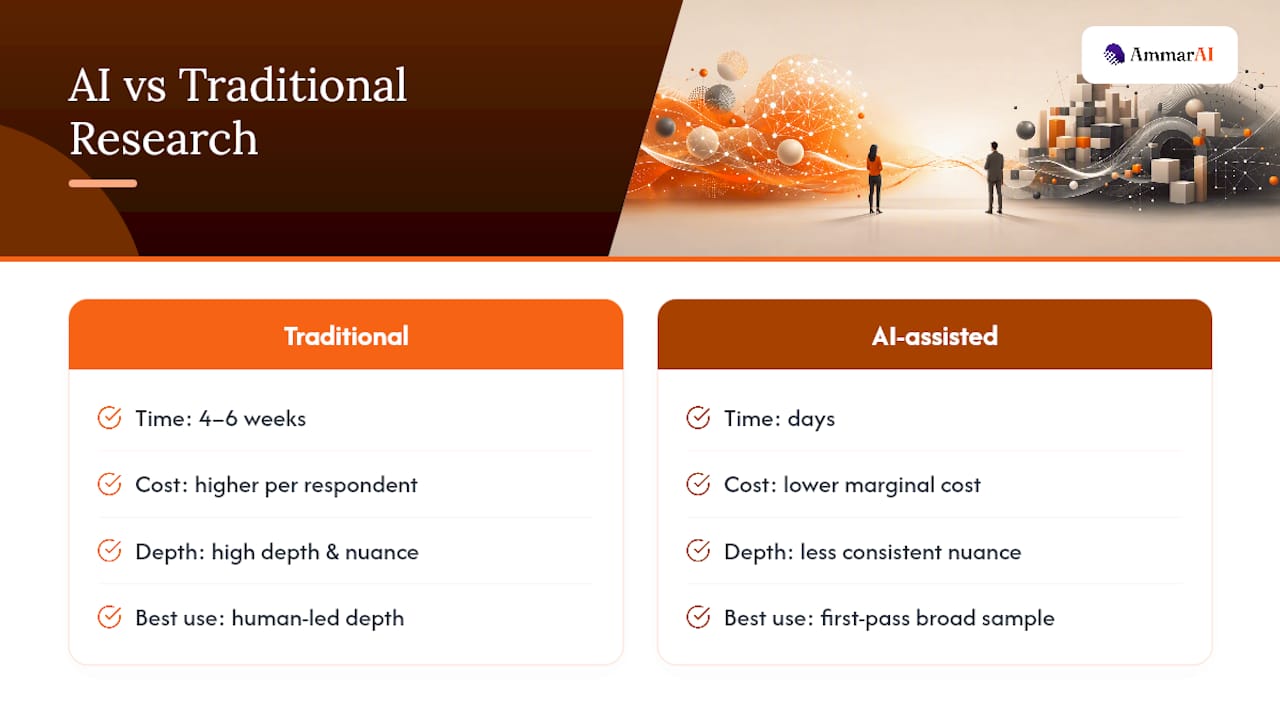
The time difference is the most visible shift. A traditional concept test, recruiting a panel, scheduling interviews, transcribing, coding themes, can easily run four to six weeks before you see a synthesized readout. AI-assisted versions of the same process, using synthetic personas or AI-moderated interviews, can compress that into days, a gap HBR’s reporting on AI market research tools frames as a genuine structural change in how research gets scheduled, not just a minor efficiency gain.
Cost follows a similar curve, though less dramatically. Traditional panels carry recruiting fees, incentive payments, moderator time, and analyst hours, with costs increasing with sample size; AI-assisted research moves more cost into software subscriptions and setup time, and marginal cost per synthetic interview is much lower once the system is built. That is part of why a16z frames this shift as budget moving from consultancy services toward software: the economics favor tools that can run the same synthesis task a thousand times without a thousand times the cost.
The trade-off sits in depth and nuance. A skilled human moderator can follow an unexpected tangent, notice a contradiction in body language, or push back on a vague answer in ways current AI moderation still handles inconsistently. Speed and cost improve dramatically. Depth on any single respondent conversation usually does not, at least not yet. The practical answer for most teams is not choosing one over the other. It is using AI for the first pass across a large sample, then reserving human-led depth interviews for the handful of segments where nuance actually changes the decision.
Connecting AI Research Tools to Your Existing Marketing Stack
Integration determines whether a research tool actually gets used past the pilot stage. The most common failure is treating the AI tool as an island: insights get generated, then someone manually exports a PDF and emails it around, and the data never touches the systems where decisions actually get made.
A workable integration sequence looks like this. First, connect your CRM so persona and segment data can flow both directions, letting the research tool ground synthetic respondents in real customer records rather than generic demographic assumptions. Second, connect your BI or analytics dashboard so research findings sit next to campaign performance data, letting a marketing team see a message-testing insight and a live campaign metric in the same view. Third, connect whatever platform handles content production and campaign execution, so a validated insight can move directly into a brief or draft without a manual handoff.
The technical lift varies by platform, but the sequencing matters more than the tooling. Teams that try to integrate everything simultaneously, CRM, ad platforms, BI, and content tools, in one rollout tend to stall for months figuring out data mapping. Teams that integrate one connection at a time, prove it works on a real project, then add the next, get a working system within a single quarter. Start with whichever connection removes the most manual work today, usually CRM or the content production tool, and expand from there once the first integration has a track record.
Where AI Market Research Projects Go Wrong
Most AI research pilots that stall or get abandoned share a small set of causes, and nearly all of them are process failures rather than technology failures.
The most common mistake is skipping the validation step because the output looks polished. A well-written synthetic persona summary or a clean-looking theme cluster can feel authoritative even when it is wrong, and teams under deadline pressure often ship it without checking it against any human baseline. The fix is structural: build a validation checkpoint into the workflow before the pilot starts, not as an afterthought if something looks off.
A second common pitfall is treating synthetic respondents as a full substitute for real customer contact. Digital twins are useful for early screening and directional signal, but a persona trained on aggregated patterns cannot surface something genuinely new that no one in the training data ever said. Teams that skip real customer touchpoints entirely tend to discover the gap only after a launch underperforms.
A third pitfall is data readiness. Feeding a RAG-based system messy, outdated, or duplicated CRM records produces synthesis that is confidently wrong rather than obviously wrong, which is worse. Clean the data before the pilot, not during it.
Finally, teams often roll AI research out to an entire organization before a single pilot has proven the accuracy threshold for their specific use case. Scope the first project narrowly, measure it honestly against a human benchmark, and only then decide whether to expand.
Ethics and Data Privacy in AI-Driven Research
Marketing research AI raises privacy questions that traditional panels mostly avoided, because the data involved is often more granular and the processing happens inside systems few researchers can fully audit.
The core ethical issue is consent and provenance. When a platform builds synthetic personas from aggregated customer or public social data, respondents in the original data set rarely consented specifically to having their patterns used to simulate future opinions. Responsible platforms disclose where synthetic respondent training data originates and give customers control over whether their own first-party data feeds shared models versus staying isolated to their account. Ask any vendor directly whether your data trains a model shared across other customers, and get a clear answer before you upload anything sensitive.
Bias compounds the ethics problem. If a synthetic respondent population skews toward whoever is most active online, and that population then informs a product or messaging decision, the research quietly excludes whoever does not fit that profile, often lower-income, older, or less digitally active customer segments. Regular distribution checks against known demographic benchmarks catch this before it shapes a real decision.
Regulatory obligations vary significantly by jurisdiction and by the type of data involved, and rules for handling personal data differ across regions and industries. Treat any AI research vendor’s privacy claims as a starting point for your own legal review, not a substitute for it, particularly when respondent data includes anything that could identify a real individual.
The Line Between Augmentation and Replacement
The honest read on marketing research AI is that it changes what researchers do, not whether they’re needed. The job shifts from running interviews to designing the simulations and stress-testing what comes back. Trust gets built the boring way: small pilots, shared dashboards, results checked against a human baseline before anyone acts on them. The real risk isn’t AI producing bad output. It’s teams trusting a synthetic respondent population that was never validated against a single real customer conversation.
— Ahmed
Try a Focused AI Research Pilot
Everything in this guide points to one practical next move: a small, time-boxed pilot rather than a full platform switch. Ammarai’s marketing tools give a team one workspace to draft survey questions, synthesize persona notes, and turn validated findings into campaign copy without juggling five separate subscriptions and five separate histories. A free plan lets you test the workflow on one real question before committing to anything larger. Pick a single decision you need to make this quarter, run it through a pilot using the checklist above, and see whether the output holds up against what your team already knows. That is a lower-risk way to find out if this fits your process than committing to a full rollout on faith.
Sources
- The AI Tools That Are Transforming Market Research
- How Gen AI Is Transforming Market Research
- Gain consumer insight with generative AI
- Faster, Smarter, Cheaper: AI Is Reinventing Market Research | Andreessen Horowitz
FAQ
Can You Do Market Research With AI?
Yes. AI handles survey generation, transcript analysis, social listening, and synthetic persona testing well, provided a human researcher defines the question and validates the output before it drives a decision.
What Is the Best AI for Marketing Research?
There is no single best tool for every use case; the right choice depends on whether you need synthetic personas, social listening, or survey analysis. An integrated workspace like Ammarai suits teams that want research synthesis and campaign production in one place instead of stitching together separate subscriptions.
Which AI App Is Best for Market Research?
The strongest option is whichever platform matches your specific workflow, your data connectors, and your privacy requirements, evaluated through a small pilot rather than a feature list alone.
What AI Is Better Than ChatGPT for Research Tasks?
General chat models like ChatGPT handle basic synthesis and drafting, but purpose-built research platforms add retrieval-augmented generation grounded in your own data, synthetic respondent controls, and explainability features that general chat tools typically lack.
Recommended
Recommended for you
- Try 3 Quick Trials to Vet AI Proposal Writing with AmmarAI for Teams
A test first workflow for AI proposal writing. Run three quick trials, learn what to upload and how to verify results, then try AmmarAI.
- Best AI Video Generator: 7 Tools Compared
Find the best AI video generator for cinematic clips, avatars, editing and value. Compare quality, length limits, pricing and ideal users.
- AI Content Repurposing With AmmarAI in 7 Steps
Follow a practical AI content repurposing workflow in AmmarAI to turn one article into social posts, a newsletter, and a short video.
Tools to try next
- AI Agent Builder
Build agents that run real workflows on a schedule or trigger — reading, deciding and acting without you.
- AI Writer
A flexible writing workspace for drafts, long-form articles, rewrites, and brand-consistent content. Includes templates, the Article Wizard, Smart Editor, and tone controls so every piece stays on-brand.
- AI Chat Pro
A multi-model chat with personas, reusable skills, smart memory, live web search, file uploads and organised folders — and it hands finished work to the rest of the platform.