
AI Marketing11 min read
One Page Tone of Voice Guide for Marketing Teams With Scoring and AmmarAI
Turn a one page tone of voice guide into repeatable processes: scoring on four dimensions, do/don't templates, and AmmarAI for audits and rewrites.

One Page Tone of Voice Guide for Marketing Teams With Scoring and AmmarAI
A usable tone of voice guide is a one-page voice summary paired with a channel-specific scoring matrix and a do/don’t gallery—nothing more elaborate. It targets writers, editors, and anyone approving customer-facing copy, and it works when a stranger can score a new piece of copy against it and get the same answer a brand manager would, as explained in company messaging and visibility best practices. The sections below walk through the templates, the scoring framework, and the rollout process that make that happen.
TL;DR:
- A tone of voice guide should be based on evidence from actual copy, focusing on 3 to 5 core traits with clear do/don’t rules, not adjectives.
- Regular calibration sessions are crucial to ensure consistent interpretation of the tone dimensions across team members and to keep the guide relevant.
- Using AI tools like AmmarAI can streamline applying the tone guide by bulk-rewriting content, scoring assets, and maintaining consistency across channels and formats.
- Starting with a quick audit of live copy and immediate scoring of key assets prevents guiding an aspirational voice that doesn’t match real communications.
- Frequent updates based on spot audits and content launches are necessary to keep the tone guide practical, usable, and integrated into daily workflows.
Table of Contents
- What’s the Difference Between Voice and Tone?
- What Are the Four Tone Dimensions Every Brand Should Score?
- How Do You Build a Tone of Voice Guide Step by Step?
- Templates and Examples for a Tone of Voice Guide That Sticks
- How Do You Keep a Tone of Voice Guide Alive After Launch?
- Operationalizing the Guide With AmmarAI
- Quick Wins and the Mistakes That Kill Adoption
- Where AmmarAI Fits in Your Tone Workflow
- Sources
What’s the Difference Between Voice and Tone?
Voice is the personality that never changes. Tone is how that personality adjusts to the moment. A brand with a warm, direct voice still sounds different apologizing for an outage than announcing a product launch, but it’s recognizably the same brand both times. The Australian Government Style Manual draws this line cleanly: voice covers stable choices like point of view, vocabulary, and grammar habits; tone is the situational layer on top, tied to formality level and audience state of mind.

Why this distinction matters for documentation: if your guide conflates the two, writers end up treating every rule as fixed, and the guide breaks the first time someone needs to write a serious legal notice in a “fun, quirky” brand.
Two examples, same voice, different tone:
- Support ticket (calm, reassuring tone): “We found the issue and we’re fixing it now. Your data is safe.”
- Social caption (energetic, playful tone): “Update’s live. Go break something (in a good way).”
Same word choices, same sentence rhythm philosophy, same core personality. Different emotional register for different jobs. Mailchimp’s public style guide documents this exact split, pairing a consistent voice with explicit tone shifts for support versus marketing content.
What Are the Four Tone Dimensions Every Brand Should Score?
Rather than brainstorming adjectives, score your brand on four spectrums. Nielsen Norman Group’s research on tone of voice identifies these as the four dimensions that consistently explain how brand tone actually varies across industries:
- Formal to casual: controls contractions, sentence length, and how much slang survives.
- Funny to serious: sets your humor allowance, especially in error states and complaints.
- Respectful to irreverent: determines how much you challenge or tease the reader.
- Enthusiastic to matter-of-fact: governs exclamation points, superlatives, and overall energy.
Pro Tip: Assign your brand a default position on each spectrum using a 1 to 5 scale, then define channel offsets from that default instead of writing separate rules for every platform. A TikTok caption might run casual +1 and enthusiastic +1 from your baseline; a compliance email might run formal +2 and matter-of-fact +1.
That numeric layer is what turns a vague brand adjective list into something a new hire can apply without a meeting. NN/g’s own tone-sample testing found that these tone shifts measurably change how trustworthy or friendly a brand reads to the same audience, which is exactly why guessing at tone by feel produces inconsistent copy across a team.
How Do You Build a Tone of Voice Guide Step by Step?
Building the guide in the wrong order is the most common reason it never gets used. Start with evidence, not adjectives.
- Audit existing copy. Pull 15 to 20 live samples across channels (emails, social posts, support replies, product pages) and score each on brand fit, clarity, and channel appropriateness using a simple 1 to 5 scale.
- Select 3 to 5 core traits. Practical brand-voice research consistently finds that smaller trait sets outperform long adjective lists because writers can actually remember and apply them under deadline.
- Write each trait as a working rule. For every trait, pair a one-sentence definition with a do/don’t example and a short prompt fragment writers can paste into a brief.
- Build the channel-tone matrix. Apply the four-dimension rubric from the previous section and populate two or three sample sentences per channel cell so the numbers have real anchors.
- Rewrite operational copy as a test. Take three boring, high-frequency surfaces (error messages, cancellation emails, a support macro) and rewrite them in the new voice.
- Run a pilot calibration session. Have five people score the same three pieces of copy independently, then compare scores and resolve gaps before publishing.
The audit step is the one teams skip, and it’s the one that saves the most rework later. Without it, you’re documenting an aspirational voice instead of the one your brand actually has. Pressure-testing on unglamorous copy like error states and support replies also tends to expose whether a trait survives contact with a bad day, not just a launch announcement.
Watch for these traps during the build:
- Writing traits as personality adjectives (“bold,” “witty”) without a behavioral test attached.
- Skipping the pilot calibration and assuming everyone will interpret the matrix the same way.
- Building the guide only around marketing copy and ignoring transactional or support content.
Templates and Examples for a Tone of Voice Guide That Sticks
A one-pager beats a 40-slide deck every time, because writers open it mid-task, not during onboarding week. Structure it around a voice summary (three sentences, no more), your 4 to 6 tone dimensions with their default score, and one before/after example per dimension so the rule is never abstract.
The do/don’t gallery is where most teams get real return on the time invested. Cover the surfaces that break trust fastest:
- Error messages: Don’t write “Error 403: Unauthorized.” Do write “You don’t have access to this page. Ask an admin to add you.”
- Support replies: Don’t write “Per our policy, refunds are not available.” Do write “We can’t refund this one, here’s why, and here’s what we can do instead.”
- Social captions: Don’t write “Exciting news!!! Check out our latest feature!!!” Do write “New feature just dropped. Here’s what it fixes.”
Pro Tip: Give writers a rewrite prompt they can paste straight into their editor: “Rewrite this in [brand] voice: formal 2, casual 4, serious 3, enthusiastic 3. Keep it under 40 words.” A scored prompt produces more consistent output than “make this sound more like us.”
How Do You Keep a Tone of Voice Guide Alive After Launch?
A guide that never gets updated becomes shelfware within two quarters. Calibration sessions are the fix: bring five to eight writers together quarterly, score the same three or four live pieces of copy independently, and discuss where scores diverge by more than a point.
Before anything ships, run it against a short editorial checklist:
- Does this match the brand’s default score on all four tone dimensions, or is the channel offset justified?
- Would this pass as written for a high-trust surface, using the plainer language standard Gov to regulated or sensitive communications?
- Does at least one do/don’t example in the guide already cover this content type?
For measurement, run spot audits on a representative sample each month rather than reviewing everything. Trigger a guide update when three or more pieces fail the same checklist item, or when you launch on a channel the matrix doesn’t yet cover.
Operationalizing the Guide With AmmarAI
A guide only works if it’s easy to apply on the fifteenth support reply of the day, not just the first. Ammarai’s Brand Voice feature turns your one-pager and trait definitions into a reusable profile that every tool in the workspace reads from, so a social caption and a product description pull from the same rules automatically.
Practical ways teams apply it:
- Feed your audit samples into a brand voice template, then use the AI Tone Changer to bulk-rewrite flagged copy against your new trait definitions instead of editing line by line.
- Run calibration scoring inside shared team workspaces so reviewers see the same draft and leave scores in one place instead of scattered email threads.
- Use voice cloning for audio when your tone guide extends to voiceovers or video scripts, keeping spoken content aligned with the same dimensions as written copy.
The recommended flow: export your audit findings, generate bulk rewrites against the new matrix, score them as a team, then publish the finalized guide as the shared reference.
Quick Wins and the Mistakes That Kill Adoption
Score three live assets against the four dimensions today. Pick your 3 to 5 traits this week, not this quarter. The three failures I see most: adjective lists with no test attached, skipping the pilot calibration, and guides nobody opens after week one. Keep the one-pager on every writer’s desktop as the daily reference, not a wiki page they forget exists.
— Ahmed
Where AmmarAI Fits in Your Tone Workflow
Once the guide exists, the real work is applying it consistently across dozens of assets a week. Instead of manually rewriting every caption, email, and product blurb against your new matrix, you feed the trait definitions into a Brand Voice profile once and every tool in the workspace, from ad copy to video scripts, pulls from the same rules.
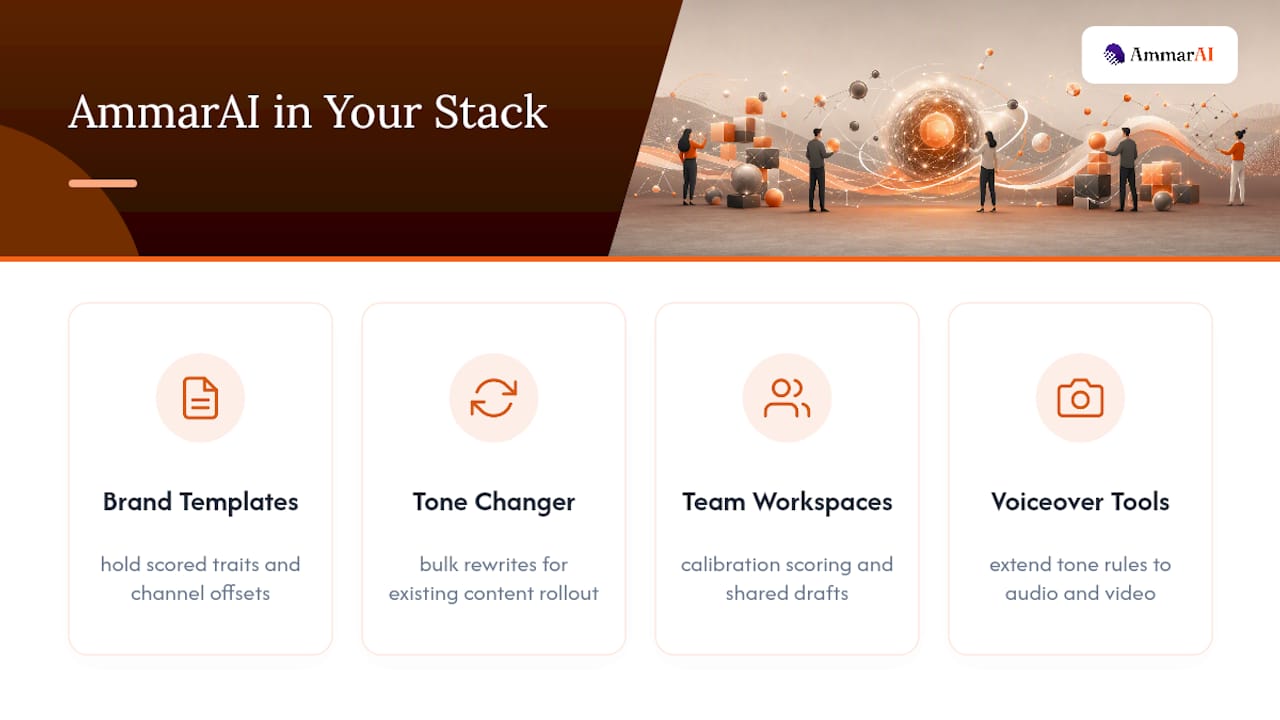
A practical stack includes Brand Voice templates to hold scored traits and channel offsets, a Tone Changer tool to handle bulk rewrites when rolling the guide out across existing content, team workspaces for calibration scoring and drafts in one shared place, and voiceover tools extending tone rules to audio and video. None of this replaces the audit or the pilot calibration session described earlier. It just removes the manual grind of applying what you’ve already decided.
If your team is rolling out a new guide, start by exploring AI use cases by role to see where the bulk-rewrite workflow fits your content calendar, then set up a Brand Voice profile with your finalized traits and matrix.
Sources
For readers who want the primary sources behind the frameworks in this guide, start with NN/g’s tone dimensions research for the mapping methodology, Mailchimp’s public style guide for operational writing rules, and Benly.ai’s scoring rubric for the channel-matrix template referenced throughout this article.
- Nielsen Norman Group — The four dimensions of tone of voice
- Australian Government Style Manual — Voice and tone
- Mailchimp Content Style Guide — Voice and tone
Recommended
Recommended for you
- Ad Copy Generator for Video, Audio, and Social
Use an ad copy generator to turn one product brief into focused video, audio, and social scripts with AmmarAI’s practical workflow.
- Marketing Plan Generator: Build a Practical Strategy
Use AmmarAI's marketing plan generator to turn a business goal into a practical plan with channels, key messages, actions, and a timeline.
- Marketing Teams: Turn a 7 Day Sprint into a 90 Day AI Marketing Plan
For marketers: run a 7 day sprint that turns one metric into a governed 90 day AI marketing plan with named owners and no new subscriptions.
Tools to try next
- AI Marketing Bot
A marketing strategist on call — it plans campaigns, writes the assets, and tells you what to run next and why.
- AI Agent Builder
Build agents that run real workflows on a schedule or trigger — reading, deciding and acting without you.
- AI Writer
A flexible writing workspace for drafts, long-form articles, rewrites, and brand-consistent content. Includes templates, the Article Wizard, Smart Editor, and tone controls so every piece stays on-brand.