
AI SEO9 min read
Avoid Risky Site Edits: AI Internal Linking for SEO Teams
Safety first playbook for AI internal linking. Use enriched sitemaps, strict rules, and human review to avoid risky site wide edits.

Avoid Risky Site Edits: AI Internal Linking for SEO Teams
AI can find and add high-quality internal links at scale, but only when you pair discovery with conservative rules and human review. The right model has AI surface candidate links across your site while a fixed rule set and an editor decide what actually gets published. Start in suggest-only mode, then widen thresholds once the suggestions consistently earn approval.
TL;DR:
- Internal linking with AI requires strict guardrails, including link caps, denylists, and confidence thresholds to prevent manipulative or irrelevant links.
- Using cluster tags and fresh content signals greatly enhances the relevance and accuracy of AI-generated links, especially in dynamic, time-sensitive situations.
- Starting with suggest-only mode and gradually increasing thresholds allows teams to refine their rules without risking site structure disruptions.
- Proper site structure, metadata, and sitemap enrichment are critical foundations for effective AI internal linking, rather than relying solely on automation.
- Monitoring discovery rates and cluster authority growth offers a more accurate measure of success than raw link counts.
Table of Contents
- What Is AI Internal Linking, and What Modes Does It Use?
- Why Does Internal Linking Still Matter for SEO and AI Search?
- What Inputs Does an AI Linking Tool Actually Need?
- What Guardrails Keep Automated Linking Safe?
- How Do You Roll Out AI Internal Linking Safely?
- What Should You Track, and How Fast Will It Move?
- How AmmarAI Fits Into an AI Internal Linking Workflow
- Why Most Teams Get AI Internal Linking Backwards
- Sources
What Is AI Internal Linking, and What Modes Does It Use?
AI internal linking uses embeddings and language models to scan a site, match relevant pages, and propose (or place) links between them automatically. It works now because embedding models got cheap enough to compare thousands of pages in seconds, something that used to take a human hour of manual cross-referencing.
There are three modes teams actually deploy:
- Proactive: a link suggestion tool built into the writing flow, flagging relevant internal pages as you draft.
- Reactive: a site-wide scan that runs periodically and outputs a batch of suggested links across existing content.
- Agentic/autonomous: a perception, decide, act loop where the system ranks candidates, checks them against policy, and executes approved edits without a human touching each one.
Most teams start reactive, then graduate to agentic once guardrails prove themselves.
Why Does Internal Linking Still Matter for SEO and AI Search?
Internal links do two jobs at once: they help search crawlers find and index pages, and they signal which topics your site treats as authoritative. A page with zero inbound internal links, an orphan page, often sits outside a crawler’s regular path entirely.
AI search adds a third job. Answer engines build semantic maps of a site from its link graph, and that map affects whether a page gets cited in a generated answer. Perplexity tends to index new content faster and often cites more sources per answer than ChatGPT, which relies more heavily on Bing’s index. A page with strong internal links to and from a topic cluster reaches Perplexity’s citation pool sooner than an isolated page waiting on a slower crawl cycle.
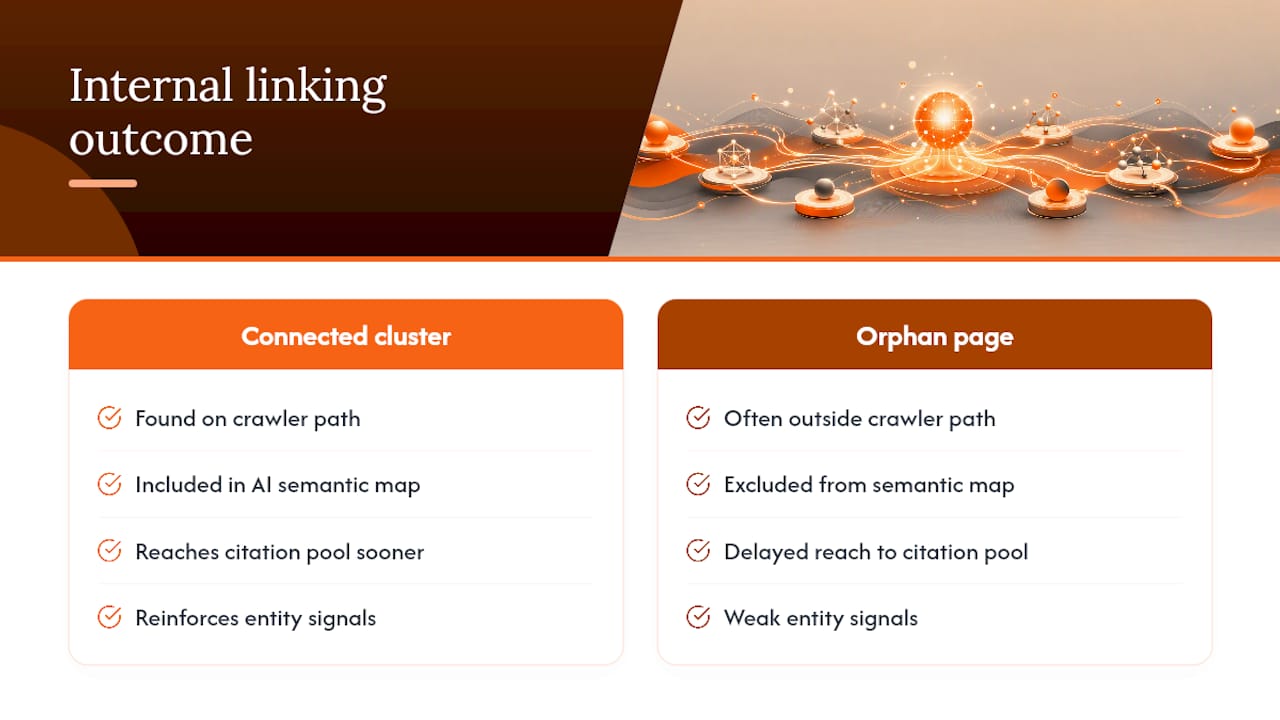
That timing gap matters for anyone publishing time-sensitive content. Internal linking also reinforces entity signals, the topic and brand associations AI systems use to decide what a page is really about, which now complement backlinks rather than replace them in how AI search ranks sources.
What Inputs Does an AI Linking Tool Actually Need?
An AI linker is only as good as what you feed it. Skip the inputs below and you get generic, low-value suggestions no matter how sophisticated the model is.
- A full URL inventory, ideally exported straight from your CMS or crawler.
- Page titles and H1s, since these carry most of the topical signal.
- Cluster or category tags that group related pages together.
- Freshness flags marking recently updated or newly published content.
From there, the pipeline typically runs in two passes. First, embedding similarity scores every page against every other page and returns a ranked list of candidates, essentially “these ten pages are semantically closest to this one.” Second, an LLM reviews the top candidates and proposes exactly where in the text a link should sit and what anchor text to use, rather than just linking the first matching keyword it finds. Enriched sitemaps and clean metadata make this second pass far more accurate, because the LLM has more context to judge relevance instead of guessing from title text alone.
Pro Tip: Feed the LLM your cluster tags explicitly rather than letting it infer topic relationships from titles alone. It cuts down on off-topic link suggestions dramatically.
What Guardrails Keep Automated Linking Safe?
Automation without limits produces exactly what critics fear: over-optimized anchor text, links crammed into irrelevant paragraphs, and a site structure that looks manipulated to both readers and search engines. The fix isn’t avoiding automation. It’s constraining it tightly.
- Set link caps. A common starting point is 3 to 5 automated links per 1,000 words, with no more than 2 in a single section, tuned per site over time.
- Build a denylist. Exclude legal pages, checkout flows, and no-link zones like intros and calls to action where a link disrupts the reader’s next step.
- Define policy outcomes. Every candidate link should resolve to act, queue for review, or reject, based on a confidence threshold you set, not a blanket “always insert.”
- Keep an audit trail. Log every change with a timestamp and a rollback point.
An agentic system pairs embeddings for ranking with an LLM for narrow editorial checks, and the policy layer decides what happens next. Snapshots and rollback aren’t optional extras. Circuit breakers that pause automation after unusual activity catch the failure modes a confidence score alone will miss.
| Guardrail | What it prevents |
|---|---|
| Link cap (3 to 5 per 1,000 words) | Over-optimized, spammy anchor density |
| Denylist for legal/CTA pages | Links breaking conversion flow or compliance pages |
| Confidence threshold + review queue | Low-relevance links going live unchecked |
| Snapshots and rollback | Irreversible site-wide errors from a bad automation run |
How Do You Roll Out AI Internal Linking Safely?
Deploying this well is a sequence, not a single setup step. Skip the audit and you’ll build rules around clusters that don’t actually reflect your content.
- Run a baseline crawl and flag orphan pages, the ones with no inbound internal links at all.
- Define your clusters and cornerstone pages, then enrich your sitemap with tags and freshness data.
- Configure your rules, run the tool in suggest-only mode first, and have an editor do a quick pass on the first batch.
- Patch in approved links, log every change, and check results monthly rather than daily.
Before any of this, confirm your critical content sits in raw HTML rather than behind client-side rendering, and that robots.txt allows AI crawlers like GPTBot, PerplexityBot, and ClaudeBot. A perfectly linked page a crawler can’t reach delivers nothing.
What Should You Track, and How Fast Will It Move?
Raw link count is a vanity metric. What matters is whether pages get discovered and whether topic clusters gain authority as a group.
These windows track reported practitioner timelines for AI-assisted linking workflows: crawl and discovery shift fast, rankings lag behind, and cluster-level authority takes the longest to show up in analytics. Judge a rollout on discovery and cluster lift, not on how many links you added last week.
How AmmarAI Fits Into an AI Internal Linking Workflow
Building an internal linking system means keeping content, rules, and review in one place instead of scattered across tools. AmmarAI’s AI SEO content optimization tools help draft and audit page content against cluster topics, while team workspaces keep editors, writers, and reviewers working from the same content and change history, which is exactly what a human-in-the-loop review queue needs. For the technical side of enriching your inputs, see AmmarAI’s guide on using AI for SEO the right way.
Why Most Teams Get AI Internal Linking Backwards
The mistake I see repeated across every “AI link building strategy” pitch is treating internal linking as a feature you turn on rather than a system you design. Tools that promise fully autonomous site-wide linking overnight skip the part that actually determines quality: whether your sitemap, cluster tags, and metadata are clean enough for an embedding model to work with in the first place. Garbage taxonomy in, garbage links out, no matter how good the LLM layer is.
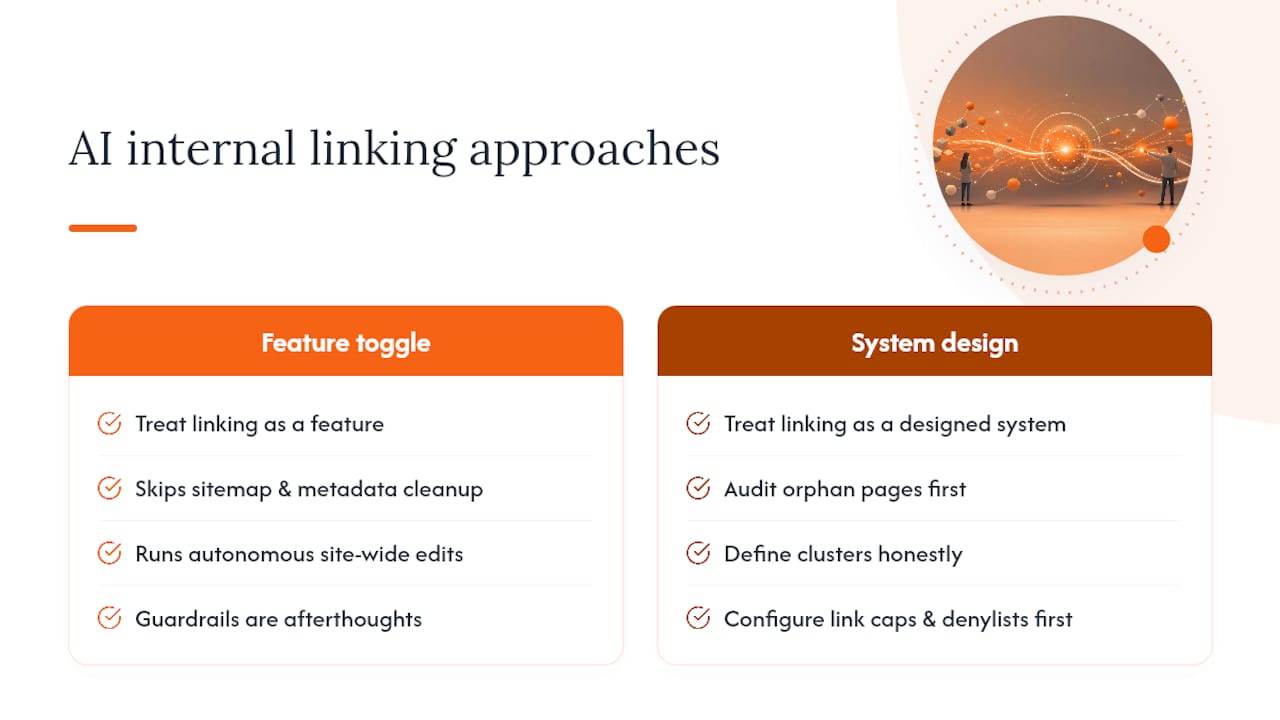
The conventional advice undersells guardrails. Link caps and denylists get treated as an afterthought, something to add if problems show up, when they should be the first thing configured, before a single automated edit goes live. An agentic system that makes dozens of edits per run isn’t impressively productive. It’s a sign the confidence threshold is set too loose.
If you’re starting from zero, prioritize the boring work first: audit orphan pages, define your clusters honestly, and get your sitemap enriched with real metadata. The AI layer is the easy part. Getting your site’s structure into a state where AI can reason about it accurately is where the actual work lives, and where most rollouts quietly fail before automation even enters the picture.
— Ahmed
Sources
- Internal Linking for AI Search: How ChatGPT, Perplexity & Gemini Use Your Links
- AI Automated Internal Linking Builds Topical Authority | DeepSmith
- How AI Search Is Reshaping Link Building Strategy in 2026
Recommended
Recommended for you
- Best AI Video Generator: 7 Tools Compared
Find the best AI video generator for cinematic clips, avatars, editing and value. Compare quality, length limits, pricing and ideal users.
- AI Content Repurposing With AmmarAI in 7 Steps
Follow a practical AI content repurposing workflow in AmmarAI to turn one article into social posts, a newsletter, and a short video.
- AI Search Visibility: Gain 3–5 Points in 4–12 Weeks for Marketers
Measure and boost AI search visibility. Use prompt audits and a visibility score, prioritize answer-first pages and third-party mentions to earn citations.
Tools to try next
- AI SEO Analyzer
Analyse a URL, a block of text or a keyword and get a scored report — technical checks, readability, keyword volume and difficulty, and what to fix first.
- AI Agent Builder
Build agents that run real workflows on a schedule or trigger — reading, deciding and acting without you.
- AI Writer
A flexible writing workspace for drafts, long-form articles, rewrites, and brand-consistent content. Includes templates, the Article Wizard, Smart Editor, and tone controls so every piece stays on-brand.