
AI SEO13 min read
AI Content Quality: Check Claims Before You Trust Detector Scores
Learn how to judge AI content quality with Google’s people first standards, NIST evaluation metrics, claim checks, and human editorial review.

AI Content Quality: Check Claims Before You Trust Detector Scores
AI content quality means a draft is useful to the person reading it, backed by checkable facts, and written in a voice that fits its audience, not just fluent or hard to detect. The single best practice is to draft first, then run claim-level evidence checks, then send the piece through human editorial review. Standard-setting bodies including NIST, Google, and UNESCO all point toward this same separation between generation and verification.
TL;DR:
- NIST’s pilot study recommends comparing generated summaries with source documents for fluency, informativeness, coherence, and factual consistency; detector scores do not establish truth.
- A study found text scorers rated GPT writing 10% to 20% higher than comparable human work in some settings, possibly because of training overlap.
- Automate repeatable checks such as formatting and broken links, but route claims with low confidence and sensitive, legal, or ethical issues to human reviewers.
- Disclose AI involvement when the creation method could affect reader trust; UNESCO’s 2026 guidance also requires human verification and intellectual property compliance for formal publications.
Table of Contents
- What search engines and publishers actually look for
- Can detectors and benchmarks actually measure quality?
- Where human-in-the-loop review fits, and when to escalate
- A practical checklist for evaluating an AI draft before it goes live
- When should you disclose that AI was involved?
- What I’ve learned balancing speed, accuracy, and voice
- The conventional advice gets the order backward
- How an integrated workspace keeps generation, voice, and review in one place
- FAQ
- Sources
What search engines and publishers actually look for
Google’s guidance on helpful content centers on one question: why was this made? Content created primarily to help a real reader fits the people-first standard, while content created mainly to attract search clicks through automation risks running into spam policies, according to Google’s own framing. The “who wrote it” question matters less than the “why” behind the piece.
That framing lines up with E-E-A-T: experience, expertise, authoritativeness, and trustworthiness. None of these dimensions ask whether a sentence came from a person or a model. They ask whether the content reflects real familiarity with the topic, whether claims hold up, and whether a reader can trust what they find. AI-assisted content can satisfy all four when a knowledgeable editor shapes it; it fails all four when it’s published as a raw, unchecked draft.
In practice, publishers and quality raters tend to look for:
- Original reporting or firsthand detail that a generic model output wouldn’t contain.
- Depth that goes beyond a surface summary of the topic.
- Clear authorship, so readers know who stands behind the claims.
- Visible evidence of how automation was used, when that’s relevant to trust.
One structural point worth flagging: NIST’s GenAI Text Challenge explicitly separates how human-sounding text is from how believable its claims are, and treats both as distinct from whether the content is actually accurate. That distinction matters for anyone grading AI drafts, because sounding natural is not the same job as being correct. If you’re building a workflow around search-engine expectations, our breakdown of winning generative search citations walks through the same people-first logic in more SEO-specific terms.
Can detectors and benchmarks actually measure quality?
Detectors and benchmarks measure something narrower than “quality.” NIST’s GenAI Text Challenge is built around three separate capabilities: generating text that’s hard to tell apart from human writing, prompting a model to produce accurate or misleading narratives, and running discriminators that estimate how believable a passage is, according to NIST’s evaluation materials. Those three things don’t collapse into one score, and none of them is a truth test.

The metrics behind detector performance come from NIST’s 2024 pilot study, which reports results using AUC and Brier scores. A higher AUC means a detector separates AI-written text from human-written text more reliably across many cases; a lower Brier score means the detector’s confidence estimates track reality more closely. The 2024 NIST GenAI pilot study found detectors performed reasonably well overall, while generator and discriminator performance varied a lot depending on the system, and the study stresses comparing generated summaries against source documents for fluency, informativeness, coherence, and factual consistency rather than relying on a single pass or fail signal.
This is why detection and factuality are different problems:
- A detector score tells you about writing-pattern provenance, not whether the claims are true.
- Automated scoring models themselves can carry bias: one peer-reviewed study found transformer-based and LLM-based scorers rated GPT-generated text 10 to 20 percent higher on average than comparable human-authored text in some evaluation settings, likely because of overlap with training corpora.
- Quality still needs a separate factual and citation check that no detector performs.
Our AI content detector is useful for a quick sanity check on phrasing, but it was never meant to replace a human verifying the actual claims in a draft.
Where human-in-the-loop review fits, and when to escalate
Human-in-the-loop (HITL) quality control means a person actively guides, corrects, or approves AI output rather than letting it publish untouched. AWS defines it as the practice of routing ambiguous, low-confidence, or consequential cases to a human reviewer while automated checks handle the routine, repeatable stuff. A few established HITL patterns show up across the research:
- Active learning, where the system flags the examples it’s the least confident about and routes those specifically to a reviewer.
- Reinforcement learning from human feedback (RLHF), where human judgments train the model’s future behavior rather than just fixing one draft.
- Interactive review gates, checkpoints a draft must pass before it moves to the next stage of production.
- Approval thresholds, preset confidence levels below which a piece cannot publish without a human sign-off.
The rule of thumb that keeps this efficient: automate what’s repeatable and escalate what’s risky. Formatting checks, broken-link checks, and required-section checks can run without a person watching. Low-confidence factual claims, sensitive topics, and anything with legal or ethical stakes should go to a human, a pattern both AWS and IBM describe as standard practice.
Reviewer fatigue is a real design problem, not a minor inconvenience. A systematic review of HITL methods points to confidence-based sampling (only showing reviewers the cases most likely to contain errors), micro-tasks (breaking review into small, specific judgments rather than one long read-through), and aggregated dispute resolution (pooling multiple reviewer opinions on contested calls) as ways to keep human review sustainable at volume.
Pro Tip: Set your escalation threshold before you start producing at scale, not after the first factual error makes it to publication.
A practical checklist for evaluating an AI draft before it goes live
The workflow that holds up across search-engine guidance, NIST’s evaluation design, and UNESCO’s publication standards is a sequence of generating, verifying, and reviewing. Treat these as separate jobs done by separate steps, even if the same person ends up doing more than one of them.
- Draft. Generate the content without worrying about polish yet; this is the fastest, cheapest step.
- Claim-level evidence check. Go through every factual statement individually and trace it back to a source.
- Human editorial review. A person reads the whole piece for tone, accuracy, and fit, not just the flagged claims.
- Final gate. Confirm the piece passes formatting, link, and brand checks before it publishes.
Within that sequence, a handful of concrete checks catch most of the errors that matter:
- Every factual claim has a traceable citation or source, not a vague “studies show.”
- An originality pass confirms the content isn’t a close paraphrase of an existing source.
- Tone and brand voice match what the rest of the publication sounds like.
- Every link in the draft actually resolves and points where it claims to.
- Headings, structure, and on-page basics follow usable SEO conventions.
- Accessibility basics, like descriptive link text and sensible heading order, are in place.
For teams publishing at volume, a sampling strategy matters more than reviewing every single piece line by line. Set an approval gate that a draft must clear before it’s eligible to publish, pull a representative sample of output for deeper review, and give reviewers a standard template for notes so feedback is consistent from one piece to the next instead of reinvented each time. If you want a narrower pattern specifically for prose cleanup, an AI proofreading approach applies the same logic at the sentence level: one pass for structure, one for language, one for voice. Our own guide to using AI for content creation walks through how this draft-then-verify sequence looks in a real production calendar.
When should you disclose that AI was involved?
Google’s own guidance is specific here: disclose automation when the way the content was created would reasonably matter to the reader, according to Google’s developer documentation. That’s a judgment call, not a blanket rule, but it leans toward disclosure whenever a reader’s trust in the piece would shift if they knew.
A short byline note or a brief “how this was made” sidebar usually does the job without turning into a disclaimer that overshadows the content itself. The content still has to stand on its own merit; a disclosure doesn’t excuse a shaky draft.
- Note the creation method briefly, near the byline or in a short editorial note.
- Keep a simple audit trail: which sources were used, what a reviewer changed, and where confidence was low.
- Treat that audit trail as something you’d want available if a claim gets challenged later.
UNESCO’s 2026 guidance goes further for formal publications, requiring thorough human verification and IP compliance, and it’s explicit that final responsibility for accuracy sits with the humans involved, not the tool.
What I’ve learned balancing speed, accuracy, and voice
I’ve spent a good stretch of time producing content with AI tools in the loop, and the lessons that stuck are small and unglamorous. First, speed and accuracy pull against each other more often than people expect, so treating them as one goal instead of two separate checks is how errors slip through. Second, brand voice drifts fast without a reference document; a model will happily write competent prose that sounds like nobody in particular. Third, the pieces that caused real problems were never the obviously bad drafts. They were the fluent, confident ones with one wrong number buried in the middle.
If you’re starting out, run a small pilot: one documented template, one topic area, a handful of pieces, before you scale the workflow across a whole content calendar.
The conventional advice gets the order backward
Most guidance on AI content treats “sounding human” as the finish line. It isn’t. A passage can be indistinguishable from human writing and still be wrong, and NIST’s own evaluation design treats those as separate axes for exactly that reason. The bigger miss in conventional advice is spending review time polishing sentences before anyone has checked whether the claims in those sentences are true.
If I had to rank priorities for someone starting today, factual verification comes first, brand voice and tone come second, and detector scores come dead last. A detector telling you a piece “reads human” says nothing about whether the piece is useful, accurate, or worth a reader’s time. The teams getting the best results aren’t the ones with the slickest prompts; they’re the ones who built a boring, repeatable checkpoint between drafting and publishing and actually stuck to it.
— Ahmed
How an integrated workspace keeps generation, voice, and review in one place
Everything in this checklist gets harder when your draft lives in one tool, your brand guidelines live in a document somewhere else, and your reviewer leaves comments in a third app. We built AmmarAI as one workspace where content generation and brand voice consistency happen in the same place, with one history instead of scattered chat logs.
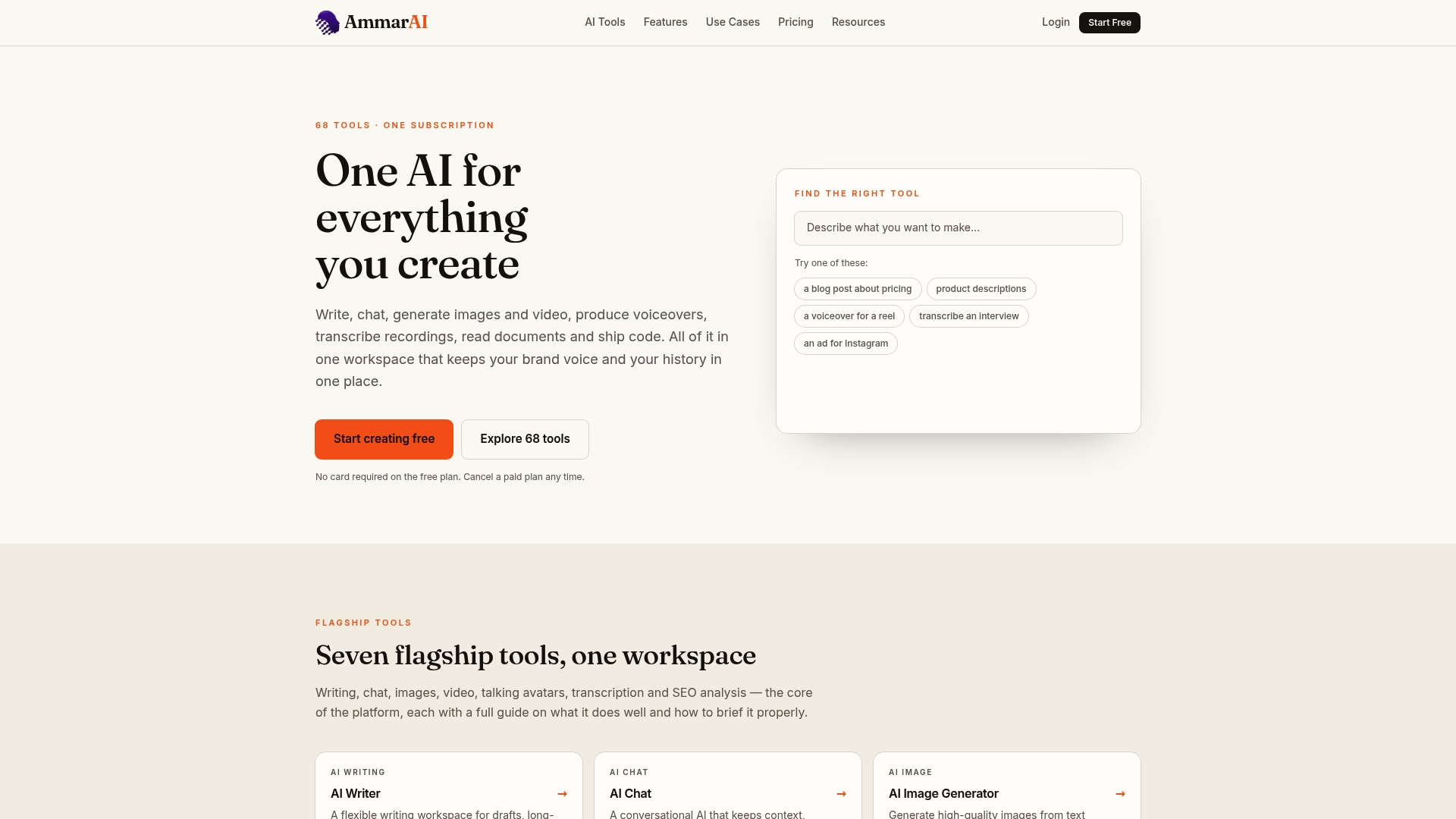
For the draft-then-verify workflow this article describes, that means your team can generate a first pass and keep tone consistent with brand voice, all without switching tabs. Start with our content creator tools or check current plans to see what fits your team’s volume.
FAQ
Can I use AI for content creation?
Yes, AI is widely used for drafting, brainstorming, and editing content, provided the output goes through factual verification and human review before publication. Google’s own guidance focuses on why content was created rather than banning automation outright, according to Google’s helpful content guidance.
What determines the quality of AI-generated content?
Quality depends on usefulness to the reader, factual accuracy backed by traceable sources, and alignment with the publication’s voice and expertise, not on how human the text sounds. NIST’s evaluation framework treats human-likeness and factual reliability as separate measurements for this exact reason.
What is AI content called?
There’s no single official term; it’s commonly referred to as AI-generated content, generative AI content, or machine-generated text, depending on the context and the publisher’s own style. Some outlets now use “AI-assisted” specifically to signal human review was part of the process.
How to use AI to make $10,000 a month?
This article focuses on content quality standards rather than income strategies, so we can’t offer a verified figure or method here. What the research does support is that scalable, trustworthy AI content production depends on a repeatable draft, verify, and review workflow, which is a foundation for any content-based income approach.
Sources
- Ai-challenges
- What is Human in the Loop? - HITL in Machine Learning Explained - AWS
- 2024 NIST GenAI (Pilot Study): Text-to-Text Evaluation Overview and Results
- When Automated Assessment Meets Automated Content Generation: Examining Text Quality in the Era of GPTs | ACM Transactions on Information Systems
- UNESCO Guidelines on the use of Generative Artificial Intelligence for publications and overall content production 1 October 2026
Recommended
Recommended for you
- AI Keyword Clustering for SEO Teams: Check 3 Shared Ranking URLs
See how AI keyword clustering helps SEO teams validate intent with shared SERP URLs, map clusters to pages, and move them into a publishing workflow.
- Best AI Tools for SEO: A Practical Buyer's Guide
Compare the best AI tools for SEO by research, briefs, drafting, audits, and internal linking, with pricing guidance, pros, cons, and picks for teams.
- Marketers: Generative Engine Optimization for 30–40% More AI Citations
Practical GEO playbook for marketers: add verifiable citations, front-load direct answers, and run repeatable tests. Benchmarks show 30–40% visibility gains.
Tools to try next
- AI SEO Analyzer
Find current keyword and search-question ideas while planning an article, then generate focused metadata for your site and blog posts.
- Brand Voice
Define how your brand sounds once, and have every writing tool follow it.
- AI Agent Builder
Build agents that run real workflows on a schedule or trigger — reading, deciding and acting without you.