
AI SEO12 min read
Marketers: Generative Engine Optimization for 30–40% More AI Citations
Practical GEO playbook for marketers: add verifiable citations, front-load direct answers, and run repeatable tests. Benchmarks show 30–40% visibility gains.

Marketers: Generative Engine Optimization for 30–40% More AI Citations
Generative engine optimization (GEO) is the practice of structuring and sourcing content so AI systems like ChatGPT and Google’s AI Overviews can verify and cite it directly. The single best action to take right now is adding verifiable citations alongside a clear, direct-answer opening, since GEO methods that combine citations, quotations, and statistics have shown measurable gains in benchmark testing.
TL;DR:
- Adding verifiable citations, quotations, and statistics can increase an AI’s likelihood of citing your content by up to 40 percent.
- Success in GEO is measured by citation frequency and answer share, not search ranking position, making content clarity and source traceability vital.
- Prioritize GEO tactics on fact-heavy topics, use structured short-form evidence, and keep sources and stats dated to ensure ongoing citation accuracy.
- Consistent testing across multiple AI engines every few months helps track citation performance and prevents outdated or inaccurate references.
- Using a unified AI platform streamlines research, editing, and testing, reducing manual effort and enhancing continuous GEO improvement.
Table of Contents
- What generative engine optimization is and how it differs from traditional SEO
- Why GEO matters for discovery, traffic, and brand authority
- High-impact GEO tactics: citations, quotes, statistics, and structure
- A repeatable GEO workflow: topic selection, question mining, edit checklist, and testing
- How to measure GEO performance and build an audit trail
- Accuracy, ethics, and the mindset shift GEO requires
- How AmmarAI fits into a GEO workflow
- When to prioritize GEO versus classic SEO in your roadmap
- Try AmmarAI for your next GEO test
- Sources
- FAQ
What generative engine optimization is and how it differs from traditional SEO
Traditional SEO chases rankings on a results page. GEO chases something different: a mention inside an AI-generated answer. Generative engines like ChatGPT and Perplexity typically use retrieval-augmented generation, pulling relevant passages from the web, then synthesizing them into a single response with inline citations. Your content isn’t competing for position ten anymore. It’s competing to become one of the three or four sources an AI model decides to quote or paraphrase.
That shift changes what “winning” looks like. Instead of tracking rank, GEO practitioners track citation probability, the odds that a given query surfaces your page as a source, and semantic contribution, which measures how much of the AI’s actual answer traces back to your content versus a competitor’s.
A few practical distinctions matter here:
- Traditional SEO optimizes for crawlers and keyword matching; GEO optimizes for synthesis and verifiability.
- SEO rewards backlinks and domain authority; GEO rewards clear, quotable, well-sourced statements.
- SEO success is measured by rank; GEO success is measured by citation frequency and answer share.
The overlap is real. A page still needs to be crawlable and indexed before any generative engine can find it, but the content itself has to earn its place in the answer, not just the index.
Why GEO matters for discovery, traffic, and brand authority
The business case for GEO comes down to a simple shift in behavior: people are asking AI tools questions they used to type into a search bar, and if your content never gets cited, you never enter that conversation.
Content that includes citations, quotations, and statistics can raise its visibility in generative engine responses by 30 to 40 percent on position-adjusted benchmark tests, according to foundational GEO research.
This matters beyond visibility metrics. When an AI engine cites your page, it’s implicitly signaling trust, which can carry over into brand perception even for readers who never click through. But the inverse risk is real too: inaccurate citations or outdated statistics attributed to your brand can damage credibility just as fast.
A few practical implications follow from this:
- Referral traffic patterns are shifting as more answers get resolved inside the chat interface itself, rather than sending clicks to your site.
- Being cited without being clicked still shapes brand recall and perceived authority.
- Content ROI calculations increasingly need to account for citation value, not just pageviews.
High-impact GEO tactics: citations, quotes, statistics, and structure
Not every tactic carries equal weight. Based on GEO-bench testing, a small set of moves consistently produces the largest gains.
- Add verifiable inline citations. Link claims to primary sources (government data, academic papers, original research) rather than secondary aggregators whenever possible.
- Use short, labeled quotations. A direct quote attributed to a named source tends to improve how faithfully an LLM reproduces your point, since quoted text is harder to paraphrase into something inaccurate.
- Name entities and cite statistics. Concrete numbers, named studies, and named organizations increase what researchers call semantic influence, the degree to which your specific wording shapes the generated answer.
- Front-load the direct answer. Open sections with a one- or two-sentence answer block before context or explanation, so both readers and retrieval systems can extract the core claim fast.
- Break evidence into short, labeled blocks. Bullet points, defined terms, and short paragraphs are easier for retrieval systems to parse and quote cleanly than dense prose.
A companion practice worth adopting from newer content-centric optimization research is treating edits as a loop rather than a one-time fix: analyze what’s currently cited, revise the weak points, then re-evaluate. That iterative approach reduces the risk of accidentally degrading content quality while chasing citation gains.
Two editorial rules protect the work: preserve factual accuracy over stylistic polish, and date your sources visibly so both readers and models can judge freshness. A statistic without a visible date is a liability, not an asset.
Pro Tip: Add a publication date next to every statistic you cite; undated numbers are the first thing careful readers and cautious AI systems discount.

A repeatable GEO workflow: topic selection, question mining, edit checklist, and testing
GEO works best as a process, not a one-off edit. Here’s a workflow that scales across a content team.
- Define the topic and conversion goal. Pick a page or topic cluster where being cited would actually move a business metric, not just vanity visibility.
- Mine real conversational queries. Pull paraphrased, question-style searches from support tickets, community forums, and AI chat logs rather than relying only on keyword tools.
- Audit currently cited sources. Run a few sample queries through generative engines and note which competitors or sources get cited, and what evidence they use that you don’t.
- Edit for direct answers and evidence. Front-load the answer, insert citations and quotes, label key facts clearly, and keep the provenance of every claim traceable to its source.
- Check technical discoverability. Confirm the page is crawlable, canonical, and free of blocking issues; Google’s own crawling guidance recommends clean subresource access to support indexing and discovery.
- Test across engines and record results. Run the same sample queries across two or three generative engines, capture whether and how you’re cited, and log the date.
A few supporting notes make this repeatable:
- Structured data helps in some cases, but it’s a support tool, not a substitute for clear, quotable prose.
- Keep a simple spreadsheet log of query, engine, citation status, and date so patterns emerge over multiple test rounds.
- Treat this like content maintenance, not a launch: schedule refreshes every few months rather than testing once and forgetting.
Teams building this into an existing content operation can lean on AI-assisted SEO workflows to keep the editing and testing cadence consistent.
How to measure GEO performance and build an audit trail
GEO needs its own scoreboard, separate from traditional rank tracking. A few KPIs make sense for most teams: citation rate, the percentage of sampled queries where your content gets cited; position-adjusted visibility, how prominently you’re cited when you do appear; downstream clicks from AI answers where platforms expose them; and semantic-contribution proxies, rough estimates of how much of the generated answer traces to your wording.
- Run experiments in small batches: pick 10 to 20 representative queries, test before and after an edit, and compare citation outcomes.
- Take snapshots of the actual AI response, not just a note that you were cited, since wording and attribution can shift between runs.
- Log the citation URL, the exact snippet text used, and the publication date for every test, building an audit trail you can revisit later.
Academic benchmarks like GEO-bench give a useful reference point: tested GEO methods produced 30 to 40% relative gains on position-adjusted metrics, per the original GEO study, though real-world results vary by domain and query type, so treat benchmark numbers as a ceiling to aim toward rather than a guarantee.
Accuracy, ethics, and the mindset shift GEO requires
GEO only works if the underlying claims hold up, and that means treating verification as part of the job, not an afterthought. OpenAI itself warns that citations in AI-generated responses can be incomplete, outdated, or incorrect, and recommends that users verify sources rather than trust them by default. Citations, as one library guide puts it, are not self-validating; the goal is making verification easy for both humans and machines.
A few habits keep GEO work trustworthy:
- Avoid adversarial tactics aimed at gaming a model’s output rather than earning a legitimate citation.
- Expect GEO to work better in some domains (news, statistics-heavy topics) than others (highly subjective or creative content).
- Keep version history on major edits so you can trace what changed and when.
Pro Tip: Schedule a recurring quarterly review of your most-cited pages; stale statistics are the fastest way to lose a citation you already earned.
How AmmarAI fits into a GEO workflow
A unified AI workspace combining many AI tools for writing, research, and publishing is useful for GEO because the workflow above touches several distinct tasks that usually require separate subscriptions.
- Query mining and topic research map to AmmarAI’s keyword generation tools, useful for surfacing conversational search variants.
- Page refreshes and citation insertion map to the Content Improver and Article Wizard, both built for structured, bulk edits.
- Iterative testing across content variants fits agent-based tools, which support the analyze-revise-evaluate loop GEO research recommends.
When to prioritize GEO versus classic SEO in your roadmap
Prioritize GEO first on high-intent, factual topics where readers ask direct questions, pricing pages, comparisons, how-to content, since that’s where citation probability is highest. Save it for later on brand storytelling or highly subjective content where generative engines have little to quote cleanly.
Staff it as a small, cross-functional pod: one writer, one technical SEO person, one analyst tracking citation logs. GEO doesn’t replace technical SEO or content quality work, it sits on top of both, rewarding teams that already write clearly and cite carefully.
— Ahmed
Try AmmarAI for your next GEO test
Running the GEO workflow by hand across five different tools gets tedious fast. A unified AI platform can keep query research, content editing, and iterative testing in one workspace with one shared history, so a team isn’t rebuilding context every time it switches tools.
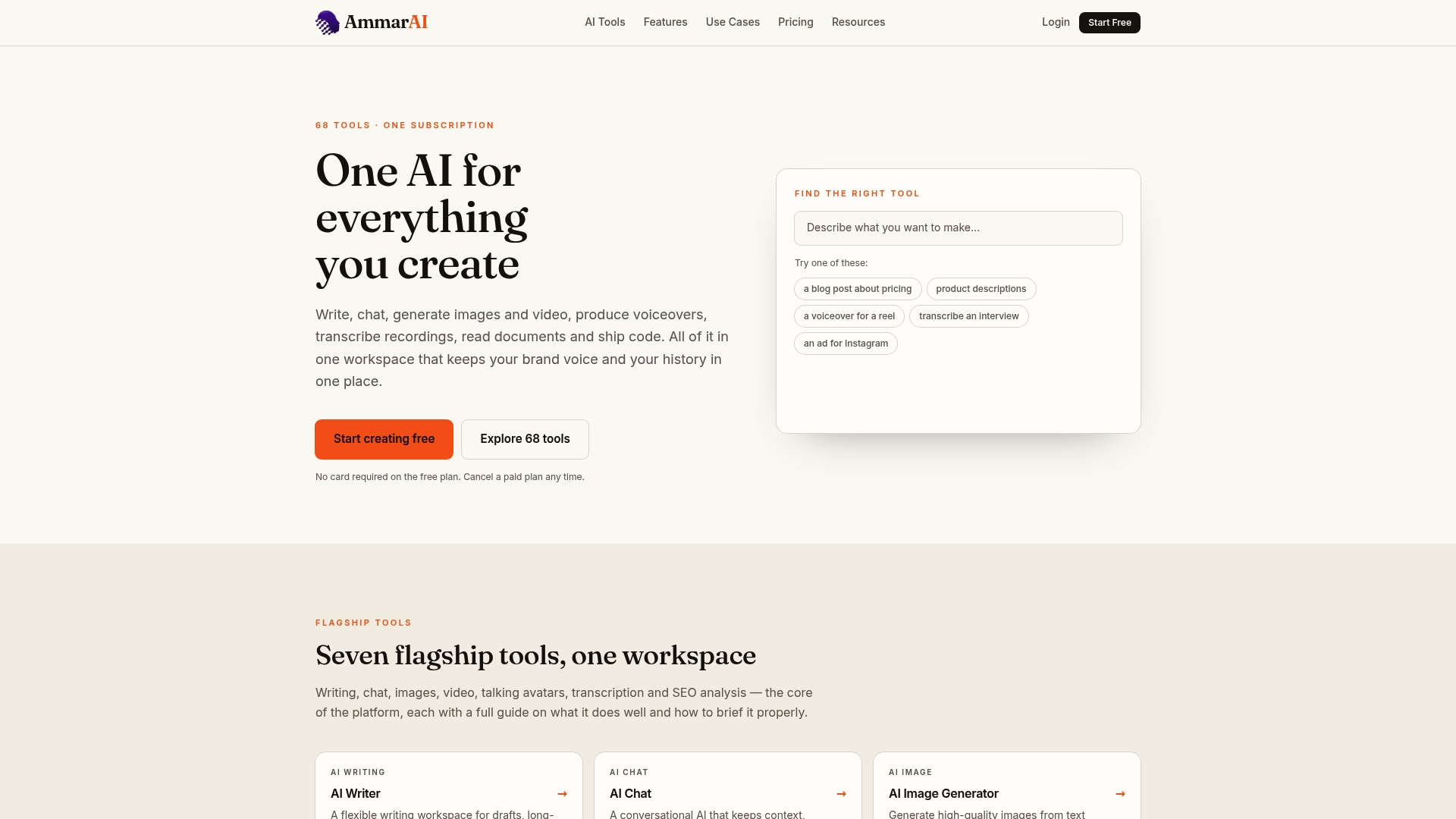
A reasonable pilot: pick one underperforming page, run it through the Article Wizard alongside the keyword tools in All AI Tools to rebuild the direct-answer lead and add sourced evidence, then test the result across two AI engines.
- Check current pricing plans, including a Free tier, to see what fits your team’s volume.
- Review the platform features page for a fuller map of tools relevant to content editing and testing.
- Start with a free plan to test the workflow before committing to a paid tier.
Sources
- GEO foundational paper (Generative Engine Optimization) — GEO-bench results
- Searching the web with ChatGPT | OpenAI Help Center
- Crawling out of December: the 2024 recap | Google Search Central Blog
FAQ
What is generative engine optimization in simple terms?
Generative engine optimization is the practice of structuring and sourcing web content so AI tools like ChatGPT can verify it and cite it in their generated answers. It focuses on citation probability rather than search ranking position.
How is GEO different from traditional SEO?
Traditional SEO optimizes content to rank on a search results page, while GEO optimizes content to be quoted or cited inside an AI-generated answer. The two overlap on crawlability but diverge on what counts as success: rank position versus citation frequency.
Do citations and statistics actually improve AI visibility?
Yes, benchmark testing found that adding citations, quotations, and statistics improved visibility by 30 to 40% on position-adjusted metrics in controlled GEO-bench experiments. Real-world results vary by topic and query type.
Can AI-generated citations be wrong or outdated?
Yes, OpenAI itself notes that citations in AI search results can be incomplete, outdated, or incorrect, so verification remains necessary. Always check the publication date and original source before trusting a cited claim.
How often should I test and refresh content for GEO?
A quarterly review cycle works for most teams, since statistics and cited sources can go stale within months. Testing sample queries across two or three generative engines each cycle helps catch citation drift early.
Recommended
Recommended for you
- AI SEO Content: 6 Step Workflow to Win Generative Search Citations
Follow a reproducible AI SEO content workflow: six steps from research to publish, GEO tactics to earn generative search citations, and how AmmarAI...
- Avoid Risky Site Edits: AI Internal Linking for SEO Teams
Safety first playbook for AI internal linking. Use enriched sitemaps, strict rules, and human review to avoid risky site wide edits.
- Best AI Music Generator: 6 Tools Compared
Find the best ai music generator for songs, stems, vocals, and commercial projects. Compare licensing, output length, pricing, and ideal buyer types.
Tools to try next
- AI SEO Analyzer
Find current keyword and search-question ideas while planning an article, then generate focused metadata for your site and blog posts.
- AI Agent Builder
Build agents that run real workflows on a schedule or trigger — reading, deciding and acting without you.
- AI Social Media Agent
An agent that plans, writes, schedules and adjusts a month of social posts across your accounts.