
AI SEO15 min read
AI SEO Content: 6 Step Workflow to Win Generative Search Citations
Follow a reproducible AI SEO content workflow: six steps from research to publish, GEO tactics to earn generative search citations, and how AmmarAI...

AI SEO Content: 6 Step Workflow to Win Generative Search Citations
Yes, AI can carry real weight in an SEO content program, but only when a human verifies the facts, adds original insight, and structures the piece for machine extraction as well as human reading. The workflow that works is research, brief, AI draft, human edit, then optimization for both classic search and generative engines before publishing. Start this week by running one article through a locked prompt template and adding a mandatory fact-check pass before anything goes live.
TL;DR:
- Human verification, original insights, and structured content are essential for AI SEO to avoid low-quality, mass-produced pages facing search penalties.
- Different AI tools are needed for research, briefing, drafting, editing, internal linking, and publishing to maintain quality and efficiency in a workflow.
- Using structured schema, short evidence blocks with sources, and earning third-party citations improves the chances of AI systems retrieving and citing your content.
- Google prioritizes useful, factual, and well-organized content over the production method, emphasizing the importance of ongoing human oversight.
- Consistent testing, prompt control, sourcing transparency, and a clear editorial checklist are crucial to building a reliable AI-driven SEO program.
Table of Contents
- What Counts as AI SEO Content, and Which Tools Do What
- How to Build a Repeatable AI Content Workflow
- Staying Inside Google’s Rules Without Losing Your Edge
- What GEO Research Says About Winning Citations in AI Search
- What I’ve Learned Supervising AI-Assisted Content at Scale
- Where AmmarAI Fits Into This Workflow
- Sources
- FAQ
What Counts as AI SEO Content, and Which Tools Do What
“AI SEO content” gets used as a catchall, but the term hides two very different production models. AI-assisted content means a person drives the outline, edits every paragraph, and owns the final claims. Fully automated content means a system generates and publishes with minimal human touch, often at volume. Google’s own guidance treats these differently in practice, even though its policy language is model-agnostic: Google Search’s guidance on AI-generated content states plainly that automation isn’t a special signal either way, and that scaled, low-value content built primarily to game rankings can trigger spam enforcement regardless of how it was produced.
The practical difference shows up in outcomes. A financial services blog publishing 40 AI-assisted explainer pages with named reviewers and updated data behaves nothing like a content farm publishing 4,000 auto-generated location pages overnight. Same technology, opposite risk profile.
The tool roles that actually matter
Most teams buy a generative writer and stop there, which is the mistake. A working AI content pipeline needs distinct tools mapped to distinct jobs:
- Research and intent discovery: tools that pull search volume, SERP feature data, and competitor gaps before a single word gets drafted.
- Content brief generators: turn that research into a structured brief with target entities, heading suggestions, and word count ranges.
- Draft authors: the generative layer that produces a first pass from the brief, ideally with brand voice settings locked in.
- SEO analyzers: score the draft against on-page factors, keyword coverage, and readability before it reaches an editor.
- Internal-linking agents: suggest and, in some setups, insert contextual links without breaking existing link equity. AmmarAI’s approach to internal linking treats this as a safety-checked step rather than a blind automation task, which matters because bad internal linking automation is a common source of crawl and ranking regressions.
- CMS publish automation: schedules, formats, and pushes approved content live, often with version control baked in.
Treating these as one tool instead of six roles is why so many AI content programs stall. A single generative model can draft, but it can’t verify its own facts or catch a keyword you missed in research.
A selection checklist that separates real tools from wrappers
Before adding any AI SEO tool to a stack, check five things: does it integrate with real search data rather than relying purely on the model’s training knowledge; can you control and save prompts rather than starting from scratch each time; does it log what was generated, when, and by whom for audit purposes; can it hold a consistent brand voice across dozens of pieces; and can a human actually edit the output cleanly, or does it lock content into a rigid template. Practitioner reviews of AI SEO tools consistently point to the same pattern: the tools that produce results combine actual SEO data with workflow integration, not just fluent text generation. A model that writes beautiful sentences but can’t tell you what your competitor ranks for isn’t an SEO tool. It’s a writing tool that happens to know about SEO as a concept.

How to Build a Repeatable AI Content Workflow
The teams getting consistent results from AI SEO content don’t treat it as “type a prompt, publish the output.” They run a pipeline with checkpoints, and they test it like any other process.
- Discovery and intent mapping. Pull the target keyword’s SERP, note which intent it satisfies (informational, comparison, transactional), and log the entities and subtopics competitors cover that you don’t.
- Brief construction. Convert that research into a brief with a working title, target headings, required entities, internal link targets, and a word count range. This is where you decide what makes the piece different, not the drafting stage.
- AI draft generation. Feed the brief into your writing tool with a locked prompt template rather than a fresh, improvised prompt each time. Consistency in prompting produces consistency in output quality.
- Human editorial pass. A named editor checks every factual claim, adds at least one insight the AI couldn’t generate on its own, and rewrites anything that reads generic.
- GEO and on-page optimization. Add schema markup, tighten headings for question-based search, and format key facts as short, extractable blocks rather than burying them in narrative.
- Publish and measure. Track rank movement, click-through rate, and, where tools allow it, how often the page gets cited or summarized by AI answer engines.
A usable prompt template names the audience, the required tone, the sources to draw from, and an explicit instruction to flag uncertain claims rather than inventing them. The editorial checklist that follows should force four questions on every draft: is every fact traceable to a real source, does the piece say something the top five ranking pages don’t already say, does the tone match the brand voice, and would a subject-matter reader trust this. UC Davis’s guidance on AI SEO content tools recommends exactly this structure: use AI to draft and organize, then rely on human judgment for accuracy and originality.
Testing matters as much as production. Run at least two prompt variations per content type and track which one produces less editing work and better ranking outcomes over a defined window, typically 60 to 90 days for organic movement to stabilize. Cross-test the same page’s visibility across different AI answer engines rather than assuming one engine’s behavior predicts another’s, since citation patterns vary by platform. Track rank, click-through rate, and AI citation frequency as three separate KPIs rather than collapsing them into one score.
Pro Tip: Keep a simple spreadsheet logging which prompt version produced which draft, then tag each published article with its prompt version. Six months in, you’ll be able to see which prompt structures actually correlate with less editing time and better rankings, instead of guessing.
Staying Inside Google’s Rules Without Losing Your Edge
Google’s policy is more permissive than most marketers assume, and also less forgiving than most marketers hope. Google’s SEO Starter Guide still centers everything on people-first content, crawlability, and originality, and explicitly notes there’s no magic word count that guarantees ranking. Length, keyword density, and publishing speed are not the levers that matter. Usefulness is.
Where AI content gets penalized isn’t the AI part. It’s the pattern of publishing content at a volume and quality level designed purely to occupy search real estate rather than serve a reader. Google has stated it will treat that pattern as spam regardless of the production method behind it, which means a human writing 500 shallow pages a month faces the same exposure as a bot doing the same thing.
Google has also floated the idea of disclosure when automation substantially generates the content, particularly for content types where readers reasonably expect a human voice, like personal essays or investigative pieces. That’s a judgment call by content type, not a blanket legal requirement.
A working set of guardrails looks like this:
- Every published piece has a named human reviewer who signs off before it goes live.
- Factual claims carry inline sourcing, especially statistics, dates, and anything regulatory.
- Content touching health, finance, legal rights, or safety, the categories often called YMYL (your money or your life), gets a stricter review tier with subject-matter verification, not just a copy edit.
- Update cadence is scheduled, not reactive. Stale AI content ages worse than stale human content because it often lacks a clear author to hold accountable for freshness.
- Investigative reporting, exclusive interviews, and primary research stay human-led. AI can format and structure that work, but it cannot conduct an interview or verify a source’s credibility.
One figure worth sitting with: content optimization checklists still list structure, originality, and internal linking as core ranking levers, which means none of the fundamentals that predate generative AI have gone away. GEO tactics sit on top of that foundation. They don’t replace it.
What GEO Research Says About Winning Citations in AI Search
The research on generative search behavior is blunt: AI answer engines systematically favor earned, third-party sources over brand-owned pages, and they need content structured for extraction, not just readability. A comparative study of web search versus generative AI response generation found this bias held across engines, along with sensitivity to phrasing, content freshness, and language.
The GEO research paper on dominating AI search frames the tactical response clearly: pages need explicit justification, meaning statistics, quotations, and citations formatted so a model can lift them cleanly, plus machine-readable schema that spells out specs, comparisons, and facts without forcing an AI system to infer meaning from prose.
That research translates into a concrete checklist:
- Add structured schema (FAQ, Article, Product, or HowTo markup depending on content type) so machines can parse entities without guessing.
- Write short, self-contained evidence blocks, a sentence or two stating a fact with its source, rather than burying the fact inside a long narrative paragraph.
- Present pros, cons, and decision factors in scannable form for comparison-intent content, since generative engines lean on that structure when summarizing options.
- Pursue earned mentions, guest citations, and third-party coverage deliberately, since brand-owned claims about a brand carry less weight in generative responses than independent verification.
Testing this is straightforward in concept, harder in practice. Publish two versions of a key statistic, one in narrative form and one as an isolated, clearly sourced evidence block, and track which gets pulled into AI-generated answers more often over the following weeks. Engine-specific behavior varies enough that a fact cited reliably in one system may get ignored by another, so treat GEO testing as ongoing, not a one-time audit.
What I’ve Learned Supervising AI-Assisted Content at Scale
Three lessons keep surfacing. First, AI drafts are a starting point, not a finish line. Content becomes a punching bag for both readers and search systems the moment it feels interchangeable with a hundred other pages fed the same prompt. Second, the pages that earn citations in generative search almost always pair a fact with a source in the same breath, not two paragraphs later where a model has already moved on. Third, most penalties I’ve seen traced back to volume outpacing verification, not to AI use itself.

The pattern that consistently works: AI handles structure and first-draft speed, a human adds the one insight competitors missed, and every page carries machine-readable facts a system can lift without guessing. The pattern that consistently fails: treating AI output as done and publishing on volume alone.
If I were starting an AI content program tomorrow, I’d pick one content type, build a locked prompt and editorial checklist, run ten pieces through it, and only scale once the editing time per piece drops and rankings hold.
— Ahmed
Where AmmarAI Fits Into This Workflow
Every step described above, from briefing to publishing, is easier to run when the tools live in one place instead of four separate logins. AmmarAI is built as a workspace where the brief, the draft, the SEO scoring, and the brand voice settings share the same history, so an editor isn’t reconstructing context every time a piece moves between stages.
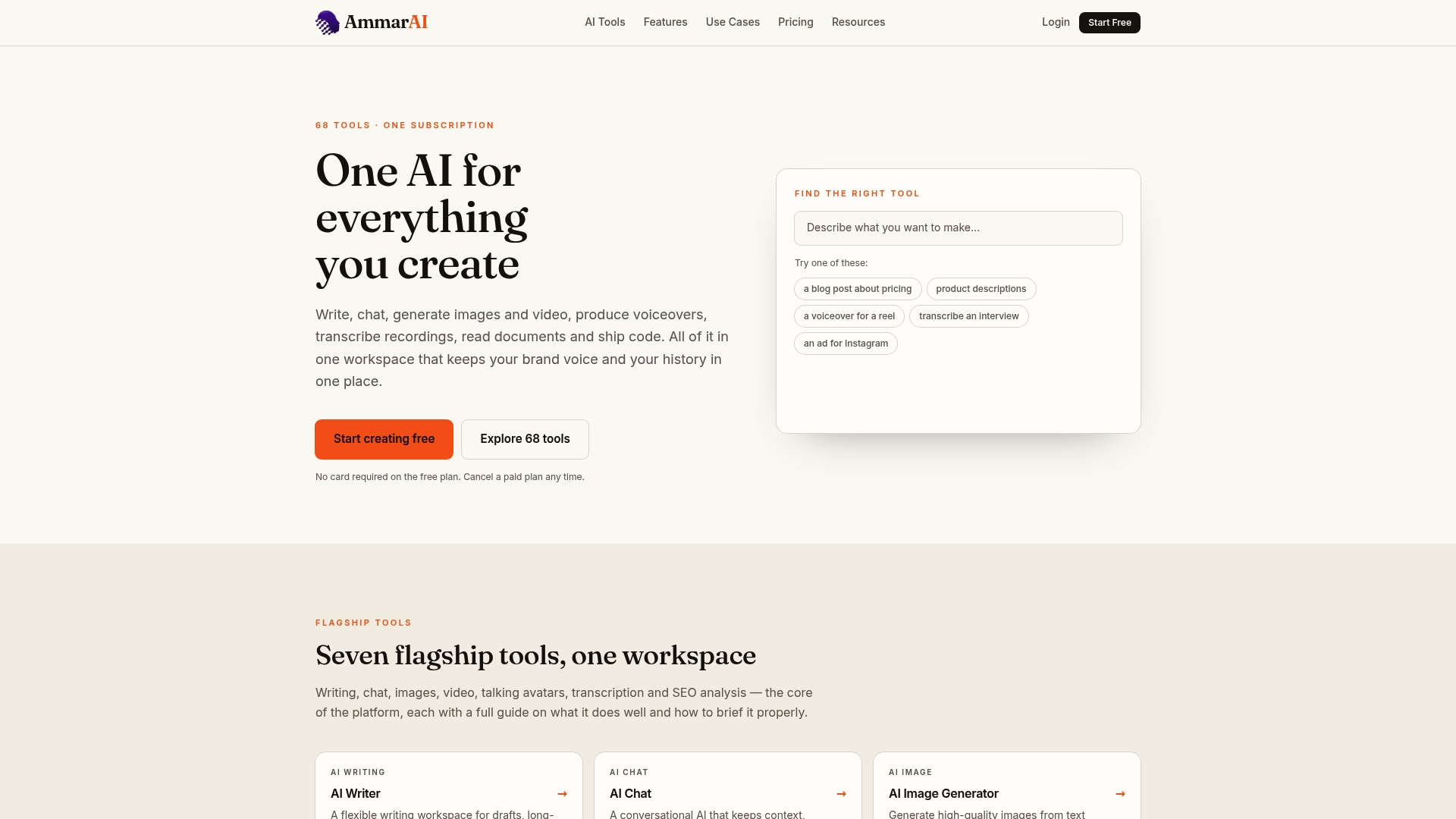
For the briefing and drafting steps, AmmarAI’s brand voice settings keep tone consistent across a whole content calendar, which matters when multiple writers or a bulk generation run are producing pieces that need to sound like one publication. For the optimization step, the AI SEO Analyzer scores a page, a block of text, or a target keyword against on-page factors before it publishes, which gives editors a concrete checkpoint instead of a gut feeling. Teams testing this workflow for the first time typically start small: run the AI SEO Analyzer against three existing pages to see where they score, then pilot a bulk generation batch using a locked brand voice template to see how much editing time it actually saves. If a broader operational build-out is the goal, teams like benchmarked work specifically on structuring AI-native production at a company level.
Pricing starts with a free plan for testing the workflow at small scale, with Starter, Professional, and Ultimate tiers adding higher generation limits and team features as the pipeline scales. Check current plan details and start a pilot on the AmmarAI pricing page.
Sources
- Google Search’s guidance about AI-generated content
- How to use AI tools to create SEO content — UC Davis
- Generative Engine Optimization: How to Dominate AI Search
FAQ
Is AI Content Good for SEO?
AI content can perform well in SEO when a human verifies facts, adds original insight, and the piece follows people-first guidance rather than existing purely to occupy keyword space. Google’s own policy treats the production method as neutral. Quality and usefulness determine the outcome, not whether AI touched the draft.
How Do You Use AI for SEO Content?
Use AI to accelerate research, briefing, and drafting, then route every piece through a human editorial pass that checks facts, adds unique analysis, and formats content for both readers and generative search extraction. Tools like an SEO analyzer, such as AmmarAI’s AI SEO Analyzer, can score the draft against on-page factors before publishing. The workflow works best as research, brief, draft, edit, optimize, then measure.
Does Google Penalize AI Content for SEO?
Google doesn’t penalize content for being AI-generated on principle, but it does penalize scaled, low-value content produced to manipulate rankings, regardless of how it was made. The risk comes from volume without verification, not from using AI as a drafting tool. Pages with named human review and original insight carry far less exposure than mass-produced, unedited AI output.
What Is the Best AI SEO Tool?
There’s no single best tool because SEO content needs several distinct capabilities: research, briefing, drafting, on-page scoring, and internal linking. The strongest setups combine a platform that handles multiple roles with shared brand voice and history, so teams aren’t reassembling context across separate subscriptions. Reviews of standalone tools consistently favor options that integrate real SEO data over ones that only generate fluent text.
What Is GEO and Why Does It Matter for AI Search?
GEO, or generative engine optimization, refers to structuring content so AI answer engines can extract and cite it accurately, using tactics like schema markup, short evidence blocks, and clear sourcing. Research on generative AI response generation shows these engines favor earned, third-party sources and machine-readable facts over narrative-only brand content. Testing which format gets cited more often is becoming a standard part of a modern SEO workflow.
Recommended
Recommended for you
- Avoid Risky Site Edits: AI Internal Linking for SEO Teams
Safety first playbook for AI internal linking. Use enriched sitemaps, strict rules, and human review to avoid risky site wide edits.
- How to Use a Changelog Generator
Use a changelog generator to turn commits into clear release notes. Learn the workflow, common failure points, review checks, and tool choices for teams.
- Best AI Marketing Tools by Job: 2026 Guide
Compare the best AI marketing tools by job, pricing model, pros, cons, and ideal user across planning, ads, social, email, and analytics.
Tools to try next
- AI SEO Analyzer
Find current keyword and search-question ideas while planning an article, then generate focused metadata for your site and blog posts.
- Brand Voice
Define how your brand sounds once, and have every writing tool follow it.
- AI Agent Builder
Build agents that run real workflows on a schedule or trigger — reading, deciding and acting without you.