
AI SEO11 min read
Best AI Tools for SEO: A Practical Buyer's Guide
Compare the best AI tools for SEO by research, briefs, drafting, audits, and internal linking, with pricing guidance, pros, cons, and picks for teams.
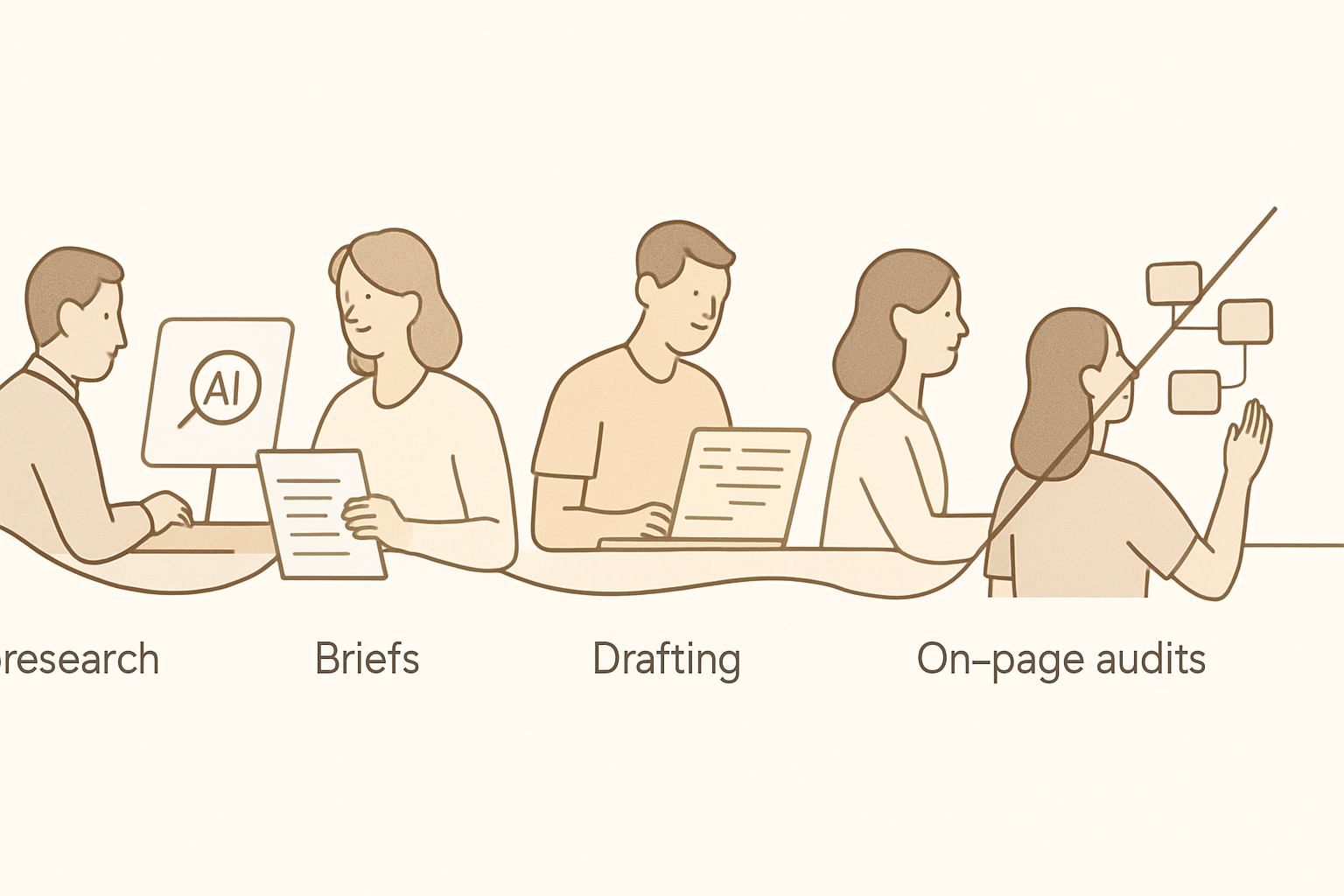
The best AI tools for SEO depend on the task: Semrush or Ahrefs for research, Clearscope or Frase for briefs, AmmarAI or ChatGPT for drafting, Screaming Frog or Surfer for audits, and Link Whisper or InLinks for internal linking. The right purchase depends on data quality, workflow fit, control, and total cost.
How we evaluated the best AI tools for SEO
We evaluated each tool against the job it is meant to perform rather than treating every AI feature as interchangeable. The main criteria were data quality, output control, workflow speed, integrations, pricing transparency, and how much human review the output requires.
Pricing changes frequently, so the comparison links to each vendor's current pricing page instead of quoting figures that may become outdated. Check usage limits as well as subscription costs: credits, tracked pages, generated words, and user seats can materially change the real monthly price.
- Data quality: Does the tool use proprietary SEO data, live search results, crawled pages, or only a language model?
- Workflow fit: Does it solve one job deeply or combine several jobs in one workspace?
- Control: Can users edit inputs, rules, structure, and recommendations?
- Verification: Does the interface make sources and assumptions easy to inspect?
- Total cost: Are crawling, AI usage, projects, seats, or exports restricted?
| Tool | Primary job | Ideal user | Pricing |
|---|---|---|---|
| Semrush | Keyword and competitor research | Marketing teams wanting a broad SEO suite | Pricing changes; see Semrush pricing. |
| Ahrefs | Keyword, backlink, and competitor research | SEO practitioners prioritizing backlink and site data | Pricing changes; see Ahrefs pricing. |
| Clearscope | Content briefs and optimization | Editorial teams with established publishing workflows | Pricing changes; see Clearscope pricing. |
| Frase | SERP briefs and content optimization | Small teams producing briefs and drafts together | Pricing changes; see Frase pricing. |
| AmmarAI | Drafting and multi-format content production | Creators and lean teams consolidating AI subscriptions | Pricing changes; see AmmarAI pricing. |
| ChatGPT | Flexible drafting and analysis | Users who want a general-purpose conversational workspace | Pricing changes; see ChatGPT pricing. |
| Screaming Frog SEO Spider | Technical crawling and on-page audits | Technical SEOs who need granular crawl control | A limited free version and paid license are available; see Screaming Frog pricing. |
| Surfer | Content-focused on-page audits | Writers optimizing individual pages against SERP patterns | Pricing changes; see Surfer pricing. |
| Link Whisper | Internal linking in WordPress | WordPress publishers with large content libraries | Pricing changes; see Link Whisper pricing. |
| InLinks | Entity-led internal linking | Sites organizing content around entities and topics | Pricing changes; see InLinks pricing. |
Best tools for keyword and competitor research
AI can accelerate keyword expansion, clustering, and competitor summarization, but it should sit on top of reliable search data. A language model alone cannot provide dependable search volume, ranking difficulty, or backlink information.
Semrush is the broader choice for teams combining SEO with paid search and competitive research. Ahrefs is often the cleaner fit for practitioners focused on backlinks, content discovery, and organic competitors. In either platform, verify suggestions against your market because databases and estimates vary by country and query.
| Tool | Best for | Pros | Cons |
|---|---|---|---|
| Semrush | Best for: Multi-channel marketing teams that need keyword, competitor, rank-tracking, and site data in one suite. | Broad research toolkit; useful competitor views; combines research, tracking, and auditing. | The interface can feel dense; relevant limits depend on the plan; a broad suite may be excessive for occasional research. |
| Ahrefs | Best for: SEO specialists prioritizing backlink analysis, competing pages, and organic opportunity discovery. | Strong backlink exploration; practical page-level competitor research; clear content and keyword discovery workflows. | Usage limits require attention; it is not a complete content-production workspace; keyword estimates still need judgment. |

Best tools for SEO briefs
A useful brief identifies the search intent, likely page type, core questions, subtopics, and evidence the writer must find. It should not be a list of every phrase used by ranking pages.
Clearscope is designed for a controlled editorial process, while Frase brings brief creation, SERP review, optimization, and drafting closer together. Both can save research time, but their term recommendations are inputs rather than instructions.
| Tool | Best for | Pros | Cons |
|---|---|---|---|
| Clearscope | Best for: Editorial teams that want consistent briefs and readable content-grading guidance. | Focused interface; straightforward term and topic guidance; easy for editors and writers to share. | Specialized rather than all-in-one; pricing can be difficult for low-volume publishers; grades can encourage unnecessary term usage if followed mechanically. |
| Frase | Best for: Small content teams that want SERP research, briefs, and optimization in one workflow. | Fast outline creation; consolidates competitor headings and questions; supports drafting and optimization. | Generated structures can become generic; recommendations may overfit the current results; outputs need fact and intent checks. |
Best tools for drafting SEO content
Drafting tools are most useful after a human has selected the angle, audience, evidence, and conversion goal. Give the model a specific brief and source material; asking it to produce a complete article from one keyword usually leads to generic coverage.
AmmarAI fits teams that also create images, video, voice, marketing assets, or agent workflows. Its 151 tools are available within one subscription, including the AmmarAI AI Writer. ChatGPT is stronger when the main requirement is an open-ended conversation for reasoning, revision, and custom analysis.
Neither tool should publish without editorial review. Confirm every factual statement, replace vague examples, add first-hand expertise, and check that the page satisfies the actual query rather than merely containing related terms.
| Tool | Best for | Pros | Cons |
|---|---|---|---|
| AmmarAI | Best for: Creators and lean marketing teams that want writing, SEO, image, video, voice, and agent tools under one subscription. | Wide range of creation tools; reduces context switching across media formats; practical for repurposing one approved concept. | Not a replacement for a dedicated keyword database or technical crawler; the breadth may be unnecessary for teams needing only text chat; drafts still require expert review. |
| ChatGPT | Best for: Individuals and teams that want flexible prompting, iterative editing, and general-purpose analysis. | Strong conversational revision; adaptable to many writing tasks; useful for challenging an outline or producing variations. | No inherent guarantee that SEO claims or keyword data are current; output quality depends heavily on instructions and source material; usage and features vary by plan. |
Best tools for on-page and technical audits
Screaming Frog and Surfer solve different audit problems. Screaming Frog crawls a site to expose technical and page-level signals, while Surfer compares a content page with patterns found across selected search results.
Use the AI SEO on-page analyzer when you want an accessible review inside AmmarAI's broader creation workflow. It is convenient for content checks, but a specialist crawler remains stronger for diagnosing large sites, rendering issues, redirect chains, and complex technical configurations.
| Tool | Best for | Pros | Cons |
|---|---|---|---|
| Screaming Frog SEO Spider | Best for: Technical SEOs auditing crawlability, metadata, directives, status codes, canonicals, and site architecture. | Granular crawl configuration; detailed exports; useful for both small checks and complex investigations. | Desktop workflow has a learning curve; interpretation requires technical knowledge; AI or external API use may introduce separate configuration and costs. |
| Surfer | Best for: Content teams reviewing the topical coverage and on-page composition of a specific page. | Accessible page-level recommendations; convenient editor workflow; useful for comparing content patterns. | Correlation does not prove a recommendation will improve rankings; scores can promote over-optimization; it is not a full technical crawler. |
| AmmarAI SEO Analyzer | Best for: AmmarAI users who want quick on-page feedback without adding another workspace. | Convenient alongside writing and marketing tools; suitable for iterative content checks; lower workflow fragmentation. | Less specialized than a dedicated crawler; not intended to replace deep technical diagnostics; recommendations still need prioritization. |
Best internal linking tools—and what AI should not own
Internal-linking software is valuable when a site has enough pages that manual discovery becomes slow. The tool should surface relevant opportunities, but an editor should decide whether the source page, destination, anchor, and reader journey genuinely fit.
Link Whisper is the direct option for WordPress publishers. InLinks is more appropriate when entity relationships and topic organization are central to the strategy. Neither should be allowed to add every suggested link automatically without sampling the results.
- AI should not own keyword strategy. A person must decide which audience, product, and business outcome deserve investment.
- AI should not make the final search-intent decision. Review the live results and determine what users are actually trying to accomplish.
- AI should not provide factual or legal signoff. Subject-matter experts must verify consequential claims, citations, and advice.
- AI should not approve technical changes without testing. Canonicals, redirects, robots directives, structured data, and templates can affect thousands of URLs.
- AI should not replace editorial judgment or original experience. The final page needs a defensible point of view, useful examples, and a clear reason to exist.
- AI should not own relationship-based link acquisition. Personalized outreach, partnerships, and editorial negotiation require accountable human decisions.
- For a fuller operating model, use this practical guide to using AI for SEO to separate automation from human review.
| Tool | Best for | Pros | Cons |
|---|---|---|---|
| Link Whisper | Best for: WordPress sites that need fast, page-level internal-link suggestions. | Fits directly into WordPress; helps find older relevant pages; makes orphaned-content review easier. | Primarily suited to WordPress; suggestions can be literal or repetitive; automatic insertion needs close oversight. |
| InLinks | Best for: Publishers using entities and topic relationships to organize content and internal links. | Entity-led approach; useful for topical organization; can support internal-link automation at scale. | Terminology and setup take time to learn; suggested relationships still need editorial review; may be more system than a small site needs. |
Our pick by user type
There is no universal winner because research data, drafting, crawling, and linking are different purchases. Buy the narrowest tool that removes a recurring bottleneck, and avoid paying for overlapping features your team will not use.
AmmarAI fits creators and lean teams that want SEO support alongside writing, image, video, voice, agents, and marketing tools on one subscription. Semrush or Ahrefs is stronger for proprietary search and backlink data, while Screaming Frog is stronger for deep technical crawling. That makes AmmarAI a practical creation hub, not a substitute for every specialist SEO system.
| User type | Our pick | Why |
|---|---|---|
| Solo creator producing multiple content formats | AmmarAI | It consolidates drafting, SEO, image, video, voice, and marketing workflows, reducing the need for several creation subscriptions. |
| SEO consultant focused on research and backlinks | Ahrefs | Its research workflow is well suited to competitor pages, backlink investigation, and organic opportunity analysis. |
| Multi-channel marketing department | Semrush | It covers a broad mix of SEO research, monitoring, competitive analysis, and adjacent marketing needs. |
| Editorial team with an established writing process | Clearscope | It adds structured optimization guidance without trying to replace the team's entire editorial system. |
| Small content team combining briefs and optimization | Frase | It keeps SERP research, outlines, drafting support, and page optimization close together. |
| Technical SEO or agency running detailed crawls | Screaming Frog SEO Spider | It offers the crawl controls and exports needed for diagnosis rather than only giving a simplified score. |
| WordPress publisher with a large archive | Link Whisper | Its CMS-level workflow makes reviewing and adding internal links relatively direct. |
| Writer who wants open-ended drafting and revision | ChatGPT | Its conversational format is flexible for questioning assumptions, restructuring drafts, and testing alternative explanations. |
Frequently asked questions
What is the best AI SEO tool overall?
There is no single best tool across every SEO job. Semrush and Ahrefs are stronger for research data, AmmarAI and ChatGPT for drafting, Screaming Frog for technical crawling, and specialist products such as Link Whisper for internal-link workflows.
Can AI tools perform keyword research accurately?
AI is useful for expanding seed topics, classifying intent, and grouping related queries. Search volume, difficulty, traffic, and backlink estimates should come from an SEO database and still be treated as estimates rather than exact measurements.
Can AI-written content rank in search results?
AI-assisted content can rank, but using AI does not create a ranking advantage or guarantee visibility. The page still needs accurate information, clear intent alignment, original value, sound technical delivery, and appropriate authority.
Can an AI audit replace a technical SEO crawl?
No. An AI review can summarize problems and suggest priorities, but a crawler is better suited to discovering status codes, directives, canonicals, duplicate elements, rendering problems, and architecture issues across many URLs.
How many SEO tools does a small team need?
Many small teams can start with one research tool and one creation or optimization workspace. Add a crawler or internal-linking product only when technical complexity or content volume makes the manual workflow inefficient.
Recommended for you
- Marketers: Generative Engine Optimization for 30–40% More AI Citations
Practical GEO playbook for marketers: add verifiable citations, front-load direct answers, and run repeatable tests. Benchmarks show 30–40% visibility gains.
- AI SEO Content: 6 Step Workflow to Win Generative Search Citations
Follow a reproducible AI SEO content workflow: six steps from research to publish, GEO tactics to earn generative search citations, and how AmmarAI...
- Avoid Risky Site Edits: AI Internal Linking for SEO Teams
Safety first playbook for AI internal linking. Use enriched sitemaps, strict rules, and human review to avoid risky site wide edits.
Tools to try next
- AI SEO Analyzer
Find current keyword and search-question ideas while planning an article, then generate focused metadata for your site and blog posts.
- AI Agent Builder
Build agents that run real workflows on a schedule or trigger — reading, deciding and acting without you.
- AI Social Media Agent
An agent that plans, writes, schedules and adjusts a month of social posts across your accounts.