AI Image19 min read
AI Search Visibility: Gain 3–5 Points in 4–12 Weeks for Marketers
Measure and boost AI search visibility. Use prompt audits and a visibility score, prioritize answer-first pages and third-party mentions to earn citations.

AI Search Visibility: Gain 3–5 Points in 4–12 Weeks for Marketers
AI search visibility is how often, and how prominently, AI engines like ChatGPT, Gemini, and Perplexity mention or cite your brand when someone asks a relevant question. The immediate move is a baseline check: run a representative set of prompts across ChatGPT, Gemini, Perplexity, and Google AI Overviews this week. That single exercise hands you a starting visibility score and a short list of which pages, if any, are already earning citations.
TL;DR:
- AI search visibility relies more on content structure and third-party mentions than traditional SEO signals like backlinks, with citations being the most valuable form of mention.
- Achieving recommended citations depends heavily on technical site eligibility, such as proper indexing, no snippet hiding, fast load times, and embedding content directly in HTML.
- Structuring content to answer questions immediately and including multiple verified sources increases the likelihood of being referenced or recommended by AI engines.
- For mid-tier brands, Perplexity and Google AI Overviews offer better opportunities to gain citations, especially if they focus on fresh, well-corroborated content.
- Regular monitoring with a set of 20 to 50 questions weekly helps track progress, identify algorithm shifts, and adjust strategies effectively over time.
Table of Contents
- What Is AI Search Visibility and How Does It Differ From SEO?
- Core Metrics: What to Track and Why It Matters
- Which AI Platforms Should You Monitor First?
- Is Your Site Even Eligible to Be Cited by AI?
- How Do You Actually Increase AI Citations?
- How Often Should You Run Prompts to Monitor Visibility?
- What Evidence Backs This Playbook?
- How Do AI Search Algorithm Updates Affect Your Visibility?
- Why Do Conversational Queries Change What Gets Cited?
- Can Training Data Bias Keep Your Brand Invisible?
- What Does a Real AI Visibility Improvement Actually Look Like?
- How Fast Should You Expect Results, Realistically?
- Run the Playbook Without Juggling Five Tools
- Where to Verify the Numbers in This Article
- Sources
- FAQ
What Is AI Search Visibility and How Does It Differ From SEO?
Traditional SEO chases a ranking position on a results page. AI search visibility tracks something different: whether a generative engine names your brand, links to your page, or recommends you when answering a question in conversational form. Three tiers matter here. A mention is your brand name appearing in the answer text. A citation is a linked reference to your page as a source. A recommended citation is the engine actively suggesting your product or service as the answer. That third tier is worth far more than the first two combined.
Citations tend to pull higher-intent traffic than a standard search click, because the user has already had their question partially answered and is clicking through to verify or go deeper. That’s a warmer visitor than someone scanning ten blue links.
The two disciplines overlap but diverge in practice:
- Classic SEO optimizes for keyword matching and backlink authority.
- AI visibility optimizes for extractable, quotable passages and third-party corroboration.
- Both still depend on the same foundation: your pages need to be crawlable, indexed, and fast.
- Only AI visibility depends on how your content reads when lifted out of context and dropped into a chat window.
Core Metrics: What to Track and Why It Matters
You can’t manage what you don’t measure, and AI visibility rewards marketers who track the right numbers instead of vanity ones.
Start with a visibility score, typically expressed on a 0 to 100 scale that reflects how often your brand shows up across a defined prompt set. Semrush’s AI visibility framework suggests treating a 3 to 5 point gain as meaningful short-term progress rather than chasing a dramatic jump in one reporting cycle.
Below that top-line number sit the metrics that explain why it moved:
- Mentions — raw brand name appearances, the weakest signal.
- Citations — linked references to your content.
- Recommended citations — the engine positioning you as the answer, the strongest signal.
- Share of voice — your citation frequency against named competitors in the same prompt set.
- Platform coverage — how many of the major engines cite you at all.
- Top-cited pages — which specific URLs keep getting pulled.
- Estimated reach and referral conversions — what that visibility is actually worth downstream.
Statistic to watch: brand-mention signals in third-party content correlate with AI citation likelihood at r=0.664, compared to r=0.218 for backlinks. Off-page reputation now outweighs link equity in this particular game.
Which AI Platforms Should You Monitor First?
Not every engine behaves the same way, and that difference should shape where you spend effort.
- ChatGPT cites sparingly and leans on authority. It tends to name only a handful of sources per answer, so getting into that short list requires established domain trust.
- Google AI Overviews and AI Mode pull from the same index that powers standard Search, so classic technical SEO health directly affects eligibility here.
- Perplexity is the opposite: it surfaces many citations per answer, drawing heavily from listicles, forums, and community content.
- Gemini and Claude sit somewhere in between, with citation patterns that shift as both models get retrained.
An analysis of 8,000 AI citations found ChatGPT and AI Overviews name roughly 3 to 4 brands per answer, while Perplexity averaged around 13. If you’re a mid-tier brand without decades of domain authority, Perplexity and AI Overviews are where you’ll see traction first. Save ChatGPT citations as the proof point you show leadership once the rest of the system is working.
Is Your Site Even Eligible to Be Cited by AI?
Before any content tactic pays off, your pages have to clear a technical bar. Miss this step and the best-written page on the internet stays invisible.
- Confirm crawler access. Check that OAI-SearchBot, PerplexityBot, and GPTBot aren’t blocked in robots.txt, and confirm the page is actually indexed.
- Check snippet eligibility. A
nosnippettag ormax-snippet:0directive silently disqualifies a page from AI Overviews, since Google’s own guidance confirms pages must be indexed and snippet-eligible to be cited. - Serve content in the initial HTML. If your answer text only renders after JavaScript executes, some crawlers never see it.
- Hit reasonable Core Web Vitals targets, aiming for a fast First Contentful Paint rather than a bloated, script-heavy load.
- Add visible metadata. A clear author byline and a
dateModifiedstamp are secondary signals, but they support trust when a bot is deciding what to cite.
Pro Tip: Run a quick technical audit before touching a word of copy. A free scan tool like Websitescan will flag indexing and crawlability issues in minutes, and there’s no point rewriting content an AI crawler can’t even see.
How Do You Actually Increase AI Citations?
This is where most of your effort should go, because content structure and off-page reach are the two levers you fully control.
Lead with the answer. Put your direct answer in the first sentence, not the third paragraph. A large-scale review of AI extractions found a disproportionate share of what gets lifted into AI answers comes from the first 30% of the page. Bury your best line under three paragraphs of scene-setting and it may never get pulled at all.
Write in extractable chunks. Citation selection often happens at the passage level, so structure sections so a single paragraph can stand alone and fully answer one sub-question. Q&A blocks and FAQ sections are built for exactly this.
- Use original data and named tools, standards, or figures instead of vague claims.
- Link to primary sources rather than other blog posts summarizing them.
- Build modular sections that could be excerpted individually without losing meaning.
- Refresh key pages on a set cadence, ideally monthly for your top 10 cited pages and quarterly for the rest.
Go earn mentions you don’t own. Listicles, review sites, podcasts, and forum threads all feed the corroboration signal that engines use to decide who’s trustworthy. Semrush’s research on AI citations backs this up: fresh, well-structured content backed by outside corroboration consistently outperforms polished but isolated brand pages.
Pro Tip: Build one internal hub page that links out to your top-cited content. When an engine crawls that hub, it reinforces the same set of pages as your most authoritative, which compounds the citation signal over time.
How Often Should You Run Prompts to Monitor Visibility?
A single prompt run is noise, not data. Brand mentions shift from one query to the next even when nothing on your end has changed, so the number that matters is a visibility rate: the share of runs, out of many, where your brand actually shows up.
- Build a representative prompt set of 20 to 50 real questions your buyers would plausibly ask an AI engine.
- Run each prompt 3 to 5 times per engine for weekly tactical checks, and roll those runs into a monthly trend report for leadership.
- Log the same fields every cycle: visibility rate, citation context (mention vs. citation vs. recommended), top-cited pages, platform breakdown, and any measurable conversion impact.
Consistency in sampling matters more than sample size. A smaller prompt set run the same way every week beats a huge one-off audit that never gets repeated.
What Evidence Backs This Playbook?
The core recommendations here aren’t guesswork. Answer-first structure lines up with where AI engines actually pull extractions from, and third-party mentions show a measurably stronger correlation to citations than backlinks ever did. Author credibility plays a role too. A visible byline and a track record of specific, sourced claims give both readers and crawlers a reason to trust the page enough to cite it.
Marketing teams running this playbook at scale tend to hit the same bottleneck: prompt research, content production, and monitoring all live in different tools with no shared history. An integrated workspace like Ammarai lets a team draft answer-first copy, generate the supporting visuals, and keep a consistent brand voice across every page feeding the citation pipeline, without stitching together five separate subscriptions.
- Centralized brand voice keeps answer-first copy consistent across dozens of pages.
- Bulk generation supports refreshing top-cited pages on a monthly cadence without a proportional increase in headcount.
- Shared workspaces let SEO, content, and monitoring functions work from one history instead of scattered documents.
How Do AI Search Algorithm Updates Affect Your Visibility?
AI search engines update constantly, and not in the batch-release cadence SEOs got used to with Google’s core updates. A model retrain, a change to retrieval weighting, or a new ranking signal for source trust can shift which brands get cited literally overnight, with no announcement and no changelog to consult.
This is the single biggest reason a one-time visibility audit is close to worthless. A brand that shows up reliably in Perplexity answers in January can disappear in March after a retrieval change, with nothing on the brand’s own site having moved at all. The fix isn’t chasing every algorithm rumor. It’s running the monitoring protocol described earlier on a fixed schedule, so a drop shows up in your dashboard within a week rather than getting discovered three months later when a sales rep asks why leads dried up.
There’s a second, quieter effect. Engines are increasingly weighting freshness and corroboration over raw domain age. That means a smaller, newer brand with tightly structured, frequently updated content and a handful of genuine third-party mentions can outperform a legacy competitor sitting on stale, uncorroborated pages. Algorithm volatility cuts both ways. It punishes complacency, but it also means the playbook in this article can move a challenger brand into a citation slot that used to be locked up by whoever had the biggest domain.
Treat every monitoring cycle as a chance to catch drift early, not as a formality. The brands that get burned by algorithm shifts are almost always the ones that stopped checking after the first audit.
Why Do Conversational Queries Change What Gets Cited?
A user typing “best project management software” into Google and a user asking an AI assistant “I run a five-person design studio and need something simple to track client projects, what should I use” are sending completely different signals, even though they might resolve to a similar product category.
Conversational queries carry context that keyword searches strip out: team size, budget hints, urgency, prior frustrations. AI engines use that context to narrow the answer set, which means a brand’s chance of being cited depends heavily on whether its content actually addresses those specific situational variants, not just the head-term keyword.
This changes what “good content” means for AI visibility. A page optimized purely for “best project management software” as a keyword might never surface for the five-person design studio query, because it never addresses studio-specific pain points like client approval workflows or asset versioning. A page that explicitly covers three or four realistic user scenarios, in plain conversational language, has a far better shot at matching what the engine is trying to satisfy.
The practical implication: build content around the actual phrasing and context your buyers use in chat interfaces, not just the keyword variants your rank tracker shows you. Pull real questions from sales call transcripts, support tickets, and community forums. Those phrasings are closer to what people actually type into an AI assistant than anything a traditional keyword tool will surface, because keyword tools were built for a search behavior that conversational AI is actively replacing.
Can Training Data Bias Keep Your Brand Invisible?
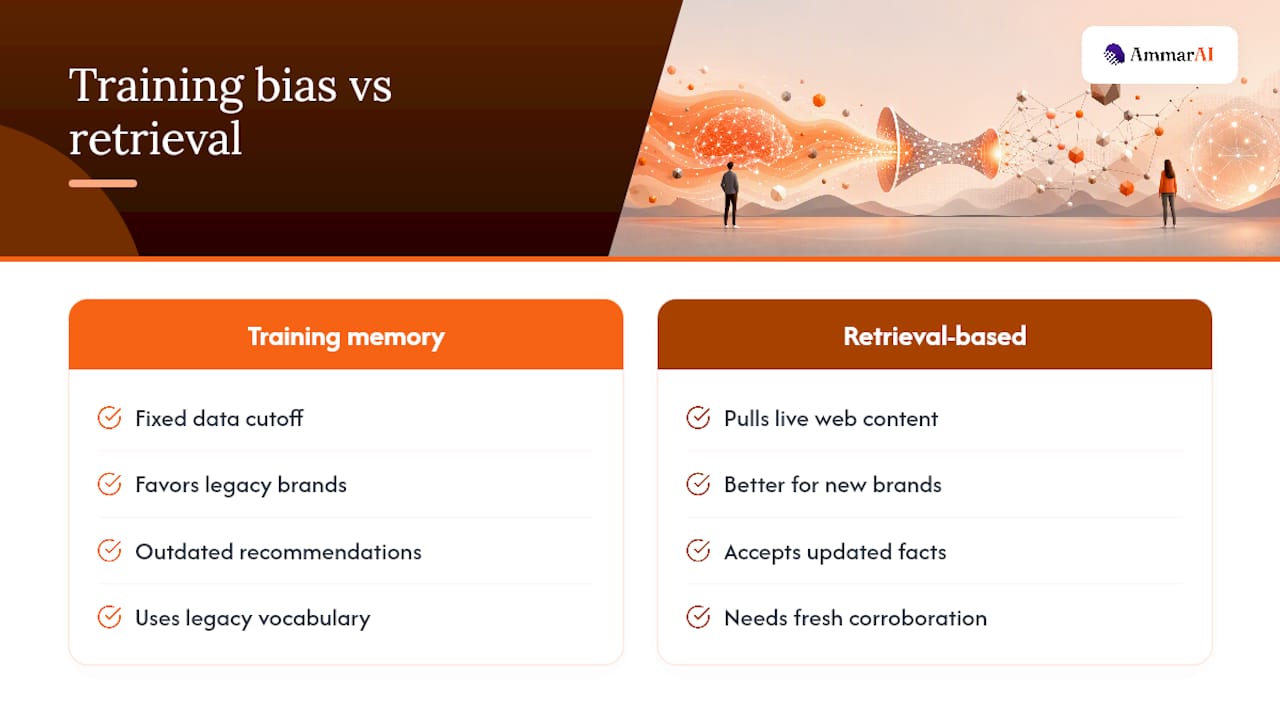
AI models learn what they know from the data they were trained on, and that data has a shape. It favors brands and content that were already prominent, well-linked, and widely discussed before the model’s training cutoff. A brand that launched or repositioned after that cutoff starts at a structural disadvantage that has nothing to do with product quality.
This shows up in a specific, frustrating way: an AI answer confidently recommends outdated competitors, describes your category using stale terminology, or simply doesn’t know your brand exists, even though your current website is excellent. Retrieval-augmented systems like Perplexity and Google AI Overviews partially correct for this by pulling live web content at query time rather than relying purely on trained-in knowledge. That’s precisely why those two platforms tend to be more winnable for newer or repositioned brands than a model’s raw training memory.
There’s also a subtler bias worth watching: category language. If a model’s training data associates your product category with a specific set of legacy players or a specific vocabulary, your content needs to bridge that gap explicitly, using the terminology the model already associates with the category while introducing your brand as the current, active alternative. Fighting the model’s baseline assumptions with generic marketing language rarely works. Meeting the established vocabulary while updating the facts tends to work better.
The monitoring protocol matters again here. Training data bias isn’t something you fix once. It’s something you route around continuously, by keeping fresh, well-corroborated content flowing into the retrieval-based engines even as you accept that pure training-data recall will always lag reality by however many months separate now from the model’s last training cutoff.
What Does a Real AI Visibility Improvement Actually Look Like?
The pattern that shows up across practitioner reporting is consistent, even without a single dramatic before-and-after number to point to: brands that combine answer-first content restructuring with a deliberate push for third-party mentions see citation frequency climb within one to two monitoring cycles, not overnight, but not glacially either.
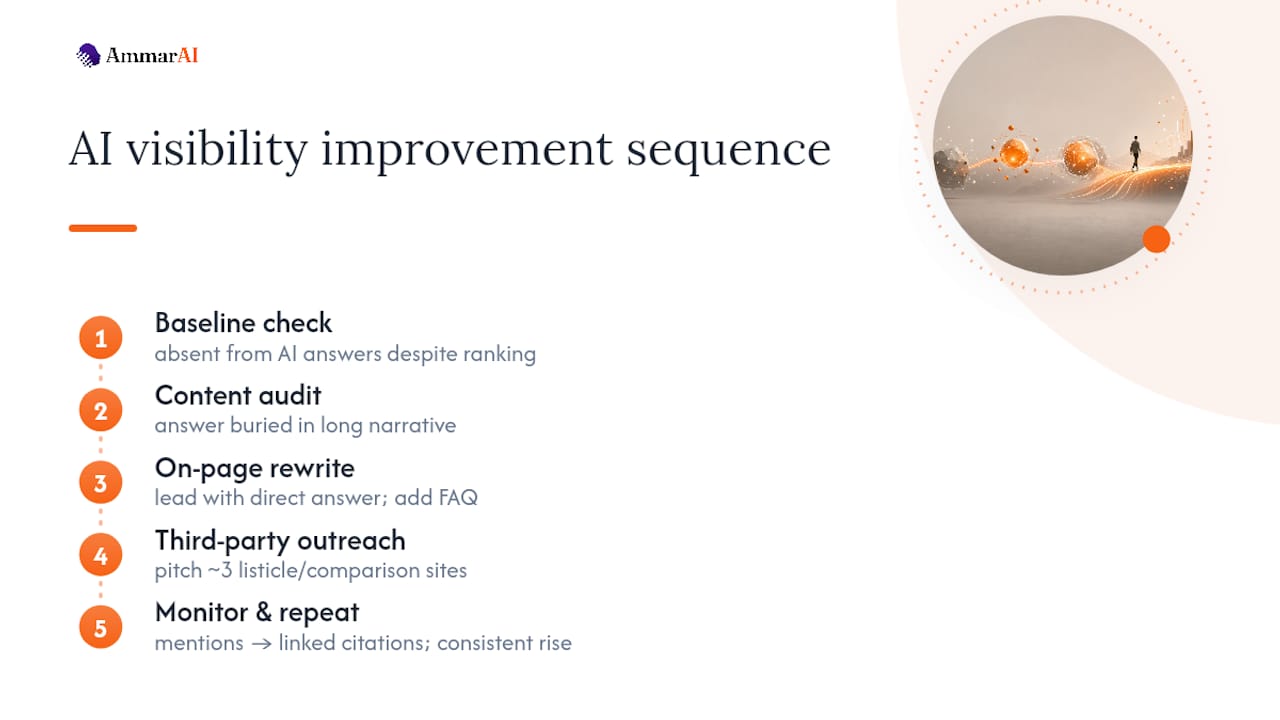
A typical sequence looks like this. A brand runs a baseline check and finds it’s absent from Perplexity answers for its core category questions, despite ranking well in traditional Google search. An audit finds the content is well-written but structured as a slow narrative build, with the actual answer buried three paragraphs in behind a long introduction. The team rewrites the top few pages to lead with the direct answer, adds an FAQ block covering the specific sub-questions buyers actually ask, and simultaneously pitches three relevant listicle and comparison sites for inclusion. Within a few monitoring cycles, the brand starts appearing in Perplexity answers for those same queries, first as a mention, then progressively as a linked citation as the third-party placements start to compound.
What separates a real improvement from a false signal is repetition. A brand showing up once in a spot-check isn’t proof of anything, given how much run-to-run variance exists in these engines. A brand showing up consistently across repeated weekly sampling, with the visibility rate trending upward over multiple monthly reports, is the version of “success” worth reporting to a leadership team. That’s also the version that survives an algorithm shift, because it was never dependent on a single lucky citation in the first place.
How Fast Should You Expect Results, Realistically?
Expect tactical wins in four to twelve weeks: technical fixes and answer-first rewrites move faster than earned mentions. Higher-tier recommended citations, the kind driven by accumulated third-party trust, usually take twelve to twenty-four weeks. Because engine output varies run to run, judge progress by visibility rate trends across repeated sampling, not a single lucky mention, and tie movement back to referral traffic and conversions before calling it a win.
— Ahmed
Run the Playbook Without Juggling Five Tools
There are plenty of ways to piece this together: a rank tracker for the visibility score, a separate writing tool for the answer-first rewrites, a design tool for the supporting graphics, and a transcription tool to mine sales calls for real conversational phrasing. A single integrated workspace carries a consistent brand voice and unified history across every step.
A typical workflow looks like this: pull real buyer language from a recorded sales call using AI transcription, draft the answer-first page structure and score it for AI readiness with the AI SEO Analyzer, then generate supporting visuals without leaving the workspace or opening a new subscription. The AI for SEO toolset is built specifically for the content-refresh cadence this playbook depends on, producing pages at the pace monthly updates actually require instead of the pace a single writer can sustain alone.
If you’re running this playbook across client accounts, start with the AI SEO Analyzer on your highest-priority page today and see where the technical gaps actually are before you rewrite a single word.
Where to Verify the Numbers in This Article
For deeper reading on the specific figures cited above: Semrush’s AI search ranking playbook and free AI visibility checker, GeoToolbox’s breakdown of what actually earns AI citations, Google’s own guidance on succeeding in AI search, and Search Engine Land’s analysis of 8,000 AI citations.
Sources
- How to rank in AI search (6-month playbook) — Semrush
- How to Get Cited by AI: What Actually Works in 2026 — GeoToolbox
- Succeeding in AI search — Google Developers (2025)
- How to Get Cited by AI: SEO insights from 8,000 AI citations — Search Engine Land
FAQ
What Is a Good AI Visibility Score?
There’s no universal benchmark, but Semrush’s framework treats a 3 to 5 point gain on the 0 to 100 scale as meaningful short-term progress rather than expecting a dramatic jump in one cycle.
How Is AI Search Visibility Different From SEO Rankings?
SEO ranks a page on a results list; AI search visibility measures whether an engine mentions, cites, or recommends your brand inside a generated answer, which depends more on extractable content structure and third-party corroboration than on keyword matching alone.
Which AI Platform Should I Monitor First?
Start with Perplexity and Google AI Overviews, since both cite more sources per answer than ChatGPT and give mid-tier brands an easier first foothold, according to analysis of 8,000 AI citations.
How Often Should I Check My AI Search Visibility?
Run weekly tactical checks across a 20 to 50 prompt set with 3 to 5 runs per prompt, and roll results into a monthly trend report, since single-run checks are too noisy to trust on their own.
Can a Tool Help Me Scale This Playbook?
Yes. An integrated workspace lets teams handle prompt research, answer-first content drafting, and page refreshes from one platform instead of managing separate subscriptions for each task.
Recommended
Recommended for you
- Batch 4–6 On Brand AI Images: Prompt Formula for Creators
A creator-first playbook for AI image generation. Use a repeatable prompt formula, batch 4–6 variants, and a brand workflow to produce consistent on brand...
- Best AI Video Generator: 7 Tools Compared
Find the best AI video generator for cinematic clips, avatars, editing and value. Compare quality, length limits, pricing and ideal users.
- AI Content Repurposing With AmmarAI in 7 Steps
Follow a practical AI content repurposing workflow in AmmarAI to turn one article into social posts, a newsletter, and a short video.
Tools to try next
- AI Image Editor
Edit a photo by describing the change — swap the background, remove objects, extend the frame, fix the light.
- AI Product Photoshoot
Turn one plain product photo into a full commercial shoot — studio, lifestyle and seasonal scenes.
- AI Fashion Try-On
Put a garment on a model without a shoot — same clothes, real fit, any model, any setting.