
AI Business11 min read
Creators: Cut Editing Time with AI B Roll, Polish in 10 to 15 Minutes
Turn transcripts into AI b roll rough cuts and finish with a 10 to 15 minute polish. Includes licensing checklist and AmmarAI workflow tips.

Creators: Cut Editing Time with AI B Roll, Polish in 10 to 15 Minutes
AI b-roll is a tool or workflow that reads your transcript, detects the beats in your talk track, and either finds or generates cutaway footage that matches what you are saying at that moment. It works best on reference-rich talking-head videos and tutorials, cutting editing time and improving retention through visuals that land on the right word. It is not a substitute for a human review pass: brand safety, licensing, and factual accuracy still need a person’s eyes before publishing.
TL;DR:
- Stock footage is best used for verifiable, real subjects like people, places, and software interfaces, while AI generation suits abstract ideas and rare scenes.
- A hybrid approach of mainly stock with fallback to generation produces the highest acceptance rate for inserts, ensuring visual consistency and authenticity.
- Accurate, timed transcripts and a simple beat taxonomy are crucial for effective placement of clips on exact words rather than near them.
- Automation handles transcript reading and beat flagging but requires focused human review to correct factual errors, mismatched timing, and visual inconsistencies.
- Using an all-in-one platform like AmmarAI streamlines the workflow, enabling transcription, clip sourcing, and editing within a single workspace to save time and maintain brand coherence.
Table of Contents
- How AI b-roll tools turn a transcript into visuals
- A step-by-step workflow for sourcing and placing b-roll
- Stock footage or AI generation: picking the right source
- Licensing, disclosure, and a commercial-safety checklist
- How AmmarAI fits into a transcript-aware b-roll workflow
- Where automation earns its keep and where it does not
- Speed up your b-roll workflow without juggling five subscriptions
- Sources
- FAQ
How AI b-roll tools turn a transcript into visuals
The pipeline starts with automatic speech recognition, which produces a word-level, time-aligned transcript. From that transcript, the tool detects candidate beats: moments where the speaker introduces a subject, makes a claim, or shifts tone. Natural language processing then tags each beat with an entity, an action, or an emotional cue, turning plain sentences into structured data the system can act on.
Those tags become search queries or generation prompts. A line like “our revenue grew last quarter” becomes a query for financial charts or office footage; a line about a rare or invented scenario becomes a generation prompt instead. One documented approach to this routing comes from an agent skill that reads transcripts and classifies each beat by source type (entity, receipt, concept, or meme) before presenting vetted candidate clips for a human to pick from, rather than letting the system make the final call.
The routing decision usually follows a simple logic:
- Stock search handles concrete, verifiable subjects like people, places, and screen recordings.
- Generation fills gaps for abstract ideas, rare scenes, or anything stock libraries do not cover.
- User-supplied footage proves claims that require the creator’s own product, data, or environment.
Where this breaks down is predictable. Semantic errors happen when NLP misreads intent, pulling a literal match for a figurative line. Timing mismatches happen when a clip is placed near a beat instead of on the word that triggers it. Aesthetic inconsistency creeps in when stock and generated clips are graded differently, breaking the visual continuity a viewer expects.
A step-by-step workflow for sourcing and placing b-roll
Getting from raw footage to a polished cut follows a repeatable sequence.
- Clean the audio and generate a word-level transcript. Accurate timestamps here determine how well every later step lands.
- Tag beats and label visual intent. A simple taxonomy works better than a complex one: hook, demo, proof, and emotion cover most talking-head content, as recommended in workflow guides that turn beats into visual prompts rather than single-word queries.
- Choose a source strategy per beat. Default to stock for anything verifiable, fall back to generation when stock comes up empty, and reserve your own footage for proof points that need to be real.
- Place clips on the word, not near it. Talking-head videos typically run 3 to 4 second cutaways, while vertical shorts do better with 1 to 3 second cuts, based on patterns documented across automatic b-roll pipelines. Alternate shot types so consecutive cutaways do not feel repetitive.
- Run a review pass before export. Check for watermarks, stray logos, likeness consent on any recognizable face, and factual accuracy on anything resembling a receipt, chart, or screenshot. Log who approved the final cut.
Pro Tip: Build your beat taxonomy once and reuse it across projects. A consistent label set makes it far faster to spot which beats consistently need a human override.
Stock footage or AI generation: picking the right source
Stock footage wins when the subject is concrete and verifiable: real people, real places, real software interfaces. Viewers can tell when a hand on a keyboard or a city skyline looks wrong, and stock libraries are built for exactly that kind of grounded realism. Generated media earns its place on abstractions and rare scenes that no stock library carries, like a visual metaphor for an economic trend or a scenario too specific to shoot.

A hybrid approach tests best. Comparisons of current tools point to a stock-first workflow with generation as fallback, reporting that this hybrid model produces the strongest accepted-insert rate compared to leaning on pure generation. A practical starter mix uses mostly stock footage with some generated and personal clips, adjusted to fit your brand’s visual identity.
A few habits keep the mix looking intentional rather than stitched together:
- Match color grade across stock and generated clips before final export.
- Crop each clip for its platform instead of stretching or letterboxing.
- Vary shot types (wide, close-up, over-the-shoulder) so the cutaways do not repeat the same framing.
Skip b-roll entirely on lines that are too abstract to illustrate honestly, or on moments where the speaker’s face carries the trust the message needs.
Licensing, disclosure, and a commercial-safety checklist
Commercial-use permission from a paid plan is not the same thing as owning the copyright. As of Q3 2026, purely AI-generated video created from text prompts alone lacks meaningful copyright protection in the United States and a paid subscription license does not guarantee ownership or protect against third-party infringement or likeness claims. Document the human creative decisions in your edit (beat selection, shot ordering, review approvals) since that human contribution is part of what supports a usage claim.
Enterprise workflows add human review gates for brand accuracy, factual claims, and rights checks before any paid placement.
That review discipline matters just as much for a solo creator. Before publishing, run through this:
- Get written consent for any recognizable face or a cloned voice.
- Scan generated and stock clips for stray logos or trademarks that could complicate commercial use.
- Apply the disclosure rules for wherever the video runs (YouTube, TikTok, Meta) and keep a record of who approved the final cut.
- Verify any receipt, chart, or screenshot-style visual against the real numbers it represents.
A documented review process is what makes an AI-assisted video defensible if a claim or a clip is ever questioned later.
How AmmarAI fits into a transcript-aware b-roll workflow
AmmarAI is built as one workspace rather than a stack of single-purpose subscriptions, which matters for a workflow that touches transcription, generation, and editing in the same session. Instead of exporting a transcript from one app and re-uploading it to another, the steps above stay inside one history and one brand voice setting.
- The platform combines transcription, AI video generation, and editing tools in a single workspace, so beat tagging and clip sourcing do not require switching platforms.
- Its AI transcription tool produces the time-aligned text that beat detection depends on.
- Brand voice controls carry over into generated visuals, keeping tone consistent across a project.
A practical sequence on the platform looks like this: upload the raw footage, run transcription to get word-level timestamps, turn key beats into visual prompts, generate or pull candidate clips through the AI video generator, then move into the AI video editor to place, trim, and finish the cut. The heavier lifting of rough-cut assembly happens inside one tool set, leaving the human polish pass to focus on taste and accuracy rather than file management.
Where automation earns its keep and where it does not

Automation is genuinely good at the tedious parts: reading a transcript, flagging beats, and proposing a first-pass match for each one. It is not good at taste, and it should not be trusted with final judgment calls on anything a viewer might question.
The highest-leverage minutes in any AI-assisted edit go to three things: catching factual errors in generated visuals, swapping out a clip that technically matches the words but reads wrong on screen, and tightening pacing so captions and cuts land together. A workable rule of thumb: let automation produce the rough cut, then budget a focused 10 to 15 minute polish pass for every 10 minutes of finished video. That ratio holds up whether the source footage is a five-minute tutorial or a longer interview.
— Ahmed
Speed up your b-roll workflow without juggling five subscriptions
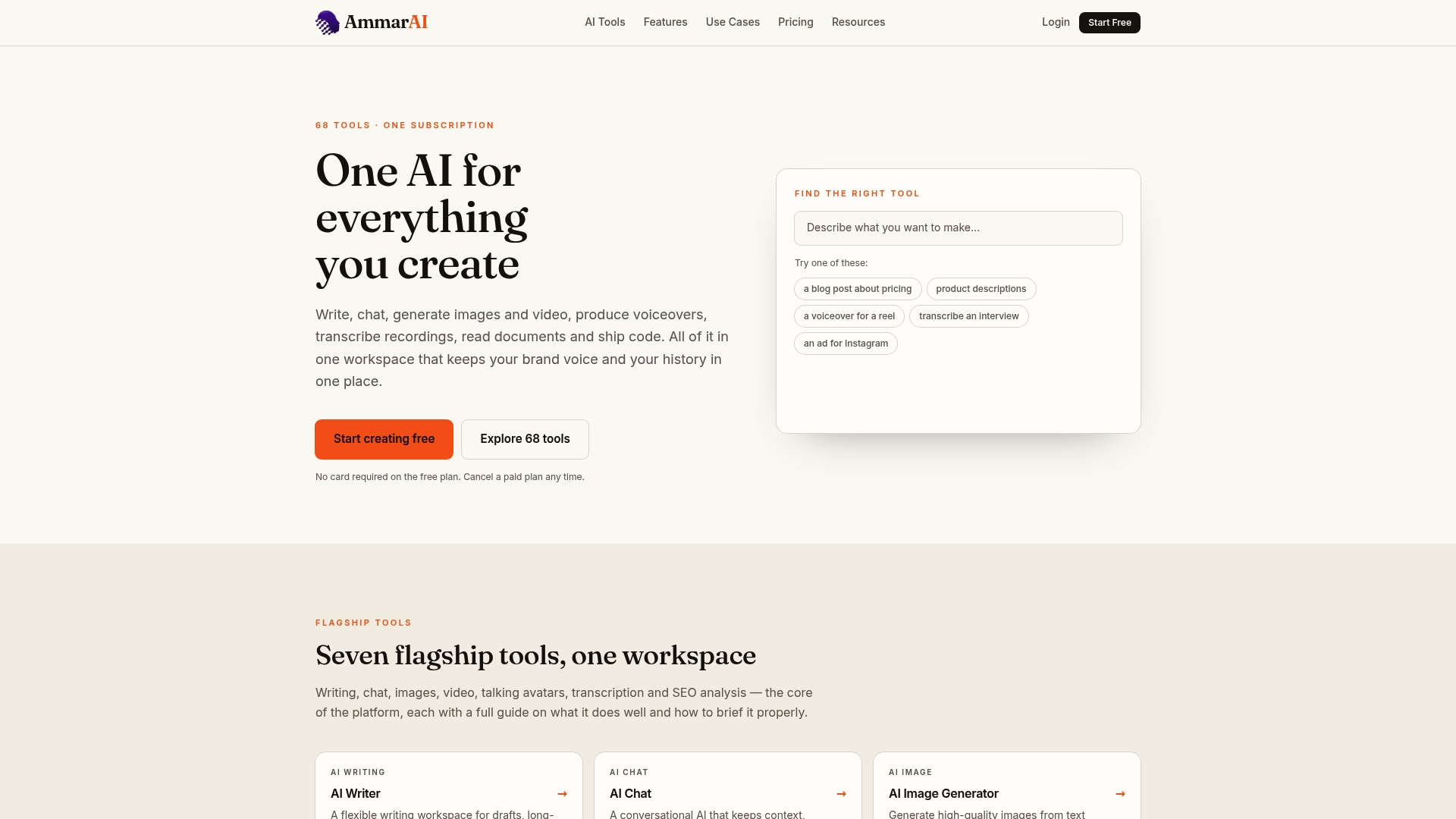
Building transcript-aware b-roll usually means separate tools for transcription, stock search, generation, and editing, each with its own login and its own bill. AmmarAI keeps all of it in one workspace with a shared brand voice, so a cutaway generated on Monday matches the tone of one you make on Friday.
- Start on the Free plan or move straight to a paid tier for higher generation limits and team features.
- Pull time-aligned transcripts and generate matching visuals without leaving the workspace.
Check the pricing page to see which plan fits your editing volume, then run your next transcript through AmmarAI to see how much of the rough cut it can carry for you.
Sources
- AI video copyright & commercial safety checklist
- hbcbh1999/b-roll-finder
- How to add b-roll to a video automatically with AI (2026) | Vidpal
- AI B-Roll Generator 2026: Generated vs Stock B-Roll Tested
FAQ
What is an AI b-roll?
AI b-roll refers to cutaway footage that a tool sources or generates automatically based on a video’s transcript, matching visuals to specific words or beats. It is meant to save editing time by producing a rough cut of supporting footage that a human then reviews and refines.
What does the term “b-roll” mean?
B-roll is supplementary footage cut alongside the main shot, such as a talking-head interview, to illustrate what the speaker is describing. It is used to break up a static shot, add visual proof, or cover a transition without losing the audio track.
Which AI b-roll generator is the best?
There is no single tool that fits every project; the right choice depends on whether you need verifiable stock footage, generated abstractions, or both. A hybrid workflow that pulls stock first and falls back to generation tends to produce better results than relying on one source type alone.
How do you make an AI b-roll?
Start with a clean, word-level transcript, then tag each beat with a simple label like hook, demo, proof, or emotion. From there, route each beat to stock search, generation, or your own footage, place the clip on the exact word it supports, and run a human review pass before publishing.
How long should AI-generated b-roll clips be?
Talking-head videos typically use 3 to 4 second cutaways, while vertical short-form content works better with 1 to 3 second cuts, based on patterns seen across automatic b-roll tools. Clips that run much longer risk shifting the tone of the piece away from the presenter.
Recommended
Recommended for you
- How to Use an AI Text Expander Without Adding Fluff
Use an ai text expander to develop thin passages without adding filler. This guide shows how to brief, expand, edit, and verify drafts with AmmarAI.
- Best AI Workflow Automation Tools for 2026
Compare the best AI workflow automation tools by automation style, integrations, pricing, governance, and team size to choose the right platform.
- Six Part Image Prompt Formula for Creators: Ship Campaigns Faster
Creator focused image prompt guide with a six part formula, 3–9 seed iteration rules, and ready templates for product, hero, and UI campaigns.
Tools to try next
- AI Agent Builder
Build agents that run real workflows on a schedule or trigger — reading, deciding and acting without you.
- AI Social Media Agent
An agent that plans, writes, schedules and adjusts a month of social posts across your accounts.
- AI Phone Call Agent
A voice agent that answers and makes real phone calls, books appointments and logs every conversation.