
AI Business11 min read
Teams: Cut tool sprawl with one AI document analysis workspace
Enterprise teams get practical workflows, token limit workarounds, citation checks, and governance steps for reliable AI document analysis in a single...

Teams: Cut tool sprawl with one AI document analysis workspace
AI document analysis automatically reads, summarizes, extracts, and answers questions about PDFs, scanned files, and other documents, letting you pull insight from one file or hundreds without reading each page yourself. It saves time on research synthesis, legal review, and report digestion, but it runs into real limits. Context windows cap how much text a model can see at once, and every tool carries some risk of confabulating facts it never actually read.
TL;DR:
- Most AI tools process scanned documents with OCR and layout analysis before text extraction, with digital files skipping this step for faster processing.
- File size, token limits, and upload quotas significantly influence which AI platform is suitable, requiring strategies like chunking or indexing for large documents.
- Use case effectiveness depends on precise source citations, long-context handling, and security features like encryption, especially for legal or technical documents.
- Reliable workflows involve segmenting documents, summarizing each part, merging summaries, and verifying critical facts against the original source.
- Confabulation remains a major risk, so cross-check extracted facts and request exact source citations to ensure accuracy.
Table of Contents
- How AI document analysis works: workflows and processing methods
- File types, size, and token limits you must plan for
- Common professional use cases and tasks
- How to evaluate and choose an AI document analysis tool
- Practical workflows, prompts, and verification tactics to reduce errors
- Security, governance, and accuracy risks to plan for
- Perspective: what consolidation actually buys you
- Try AmmarAI for document analysis without the tool sprawl
- Sources
- FAQ
How AI document analysis works: workflows and processing methods
Before a model can summarize anything, the document has to become usable text. Scanned pages and photographed documents go through optical character recognition and layout analysis, which identifies columns, headers, and reading order before any language model touches the content. Document layout analysis research such as M6Doc and TransDLANet shows that this structural step remains a prerequisite for accurate understanding, whether the source is a scanned contract or a modern PDF with embedded fonts.
Born-digital files, meaning PDFs or Word documents created electronically rather than scanned, skip OCR and go straight to text extraction, which is faster and more reliable.
Once text is extracted, tools handle length in one of two ways. Context stuffing feeds the entire document into the model’s working memory, which preserves full context but hits a ceiling fast on long files. Vector store retrieval breaks the document into chunks, indexes them, and pulls only the most relevant pieces for each question, which scales better but can miss connections between distant sections. Multimodal pipelines add a third layer, using visual retrieval to interpret charts, tables, and embedded images rather than just the surrounding text.

File types, size, and token limits you must plan for
Every platform enforces some combination of file size caps, token limits, and daily upload quotas, and these numbers determine which tool fits your workload. OpenAI’s enterprise documentation notes that large uploads get routed to a private search index once they exceed a context window of roughly 110,000 tokens, and that file handling differs by type: text documents are processed directly, spreadsheets are parsed for structure, and images inside PDFs use visual retrieval rather than plain text extraction. Separately, OpenAI’s consumer-plan documentation describes smaller daily upload caps for some plans, a real constraint if you’re processing many files in a single session.
Spreadsheets trigger a different workflow than prose documents because rows and columns need to stay structurally intact rather than getting flattened into plain text, which is why a tool that handles PDFs well can still mishandle a budget spreadsheet.
The standard workarounds when a document exceeds these ceilings are chunking the file into sections, running a summary-of-summaries pass where each chunk gets condensed and then the condensed versions get merged, and building a vector index so the system retrieves only what’s relevant to a given question instead of reprocessing the whole file every time.

Common professional use cases and tasks
AI document analysis earns its keep on a specific set of tasks rather than open-ended reading. The most common ones:
- Executive summaries and section-level TL;DRs that compress a long report into a few decision-ready paragraphs.
- Fact and citation extraction for legal brief review or academic research, pulling specific clauses, dates, or cited sources on request.
- Comparative synthesis across multiple documents, such as lining up three vendor proposals or a stack of research papers to spot agreement and contradiction.
- Structured data extraction from tables, pulling line items, figures, or specifications into a clean format for further analysis.
OpenAI’s file-upload guidance recommends breaking these tasks into smaller, targeted prompts rather than asking for everything in one shot, since narrower requests tend to produce more reliable extraction.
How to evaluate and choose an AI document analysis tool
Picking a tool for professional work means checking a short list of things that actually predict reliability, not just the demo.
- Accuracy and provenance: does the tool give extractive answers with exact-source clipping, so you can verify a claim against the original passage rather than trusting a paraphrase.
- Long-document strategy: ask whether the vendor uses true long-context processing or a retrieval-augmented approach, and request concrete examples of document length handled. ACL 2026 findings report that even strong models perform worse on long-horizon synthesis that requires linking facts across very large documents, so a vendor’s marketing claim about “long context” deserves a specific test case, not just a number.
- Security posture: encryption at rest, customer-managed encryption keys, controlled API key handling, and audit logs that record who queried what.
- Operational fit: pricing model, team permission controls, consistent brand voice across outputs, and whether the tool slots into your existing workflow or forces a new one.
Treat citation format as a non-negotiable line item: a tool that cannot point back to the exact page or paragraph it drew from is harder to audit, no matter how fluent its summaries read. For teams weighing several vendors, the NIST AI Standards documentation suggests asking for evidence tailored to your actual use case rather than generic capability claims, a principle worth applying directly in vendor conversations.
Practical workflows, prompts, and verification tactics to reduce errors
A reliable document analysis workflow follows a predictable sequence rather than a single giant prompt.
- Chunk the document into logical sections (chapters, clauses, or topic blocks) rather than arbitrary page counts.
- Summarize each chunk separately, asking for key facts and direct quotes rather than loose paraphrase.
- Merge the chunk summaries into a single pass, explicitly asking the model to flag contradictions between sections.
- Ask targeted follow-up questions against the merged summary instead of re-querying the full document each time.
- Request exact-source citations for any factual claim, specifying the page or section the model should quote from.
This chunk-summarize-merge pattern, recommended in OpenAI’s enterprise file-handling guidance, preserves nuance that single-shot summarization tends to flatten.
For verification, cross-check a sample of extracted facts against the source document by hand, especially numbers and dates, since those are where confabulation does the most damage. Spot-check at least one claim per section rather than trusting the whole output uniformly.
Combine vector search with context stuffing when a question requires linking facts across sections the retrieval system might otherwise treat as unrelated, such as tracing how an assumption in a report’s introduction shows up in its conclusion.
Pro Tip: Ask the model to quote the exact sentence it used before summarizing it. If it can’t produce the quote, treat the summary as unverified.
Security, governance, and accuracy risks to plan for
Confabulation, often called hallucination, is when a model produces a fact, citation, or figure that sounds plausible but doesn’t exist in the source document. The NIST AI Standards “Zero Draft” names confabulation as a material risk in AI-driven document work and recommends documentation practices built around correctness and comprehensibility rather than vague reassurance.
Beyond accuracy, governance gaps are the bigger operational risk. The 2026 State of AI Security Report from Orca Security found that AI adoption has outpaced governance across many organizations, with common misconfigurations including:
- Missing customer-managed encryption keys on document storage.
- Exposed API keys left in logs or client-side code.
- Agents and retrieval pipelines deployed without least-privilege access controls.
The fix is unglamorous but effective: enforce least privilege on who can query sensitive documents, turn on audit logs before rollout rather than after an incident, and require customer-managed keys wherever the platform supports them. Teams building retrieval pipelines should also review practical AI risk assessment frameworks and guidance on ungoverned AI as a compliance risk before scaling past a pilot.
Perspective: what consolidation actually buys you
The underrated benefit of a single workspace isn’t speed, it’s memory. When your document prompts, extraction templates, and brand voice settings live in one place, each new analysis builds on the last instead of starting from a blank prompt every time. AmmarAI’s AI Document Analyzer and shared templates reflect that logic. That said, a narrow specialist tool still wins when your entire job is one task, like OCR on handwriting. Consolidation pays off once you’re juggling summaries, extraction, and writing across the same files.
— Ahmed
Try AmmarAI for document analysis without the tool sprawl
Most people analyzing documents today end up stitching together a summarizer, a separate chat tool, and a writing app to turn findings into something shareable. AmmarAI’s AI Document Analyzer sits inside the same workspace as its writing, brand voice, and productivity tools, so the summary you pull from a report and the memo you write about it share the same history and tone settings.
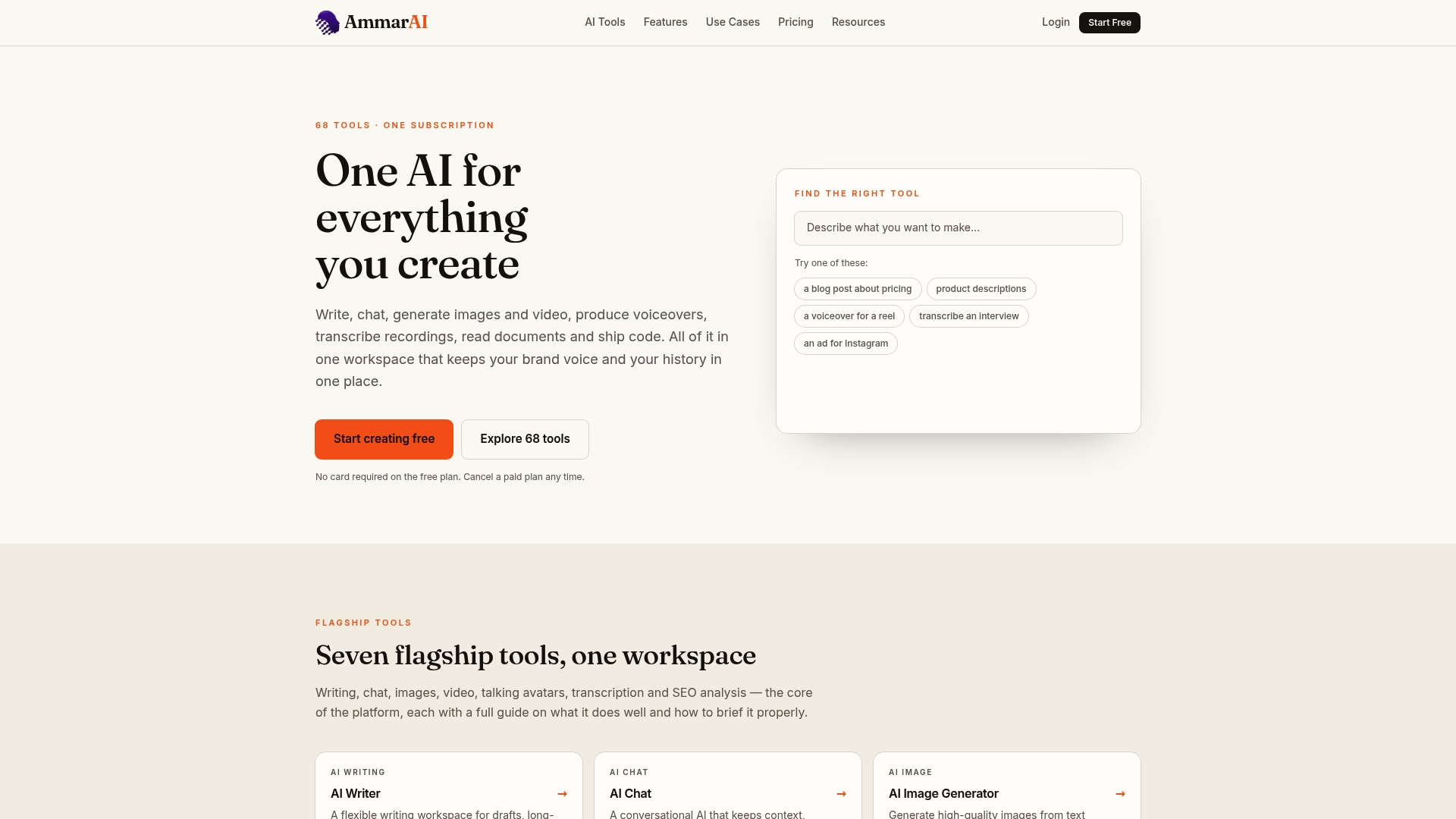
Plans run from the Free tier up through Starter at $9.99 per month, Professional at $29.99 per month, and Ultimate at $59.99 per month, each unlocking more generation volume and team features, detailed on the pricing page. If your workflow already spans research synthesis and content production, it’s worth testing whether one workspace covers both.
Sources
For deeper technical detail, see OpenAI’s enterprise file-upload documentation, the NIST AI Standards Zero Draft on governance, the 2026 Orca Security report on misconfiguration risk, and a practical AI data governance playbook for access controls.
- Guidance and Templates for Public-Facing AI Documentation: An AI Standards “Zero Draft” (NIST)
- ACL 2026 findings (long-document synthesis benchmarks)
FAQ
Can ChatGPT analyze a document?
Yes, ChatGPT can read uploaded PDFs, spreadsheets, and images to summarize, extract, and answer questions about their content. Enterprise versions handle larger files through a hybrid approach that routes very long documents to a private search index once they exceed the standard context window, as described in OpenAI’s enterprise documentation.
How do I get AI to analyze a document?
Upload the file to a tool that supports document processing, then ask a specific question rather than a vague one, such as requesting a section summary or a specific extracted fact with its source page. For long documents, break the task into chunks and merge the summaries, a pattern OpenAI’s guidance recommends over single large requests.
What is the 30% rule in AI?
There is no established “30% rule” tied to a recognized AI standard or framework that this article’s sources confirm, so treat any claim about it with caution. If you encountered the term elsewhere, check the original source’s definition before applying it to a real workflow.
What is the best AI for analyzing documents?
The right choice depends on your document length, file type, and whether you need strict source citations for audit purposes, rather than one universal winner. Tools that combine long-context handling with exact-source citation, like AmmarAI’s AI Document Analyzer, suit teams that want analysis and writing in the same workspace, while specialist OCR tools may fit narrower scanning tasks better.
Why does AI sometimes invent facts from a document?
This happens through confabulation, where a model generates a plausible-sounding answer not actually supported by the source text, a risk the NIST AI Standards documentation names directly. Asking for exact quotes and cross-checking key figures against the original document is a reliable way to catch it.
Recommended
Recommended for you
- Save Two Hours a Week: AI Business Emails Workflow for Small Teams
Workflow guide for professionals and small teams on AI business emails: prompts, edits, integrations, and how to save two hours weekly.
- Creators: Cut Editing Time with AI B Roll, Polish in 10 to 15 Minutes
Turn transcripts into AI b roll rough cuts and finish with a 10 to 15 minute polish. Includes licensing checklist and AmmarAI workflow tips.
- How to Set Up an AI Brand Voice
Build an AI brand voice that stays consistent. Gather source copy, define clear rules, test real prompts, and correct drift with a repeatable review process.
Tools to try next
- Brand Voice
Define how your brand sounds once, and have every writing tool follow it.
- AI Agent Builder
Build agents that run real workflows on a schedule or trigger — reading, deciding and acting without you.
- AI Social Media Agent
An agent that plans, writes, schedules and adjusts a month of social posts across your accounts.