
AI Writing16 min read
90 Days to a Workflow for AI Copywriting for Ads for Small Teams
Learn a workflow first approach to AI copywriting for ads: generate, review, and test ad assets in 30 day pilots while keeping brand voice.

90 Days to a Workflow for AI Copywriting for Ads for Small Teams
Yes, AI can produce effective ad copy when you use a disciplined, test-driven workflow. Pick a platform with brand-voice controls and bulk export, generate 8 to 12 distinct headline and description options for one campaign, and run a short pilot before you scale. AI excels at producing large pools of distinct variants fast, and in controlled tests it has matched or beaten human-written ads when a person still reviews the output.
TL;DR:
- AI produces the best results when generating multiple distinct headlines and descriptions, with at least three headlines and two descriptions needed for responsive search ads.
- To maximize AI ad copy effectiveness, provide a detailed brief including campaign goal, audience, keywords, claims, and brand voice, then human review and verify all content.
- AI-generated ads have shown a preference of 59.1% over human ads in tests, but performance drops when audiences are informed they are machine-made.
- Testing multiple AI variants and monitoring conversion rates and cost per acquisition helps identify high-performing assets worth scaling.
- Use AI as a drafting partner with human oversight to avoid fabricated claims and ensure ad content aligns with brand, legal, and accuracy standards.
Table of Contents
- How AI ad copy fits into responsive search and display formats
- What the evidence and Google’s own guidance say about AI-written ads
- A practical workflow: brief, review, align, and launch
- Prompt recipes for headlines, descriptions, and asset pools
- Testing and measuring AI-generated ad variants
- Avoiding hallucinations, brand drift, and disclosure problems
- Choosing a platform or building your own process
- What I’d tell a small team starting this today
- Getting the workflow running with AmmarAI
- FAQ
- Sources
How AI ad copy fits into responsive search and display formats
Google’s responsive search ads do not run a single fixed line of copy. The system rotates combinations of headlines and descriptions to learn which pairings perform best for a given search, which is why the format rewards variety over a single polished slogan. According to Google’s developer documentation, responsive search ads need at least three headlines and at least two descriptions, though the platform serves only three headlines and two descriptions at any one time.
That structure changes how you should brief an AI tool. Instead of asking for “a great headline,” you want a set of assets built around different angles: one on price, one on a guarantee, one on a specific feature, one on urgency. Each slot also has a hard character limit, and a phrase that reads naturally at 35 characters often gets clipped or feels stiff once it is forced into 30.
A few mechanical details shape how you write prompts for these formats:
- Headlines typically cap at 30 characters and descriptions at 90, so ask the AI to write to those limits, not just “a short headline.”
- Pinning locks a specific headline or description into a fixed position when legal text, a brand name or a required disclaimer must always appear.
- Path fields (the text after your display URL) have their own short limits and work best when they echo the keyword, not the brand tagline.
The practical implication is that quantity only helps when each asset says something different. Ten headlines that are reworded versions of the same sentence do nothing for Google’s rotation algorithm or for your test data. Brief the AI to build an asset system of distinct hooks, not a pile of synonyms.
What the evidence and Google’s own guidance say about AI-written ads
The research on AI-generated ad copy is more encouraging than most marketers expect, with real caveats attached. A large-scale study on LLM-generated ads found they achieved a 59.1% preference over human-created ads in persuasion tests, against 40.9% for the human versions, with the strongest gains coming from ads built around Authority and Consensus appeals.
59.1% preference for AI-generated ads over human-written ones, according to a 2025 persuasion study, with a notable twist: when readers were told an ad was AI-generated, its preference dropped by about 21 percentage points. The lesson is not that AI writes better copy in some abstract sense. It is that AI-generated copy performs best when it stands on its own merits rather than being flagged as machine-made, and that persuasion strategy matters more than polish.
Google’s own guidance backs a collaborative approach rather than a hands-off one. Its business guidance on AI ad copy recommends briefing the tool with campaign goal, audience, keywords, offer details and brand context, then auditing what comes back for accuracy. Google’s support documentation on text customization adds that generated assets draw on your landing-page content, so outdated or inaccurate pages will produce outdated or inaccurate ad copy downstream.
The practical takeaway: AI is a strong engine for variant generation and persuasion framing, but it needs a human checking facts, claims and brand fit before anything goes live. Skipping that step is where most of the real risk in AI ad copy actually lives.
A practical workflow: brief, review, align, and launch
Treat AI as a drafting partner that needs a clear brief and a firm editorial pass, not a system you can run unattended. The workflow below turns a blank prompt into publishable, platform-ready assets.
- Brief the AI with specifics: campaign goal, target audience, primary keywords, the exact offer (price, discount, deadline), claims you are allowed to make, two or three brand voice markers (words or phrases that sound like you), the CTA, and the character limits for the channel.
- Generate in volume: ask for 12 to 15 headline options and 6 to 8 descriptions so you have enough raw material to be selective rather than settling for the first batch.
- Filter for factual accuracy: cut anything that states a number, guarantee or claim you cannot verify against your actual product or offer.
- Check against the landing page: every promise in the ad copy should appear, in some form, on the page the click lands on; mismatches hurt quality score and trust.
- Adjust tone: read the surviving assets aloud; rewrite anything that sounds generic or off-brand rather than accepting it as close enough.
- Add required legal or disclosure language: insert and pin any wording your industry or platform requires, rather than hoping it survives rotation.
- Build out supporting assets: sitelinks, callouts, structured snippets, and promo text extend the ad beyond headlines and descriptions.
- Pin only what must stay fixed: use pinning for legal text or a required brand mention, and leave everything else unpinned so the system can keep testing combinations.
Pro Tip: Run your edited copy past someone outside the marketing team before launch. If a stranger would not understand the offer in five seconds, neither will most of your audience.
This sequence takes a messy first draft through the same scrutiny a human copywriter’s work would get, which is the difference between AI copy that performs and AI copy that just looks finished. For teams deciding which parts of this process to automate versus keep manual, it helps to map out which tasks to automate and which to keep human before building the workflow into a repeatable system.
Prompt recipes for headlines, descriptions, and asset pools
Specific prompts produce specific, usable output. Vague prompts produce vague, forgettable copy that needs a full rewrite anyway. The templates below are built around Google’s character constraints and a few proven persuasion angles.
- Benefit-led headline: “Write 5 headlines, 30 characters or fewer, each leading with a different customer benefit of [product], based on these verified features: [list].”
- Social proof angle: “Write 3 headlines using this verified customer count or rating: [exact figure], framed as a reason to trust [brand].”
- Objection handling: “Write 3 descriptions, 90 characters or fewer, that address this common hesitation: [objection], using only these facts: [list].”
- Authority framing: “Write 2 headlines that reference [verified credential or certification] without overstating what it covers.”
- Measured scarcity: “Write 2 descriptions mentioning this real deadline or stock limit: [exact detail], without implying urgency we cannot support.”
The common rule across every recipe: feed the AI verified facts and tell it explicitly not to invent numbers, awards, certifications or guarantees. If you do not have a statistic to give it, do not ask it to find one. One partner resource on AI ad copy edits walks through real before-and-after examples that show how much editorial work a first draft typically needs, which is a useful gut check if you are new to this process.
Once you have a working set of prompts, small adjustments to phrasing (how specific the input facts are, how tightly you define the audience) tend to matter more than finding a magic prompt format. A closer look at how to structure prompts for sharper AI output is worth a read before you lock in your templates.

Testing and measuring AI-generated ad variants
Generating copy is the easy part. Knowing whether it actually works requires watching the right numbers and giving each variant enough runway to produce a real signal.
- Track CTR and conversion rate together, since copy that grabs clicks but does not convert is usually overpromising relative to the landing page.
- Watch cost per acquisition and ROAS as the metrics that actually determine whether a winning headline is worth scaling.
- Use the asset-level performance report in Google Ads to see which specific headlines and descriptions are pulling “best,” “good” or “low” ratings inside your responsive ad group.
- Run a ramp-and-scale cadence: test a new pool of assets at modest spend, let it collect enough impressions to be meaningful, then increase budget only on the combinations that are winning.
- Avoid calling a test early: a headline that looks like a winner after 200 impressions can easily reverse once it reaches a few thousand.
When a variant clearly outperforms the rest, feed its structure back into your next prompt round: ask the AI for five more headlines in the same style as the winner, rather than starting from a blank brief each cycle. That loop, win, extract the pattern, regenerate, is what separates teams that get steadily better results from teams that just keep producing more copy.
Avoiding hallucinations, brand drift, and disclosure problems
The most common failure mode in AI ad copy is not bad writing, it is confident writing about things that are not true. A close second is copy that sounds slightly off-brand in ways that compound across dozens of assets.
- Never let the AI invent proof: a fabricated statistic, award or customer count can trigger platform policy violations and damage trust once a customer notices the mismatch.
- Check claims for consistency across assets: a 20%-off headline next to a 15%-off description is the kind of error that slips through when reviewers skim instead of read.
- Limit high-pressure scarcity language: “only 2 left” or “today only” should appear only when it is literally true, not as a default persuasion tactic.
A short governance playbook keeps this manageable: maintain a written list of allowed and disallowed claims, require one editorial sign-off before anything launches, keep a simple change log of what was edited and why, and version your copy so you can trace a live ad back to its original prompt and brief.
Pro Tip: Keep a one-page “claims we can make” document next to your prompt templates. It takes ten minutes to write and saves hours of back-and-forth edits later.
Some categories warrant human-only copywriting rather than a hybrid process, particularly regulated areas like health, finance or legal services where a wrong claim carries real consequences. For most other campaigns, a hybrid approach, AI drafts, a human reviews and edits, works well, and research on generative AI in advertising suggests that hybrid output is better received than AI-only content, especially when the AI’s role is disclosed rather than hidden.
Choosing a platform or building your own process
The right tool depends less on how polished its sample headlines look and more on whether it fits the workflow you just read. A few criteria matter more than the rest.
- Brand-voice support: the tool should let you define tone markers once and apply them across every generated asset, not force you to re-explain your brand in every prompt.
- Bulk generation and export: you need to produce and download dozens of headline and description combinations at once, formatted for direct upload.
- Multi-format asset support: beyond text, support for images, video and other ad formats matters if your campaigns run across channels, as shown in tools built for ad copy across video, audio and social.
- Ad-platform integrations: direct export or integration with Google Ads and other ad managers saves real time over copy-pasting.
- Team collaboration: shared workspaces and shared history matter once more than one person is writing or reviewing copy.
- Governance features: version history and the ability to flag or lock approved claims reduce the risk of drift.
- Pricing shape: per-generation pricing can get expensive fast for ad-heavy workflows, while a flat monthly plan with generous limits tends to fit better.
Run a short pilot before committing: pick one real campaign, generate a full asset pool, launch it, and give it a defined evaluation window with clear KPIs before deciding whether to scale the tool across your account.
What I’d tell a small team starting this today
Start with a low-stakes campaign, not your highest-spend account. Own every factual claim yourself; the AI is a drafting tool, not a fact-checker. Run short tests before you commit real budget to any single asset pool.
A simple pilot: in the first 30 days, brief and launch one campaign with AI-generated assets reviewed by a human. In the next 30, expand to two or three campaigns and start tracking which prompt patterns produce your best performers, using early ROI signals the way smaller teams have applied AI tools for measurable returns. In the final 30, formalize your claims document and prompt library so the process runs without rebuilding it each time.
— Ahmed
Getting the workflow running with AmmarAI
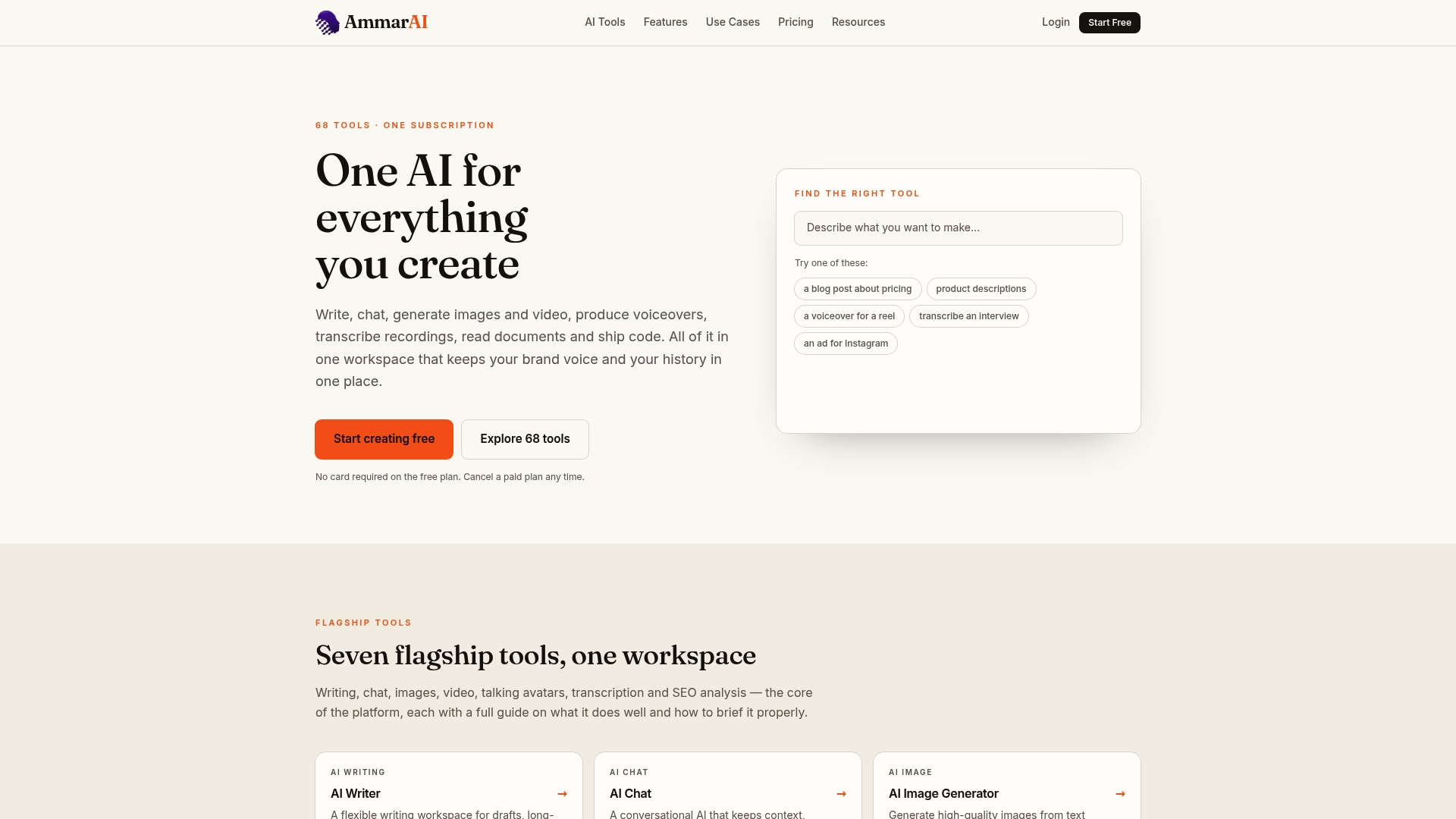
Everything in this workflow, brand voice, bulk generation, multi-format assets, team review, is faster when it lives in one place instead of across five separate tools. A unified AI workspace that combines many AI tools, from copywriting to image and video generation, under one brand voice setting and one shared history, helps marketing teams draft, review and export ad assets without switching platforms or juggling separate subscriptions.
If you want to run the pilot described above, the Free plan lets you test the workflow at no cost, and the Starter plan at $9.99 per month adds the generation volume most small teams need for a real campaign test. For teams producing ads across more than text, the AI UGC Creator extends the same workflow into creator-style video ads built from the same brand voice settings. Check the pricing page for the full breakdown of plans and limits before you commit a campaign budget to the test.
FAQ
Does AI-generated ad copy actually perform better than human-written ads?
In controlled persuasion tests, AI-generated ads achieved a 59.1% preference against 40.9% for human-written ads, according to a 2025 study. That advantage shrank by about 21 percentage points when readers knew the ad was AI-generated, so undisclosed, well-edited AI copy tends to perform best.
How many headlines and descriptions do responsive search ads need?
Google’s developer documentation specifies at least three headlines and at least two descriptions for responsive search ads, though the system only displays three headlines and two descriptions at any given time. More distinct, non-redundant options give the rotation system more combinations to learn from.
What information should I give an AI tool before asking for ad copy?
Google’s own guidance recommends briefing the tool with your campaign goal, audience, keywords and offer along with any claims you are allowed to make. Skipping this step is the main reason AI drafts come back generic or factually off.
How do I test which AI-generated ad variant actually works?
Launch a pool of distinct variants inside one ad group, let the platform’s asset-level reporting show which headlines and descriptions are rated “best” or “good,” and judge winners by conversion rate and cost per acquisition rather than clicks alone. Avoid declaring a winner before the test has collected enough impressions to be reliable.
Is it legal or ethical to use AI for writing ad copy?
There is no blanket rule against using AI to draft ad copy, but every ad still has to meet the advertising platform’s policies on accuracy and the claims your business can actually support. The practical safeguard is a human review step that checks every AI-generated claim against verified facts before the ad goes live.
Sources
- Responsive search ads | Google Ads API | Google for Developers
- AI Copywriting: Effective Ways of Using AI for Ads - Google Ads
- LLM-Generated Ads: From Personalization Parity to Persuasion Superiority
- About text customization in Search campaigns - Google Ads Help
Recommended
Recommended for you
- How to Set Up an AI Brand Voice
Build an AI brand voice that stays consistent. Gather source copy, define clear rules, test real prompts, and correct drift with a repeatable review process.
- 6 Prompts That Make AI YouTube Scripts Film Ready for Creators
Turn AI drafts into film-ready YouTube scripts with time codes, read-aloud timing checks, and a 6-item prompt checklist creators can paste into any AI tool.
- AI Prompt Libraries: A 9-Point Checklist for Production Use
Evaluate, adapt, and productionize AI prompt libraries with a 9-point checklist, prompt-chaining tactics, and practical tips for managing prompts in Ammarai.
Tools to try next
- AI ReWriter
Rewrite existing text in a different tone, length or reading level while keeping the meaning intact.
- Brand Voice
Define how your brand sounds once, and have every writing tool follow it.
- AI Editor
A long-form document editor with AI help built into the page, for drafting and revising in one place.