
AI Audio16 min read
5-Stage AI Transcription Workflow Teams Trust Without Vendor Lock-In
Workflow-first guide to a trusted AI transcription pipeline: five stages, a short vendor-test checklist, governance controls, and an integrated workspace...

5-Stage AI Transcription Workflow Teams Trust Without Vendor Lock-In
The right AI transcription workflow follows one path: ingest, then a single-pass transcription and diarization step, then enrichment, then governance, then distribution. Teams evaluating tools should prioritize three things above everything else: diarization quality, how well the system integrates through APIs, and whether it produces the metadata needed for audits. Platforms folding transcription into a broader content workspace can shorten the distance between raw audio and a published asset.
TL;DR:
- Single-pass transcription and diarization models significantly improve accuracy for multi-speaker recordings by reducing speaker attribution errors.
- Testing should include noisy, multi-speaker, and domain-specific samples, measuring word error rate, diarization error, latency percentiles, and confidence thresholds.
- Building a provider-agnostic pipeline with normalized outputs, retries, and security controls prevents vendor lock-in and ensures compliance with regulations.
- Human review and detailed metadata logging are essential for maintaining trust, regulatory compliance, and handling low-confidence segments effectively.
- Using an integrated workspace that manages transcription, enrichment, and distribution streamlines workflows, maintains consistency, and simplifies tooling across industry use cases.
Table of Contents
- What the end-to-end transcription workflow looks like
- The technical building blocks your pipeline depends on
- How to test transcription systems before you commit
- Architecture choices that keep your pipeline from locking you in
- A step-by-step checklist for piloting and scaling
- Keeping transcripts governable, private, and auditable
- How AmmarAI fits the workflow end to end
- What it actually costs to run this at scale
- A realistic timeline from setup to deployment
- Where teams get stuck and how to work through it
- Matching the workflow to your industry’s needs
- Why most teams overinvest in accuracy and underinvest in review
- One workspace instead of a stack of separate tools
- Sources
- FAQ
What the end-to-end transcription workflow looks like
A working pipeline has five stages. Audio or video comes in through ingest, whether that’s a meeting recording, an uploaded file, or a live stream. A single-pass model then transcribes and diarizes at once, tagging who said what and when. Enrichment layers on summaries, named entity extraction, and clip markers. Governance attaches metadata, confidence scores, and retention rules. Distribution pushes the finished transcript, clips, or notes into a CMS, a shared drive, or a social queue.
Realtime and batch modes solve different problems, and mixing them up wastes budget:
- Realtime transcription fits live meetings, customer calls, and captioning where a few seconds of latency matters more than perfect accuracy.
- Batch transcription fits podcasts, interviews, and archival audio where accuracy and full-file diarization matter more than speed.
- Hybrid setups run realtime for live capture and reprocess the same audio in batch afterward for a cleaner final transcript.
Single-pass diarize-and-transcribe models are worth the switch for messy, multi-speaker recordings. Because the model attributes speech to speakers in the same step it transcribes, it avoids the alignment drift that happens when transcription and diarization run as two separate passes on the same audio.
The technical building blocks your pipeline depends on
Every transcription pipeline rests on a handful of components, and each one needs to output more than plain text to be useful downstream.
- ASR (automatic speech recognition) converts audio to text and should output word-level timestamps, not just a paragraph.
- Diarization assigns speech segments to speakers and should output a speaker label plus a confidence score per segment.
- VAD (voice activity detection) trims silence and non-speech audio before transcription, cutting wasted processing time.
- Enrichment tasks such as summarization, named entity recognition, and topic tagging turn a flat transcript into searchable, structured content.
Speaker attribution improves noticeably when transcription and diarization run as one operation rather than two. MOSS-Transcribe-Diarize is an end-to-end model built specifically to transcribe, diarize, and timestamp in a single pass, which reduces the mismatches that appear when two separate models try to agree on who spoke when.
MOSS-Transcribe-Diarize performs transcription, diarization, and timestamping in one pass. For teams handling multi-speaker recordings like panels or customer calls, that single-pass design directly addresses the most common failure mode in transcript quality: misattributed speech.
Each component should hand off a minimum set of metadata: source file ID, timestamp ranges, speaker label, confidence score, and model version. Without that handoff, audits and downstream automation both stall.
How to test transcription systems before you commit
Choosing a transcription provider without a structured test is how teams end up locked into a system that fails on their actual audio. Enterprise media pipeline guidance recommends testing against production-like conditions rather than relying only on public benchmarks, since vendor demos rarely reflect a noisy conference room or three people talking over each other.
A workable test protocol:
- Collect 30 to 50 representative audio samples spanning your real conditions: quiet one-on-one calls, noisy multi-speaker meetings, accented speech, and domain jargon.
- Score each output on word error rate, diarization error or speaker-merge rate, timestamp drift, and recall of proper nouns and technical terms.
- Measure latency at the p95 and p99 percentiles, not just the average, since tail latency is where queues back up and users notice.
- Flag any segment below your confidence threshold for manual review instead of auto-publishing it.
Providers like GPT Transcribe support keyword hints and language hints that can lift domain-term recognition, and Google Cloud Speech-to-Text offers model adaptation and hotword prompting for the same purpose. Both are worth testing against your actual vocabulary before you decide.
Pro Tip: Keep the raw audio and diarization confidence score attached to every low-confidence segment so a human reviewer can re-check it without re-transcribing the whole file.
Architecture choices that keep your pipeline from locking you in
The biggest engineering risk in a transcription pipeline isn’t accuracy, it’s rigidity. Building a thin adapter layer that normalizes every provider’s output into one canonical JSON schema means you can swap or add a model without rewriting every downstream integration. Enterprise pipeline guidance recommends exactly this kind of composable, provider-agnostic design to avoid getting stuck with one vendor’s format.
- Normalize outputs into a shared schema (speaker, text, start time, end time, confidence) regardless of which model produced them.
- Run the pipeline asynchronously: uploads trigger events, events queue workers, and workers process transcription jobs independently of the request that started them.
- Build in retries and failover so a timeout or outage on your primary provider routes the job to a secondary provider or a delayed queue instead of failing silently.
- Apply security controls at ingest and storage: encrypt audio and transcripts at rest and in transit, tier access by role, and configure data residency settings where regulations require it.
Google Cloud Speech-to-Text supports enterprise features like data residency and customer-managed encryption natively, which is useful if regulatory scope is part of your decision.
A step-by-step checklist for piloting and scaling
Before writing any integration code, get the groundwork done. Collect representative audio samples, define the accuracy and latency thresholds you’ll hold the system to, and confirm consent and privacy requirements for the audio you plan to process.
- Prepilot: gather samples across real conditions, set SLAs for word error rate and latency, and document consent requirements for recorded speakers.
- Pilot: integrate one or two providers, run them against your test samples, capture full metadata on every job, and review every failure manually.
- Cost check: track actual per-minute cost and latency against your SLA before expanding volume.
- Scale: add monitoring dashboards, set human review gates for low-confidence output, define retention rules, and automate delivery of transcripts and clips to your CMS or analytics tools.
Pro Tip: Run your pilot on the noisiest, messiest audio you have, not your cleanest sample. A pipeline that survives a bad recording will handle the easy ones without a second thought.
Enterprise pipeline practice treats this rollout as a system, not a one-time integration: ingest, enrich, govern, and distribute all need monitoring once volume grows past a handful of files a week.
Keeping transcripts governable, private, and auditable
A transcript without metadata is just a wall of text nobody can verify or trust later. At minimum, preserve the source file ID, timestamp ranges, model version, confidence scores, and any redaction markers applied to sensitive content for every asset you process.
- Route low-confidence segments to human review automatically instead of publishing them as-is.
- Log every access to raw audio and transcripts, especially where the content includes personal or sensitive information.
- Set retention rules upfront rather than deciding case by case after a request comes in.
- Flag compliance-relevant content, such as health information under a framework like HIPAA in the United States, so it routes through stricter handling than routine meeting notes.
Diarization confidence scores and raw audio references should be stored together, according to enterprise pipeline guidance. That pairing lets a reviewer re-evaluate an uncertain segment without re-running the whole transcription job, which matters because diarization errors tend to break summarization and analytics further downstream.
Human review isn’t optional for anything feeding a compliance record, a legal transcript, or a public-facing quote. Everything else can run on a confidence threshold with spot checks.
How AmmarAI fits the workflow end to end
An integrated workspace shortens the distance between each stage of this pipeline instead of forcing separate tools to hand off files manually. AmmarAI’s transcription tool produces structured output with timestamps and speaker labels at the ingest and transcription stages, and the same workspace carries that transcript into enrichment and distribution without an export step.
Two examples show how this plays out. A recorded team meeting becomes a searchable, speaker-labeled transcript, and the same workspace can turn a key exchange into a short clip for internal sharing. A batch of podcast episodes gets transcribed together, then repurposed into social clips drawn directly from the transcript rather than re-edited from raw audio.
When transcription, enrichment, and distribution share one history and one brand voice setting, output can stay consistent across a team without separate configuration in each tool.
What it actually costs to run this at scale
Transcription pricing generally falls into three models: per-minute processing fees, seat-based subscriptions, or bundled workspace plans that include transcription alongside other content tools. Per-minute pricing scales directly with volume, which suits teams with unpredictable or seasonal audio loads. Seat-based pricing suits teams with steady, predictable usage across a fixed headcount.
Total cost of ownership goes well beyond the transcription bill itself. Factor in engineering time to build and maintain the adapter layer, storage costs for raw audio and transcripts, the labor cost of human review for low-confidence segments, and any compliance tooling required for sensitive content. A pipeline that looks cheap on a per-minute basis can cost more overall once review labor and storage are added in.
Budgeting works best when it’s tied to the checklist from the pilot stage: measure actual per-minute cost and latency during the pilot before committing to a scale-up. That number, not a vendor’s advertised rate, should drive the budget conversation. Bundled workspace plans can simplify budgeting further by folding transcription into a single monthly line item alongside the other content tools a team already pays for, rather than tracking a separate per-minute invoice.
Whatever pricing model you choose, revisit it after your pilot’s real volume and failure rate are known. A rate that looked reasonable in a demo can look very different once review overhead is factored in.

A realistic timeline from setup to deployment
Most teams underestimate how much of the timeline is tuning, not integration. Initial setup, choosing a model or provider and standing up the adapter layer, typically takes the shortest stretch of the process because the technical lift is well understood. Integration with existing systems (calendars, CMS, storage) tends to take longer, since it depends on how many downstream tools need to receive transcript output.
Tuning is where most of the calendar time goes: running the test protocol against representative samples, adjusting confidence thresholds, and retraining review workflows based on what the pilot actually surfaces. Teams that skip this stage or compress it tend to discover diarization or domain-term problems only after they’ve scaled up volume, which is a far more expensive time to find them.
Deployment itself, turning on monitoring, setting retention rules, and connecting automation to push derivatives into a CMS or analytics tool, is usually the fastest stage once tuning is done, because the hard decisions are already made. Teams that treat tuning as a real phase with its own checkpoints, rather than a quick pass before launch, consistently end up with fewer surprises once volume increases.
Where teams get stuck and how to work through it
The most common failure isn’t bad transcription, it’s bad diarization on overlapping speech. When two people talk at once, even strong ASR models can misattribute words to the wrong speaker. The fix isn’t a better model alone: flag segments with low diarization confidence for review rather than trusting every automated speaker label.
Domain jargon and proper nouns are the second recurring problem. A transcript that gets company names, product names, or technical terms wrong undermines trust in the whole output, even when general accuracy is high. Both GPT Transcribe and Google Cloud Speech-to-Text offer hint or adaptation mechanisms for exactly this, so feeding a glossary of your own terms into the model before transcription is worth the setup time.
Latency spikes under load are the third common issue, and they usually show up only after a pilot succeeds and volume increases. Measuring p95 and p99 latency during testing, not just the average, catches this before it becomes a production incident.
Finally, teams sometimes discover partway through that their retention and consent processes don’t match what they’re actually recording. Settling those requirements before the pilot, not after, avoids reprocessing or deleting data under pressure later.
Matching the workflow to your industry’s needs
The core pipeline holds steady across industries, but the enrichment and governance layers shift depending on what a team is transcribing and why.
Legal and healthcare teams need strict access logging, redaction markers for sensitive content, and retention rules that match regulatory requirements like HIPAA for health information handled in the United States. Media and podcast teams care less about compliance and more about enrichment speed: turning a batch of episodes into chapters, show notes, and clips as fast as possible after recording.
Customer support and sales teams often run realtime transcription during live calls, then feed the output into analytics for sentiment or topic tracking rather than publishing the transcript itself. Corporate and internal meeting use cases sit somewhere in between, needing searchable archives and action-item extraction but rarely the compliance overhead of healthcare or legal work.
The workflow stages don’t change: ingest, transcribe and diarize, enrich, govern, distribute. What changes is which governance controls are mandatory and which enrichment tasks matter most to the team receiving the output.
Why most teams overinvest in accuracy and underinvest in review
Most advice on transcription treats word error rate as the only number that matters, and that framing is misleading. A model with excellent raw accuracy but poor diarization on overlapping speech will still produce transcripts nobody trusts, because misattributed quotes are worse than a few misspelled words. Diarization quality deserves at least as much testing rigor as accuracy, and most buying guides give it a fraction of the attention.
The bigger gap is governance. Teams build a working pipeline, celebrate the pilot, and then never define who reviews low-confidence segments or how long transcripts get retained. That’s the point where a fine pilot turns into a compliance risk six months later. If you take one thing from this piece, prioritize the human review gate and the metadata trail before you optimize the model choice further. Accuracy differences between strong providers are usually smaller than the cost of an unreviewed, misattributed quote making it into a public document.
— Ahmed
One workspace instead of a stack of separate tools
Running transcription, enrichment, and distribution through separate subscriptions means separate logins, separate histories, and inconsistent output every time a new tool joins the stack. Some platforms keep transcription, summarization, clip generation, and publishing in one workspace with one brand voice setting and one bill, so a meeting recording or podcast batch moves through the whole pipeline without switching tabs.
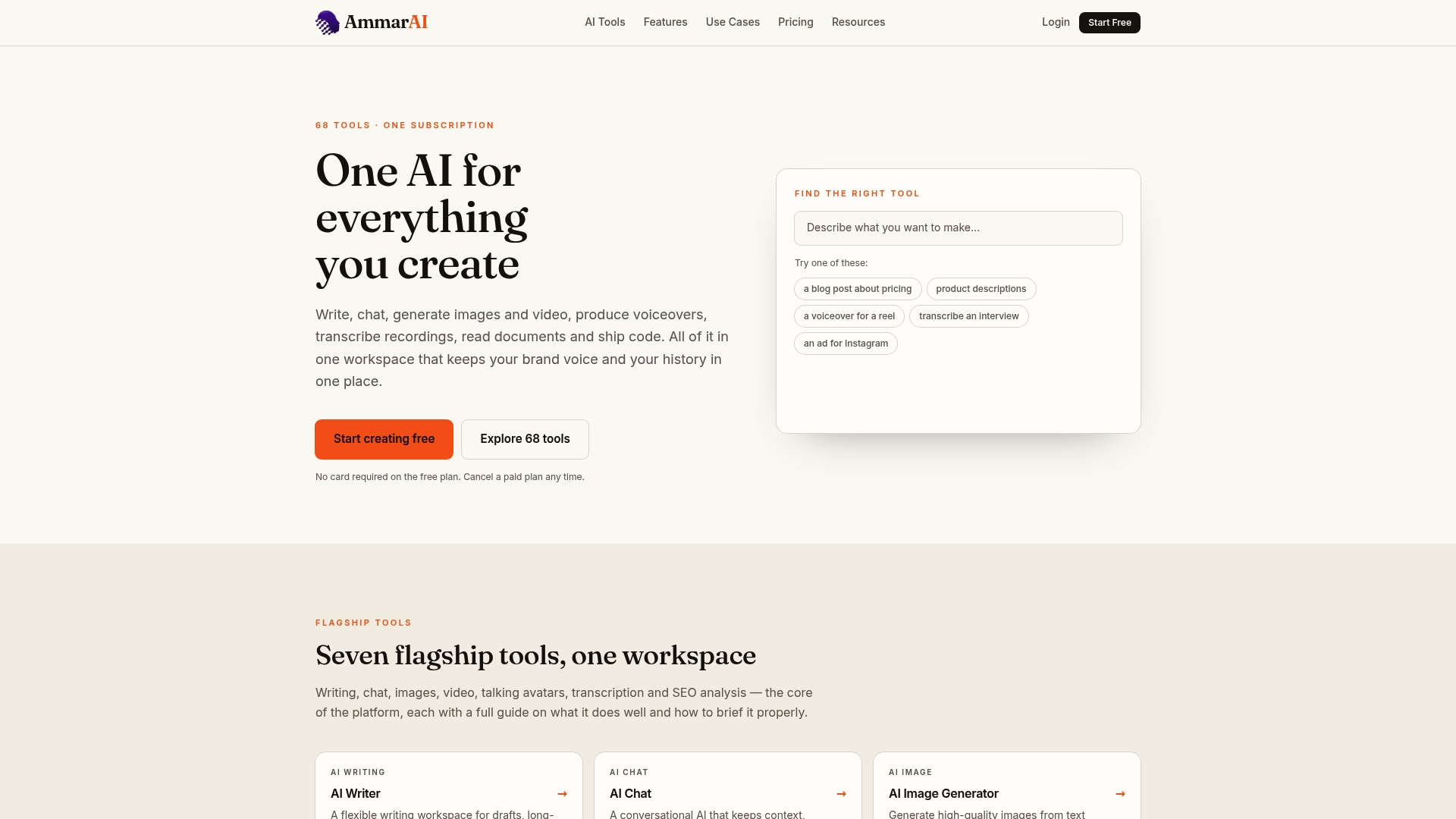
Teams that want to see how transcription fits alongside AmmarAI’s other content tools can check the pricing page for plan details, or start directly from the AmmarAI workspace to test the transcription tool against a real recording.
Sources
A short list for teams who want to go deeper on any of the technical claims above:
- Enterprise AI Media Pipeline: Transcription to Studio
- Speech-to-Text: AI voice typing & transcription | Google Cloud
FAQ
Can you make $1,000 a month transcribing?
Income from manual transcription work varies widely by client volume, rate, and speed, and no verified figure applies universally across freelancers. Many transcriptionists now use AI transcription as a first pass and focus their paid time on review and correction rather than typing from scratch.
Will transcriptionists be replaced by AI?
AI transcription handles the first pass of most audio quickly, but human review remains necessary for low-confidence segments, overlapping speech, and compliance-sensitive content. The role is shifting from typing transcripts to reviewing and correcting AI output rather than disappearing outright.
Can ChatGPT do transcription?
OpenAI’s ChatGPT Record feature supports live transcription and saves notes with export and summary options, alongside user controls for retention and training-data usage, according to OpenAI’s help documentation. For batch file transcription at scale, a dedicated API like GPT Transcribe is typically a better fit than the chat interface itself.
Recommended
Recommended for you
- Best AI Music Generator: 6 Tools Compared
Find the best ai music generator for songs, stems, vocals, and commercial projects. Compare licensing, output length, pricing, and ideal buyer types.
- Students: Study Notes AI to Build 50 Flashcards From a PDF in Minutes
Turn lectures, slides, and PDFs into notes, flashcards, and quizzes with study notes AI. Consolidate work in one AI workspace and verify outputs.
- Podcasters: Turn Podcast Transcripts into 3 Social Clips with AmmarAI
Turn episode audio into diarized, editable transcripts with AmmarAI. Fix speaker labels, export SRT/DOCX/Markdown, and repurpose one transcript into show...
Tools to try next
- AI Text to Speech
Convert articles, documents and scripts into clear spoken audio, at length and at speed.
- AI Speech to Text
Fast, accurate conversion of speech into text, including live dictation and recorded audio.
- Sound Studio
Merge audio, add background music, adjust voice speed and loudness, and fine-tune voiceovers in one place.