
AI Marketing16 min read
AI Competitor Analysis: A Step-by-Step Guide for 2026
Learn how to run AI competitor analysis: pick rivals, gather evidence, write prompts that produce decision briefs, and check every claim before you act.

AI Competitor Analysis: A Step-by-Step Guide for 2026
AI competitor analysis means using AI to collect, organize, compare and summarize what your rivals publish, so you can decide what to change in your own pricing, messaging, content or product. The method that works is simple: define the decision first, pick three to five real competitors, feed the AI their actual pages and data, and verify every factual claim before it goes into a brief. This guide walks through each step, with the inputs and prompts that make the output usable.
TL;DR
- Start with a decision (reprice, reposition, pick content topics), not with a tool. The decision tells you which evidence to gather.
- Limit the set to three to five competitors you actually meet in deals or in search results.
- Give the AI real material: homepages, pricing pages, sitemaps, keyword exports, reviews, call transcripts. Don’t ask it to recall facts from memory.
- Ask for implications and actions, not descriptions, then run a second pass where the AI audits its own draft.
- Treat traffic figures as estimates, and trace every number and quote to a source before you share the brief.
Table of Contents
- What AI competitor analysis actually covers
- Step 1: Define the decision before you collect anything
- Step 2: Choose the right competitors
- Step 3: Gather the evidence yourself
- Step 4: Three inputs that work well for AI
- Step 5: Write prompts that produce a decision, not a summary
- Step 6: Verify before you share
- Where AI needs a human
- A worked example: a small SaaS team, one afternoon
- How often to repeat it
- Perspective
- Turn the analysis into content and campaigns
- Common mistakes to avoid
- FAQ
- Sources
What AI competitor analysis actually covers
Competitive analysis has always been about the same question: what are the other options in your market doing, and what should you do differently? AI changes the speed, not the question. According to LeewayHertz, AI in this setting automates the collection of large amounts of data from social media, websites and market reports, and looks for patterns that manual methods may miss.
In practice, a good AI-assisted analysis can help you see:
- Website changes: new pages, repositioned headlines, shifted calls to action.
- Pricing and packaging: tiers, billing options, what is included at each level.
- Search opportunities: keywords rivals rank for and you don’t.
- Messaging patterns: value propositions, target audiences, proof points.
- Content topics and formats: what they publish, how often, for whom.
- Customer sentiment: what reviewers praise and complain about.
- Gaps in your own offer: where the market asks for something nobody serves well.
A useful frame is that a complete picture has three surfaces: what a brand says about itself on its own site, what third parties say about it (reviews, press, community threads), and how AI search tools describe it. If your analysis covers only the first, you are reading the competitor’s own advertising.
Step 1: Define the decision before you collect anything
The most common failure is a vague brief such as “analyze our competitors.” The result is a tidy report that changes nothing. Write one sentence that names the decision and the deadline for making it:
- “Should we move our mid-tier plan price before the next quarter?”
- “Which three blog topics should we publish next to close our biggest search gap?”
- “How should our homepage describe us so we stop sounding like everyone else?”
Each decision points at different evidence. A pricing decision needs pricing pages and changelogs. A content decision needs keyword exports and sitemaps. A positioning decision needs homepages and reviews. Keep that sentence at the top of every prompt you write, so the AI keeps filtering for relevance.
Step 2: Choose the right competitors
More rivals do not mean better analysis. Choose three to five that you actually lose customers or rankings to. Mix them deliberately:
- Direct competitors: sell the same thing to the same buyer.
- Search competitors: don’t sell what you sell but outrank you for your key queries (often publishers or comparison sites).
- Substitutes: the approach your buyer uses instead, such as a spreadsheet, an agency or a do-it-yourself workflow.
For search competitors, look at the pages that appear for your main keywords and note who keeps showing up. For direct competitors, ask your sales or support team who comes up in conversations. If you run a small team, this list takes twenty minutes and saves hours of unfocused research.
Step 3: Gather the evidence yourself
AI is a strong analyst and a poor memory. If you ask it about a competitor’s pricing from nothing, it may produce confident, outdated or invented numbers. Instead, collect the source material and hand it over. A solid decision-grade pack includes:
- Homepages and key landing pages
- Pricing pages (save a dated copy or screenshot)
- Product documentation and changelogs
- Review exports from the sites your buyers use
- Call transcripts and win/loss notes from your own team
The Product Marketing Alliance lists a wider set of inputs worth considering: competitor sites and documentation, social media, customer reviews, news coverage, job boards, analyst research, win/loss interviews, CRM data and customer conversations. Job boards are underrated: a rival hiring five sales engineers or a machine learning lead tells you where it plans to go.
For advertising, the public ad libraries run by the major ad platforms (Google’s Ads Transparency Center, Meta’s Ad Library and LinkedIn’s ad library) show the creative and offers a competitor is currently running. Paste what you find into your analysis pack.
If you record sales calls or customer interviews, you can turn the audio into text first with AI transcription and then feed the transcripts into your analysis.
Step 4: Three inputs that work well for AI
Orbit Media’s guide to AI competitive analysis describes three simple inputs that give a chatbot enough to work with. Each maps neatly onto a decision.
Search rankings

Export a keyword-gap report that shows queries your competitor ranks for and you don’t. Clean it first: keep search volume, keyword difficulty and cost per click, and remove branded and irrelevant terms. Give that table to the AI and ask it to identify commercial-intent opportunities. Cost per click is a handy proxy here, because queries advertisers pay more for often signal buyers closer to a purchase.
A prompt you can adapt:
Here is a keyword-gap export for [competitor] versus my site. Our decision: which five topics should we publish first? Group keywords by search intent, flag the ones with commercial intent, and rank the groups by the ratio of opportunity to difficulty. Explain each ranking in one sentence.
Grouping by intent is where AI saves the most time. If you want to go further, our guide to AI keyword clustering shows how to check whether keywords that look related really share ranking pages before you build a page for each.
Sitemaps
A sitemap is a map of how a competitor organizes its site. Give the AI the sitemap file and ask it to compare page types, niches, formats, topical focus and geography. You will quickly see whether a rival leans on comparison pages, location pages, templates or long guides, and where it has nothing at all.
Homepage screenshots
For messaging and positioning, give the AI full-page screenshots rather than copied text. Screenshots carry the visual elements text strips out: trust seals, product imagery, the order in which claims appear. Ask for a comparison across the same dimensions for every competitor:
- The headline and who it speaks to
- The main promise and the proof behind it
- The call to action
- What the page leaves out
That last item often produces the best insight. If all four competitors promise speed and nobody talks about consistency or support, you have found positioning room.
Step 5: Write prompts that produce a decision, not a summary
A description of what a competitor does is not analysis. Ask for the so-what. A framework from Datagrid is worth borrowing here: connect every finding to an implication and a recommended action. You can build that into one reusable prompt:
Decision: [one sentence]. Using only the sources I pasted below, build a table with one row per competitor and these columns: positioning claim, pricing structure, strongest proof point, visible weakness, and what it means for us. After the table, list three recommended actions, each tied to a specific finding. Mark anything not found in the sources as “not in sources.”
Three habits improve results every time:
- Constrain the sources. “Use only the material below” cuts down invented detail.
- Ask for a fixed format. Tables make gaps visible and let you compare competitors line by line.
- Request uncertainty labels. Ask the AI to separate what the sources state from what it infers.
Step 6: Verify before you share
AI output reads smoothly whether or not it is correct, which is exactly why it needs checking. Build verification into the workflow rather than leaving it to the end.
Run a two-pass review. After the AI drafts the brief, start a new prompt, paste the draft and the sources, and ask it to act as an auditor: list unsupported claims, missing citations, suspicious numbers and data still needed. Then fix those items.
Trace the material claims. Precise numbers, direct quotes and named customers must trace to a current source. Open the source and check that the passage says what the brief says it does. A claim you cannot trace gets removed or labeled as an assumption.
Label estimates as estimates. Traffic and keyword-volume numbers for other people’s websites come from models, not from the competitors’ own analytics. Write “estimated” next to them, and avoid building a decision on a small difference between two estimates.
Mind confidentiality. Use public information and your own customer data. Don’t paste a competitor’s private documents, leaked material or anything shared under an agreement into an AI tool. If a sales rep heard something in a call, ask whether it was meant to be public before it goes into a battlecard.
Check dates. Pricing pages and product pages change. Put the capture date on every source in the pack, and treat anything older than a quarter as something to recheck.

Our walkthrough on running AI deep research with cited sources covers the same discipline for broader research questions.
Where AI needs a human
General-purpose AI assistants are good at synthesis, and they are weaker at judging how reliable each input is. A glowing quote from a real buyer, a competitor’s marketing claim and a half-broken link can all look equally credible to a model. The Product Marketing Alliance draws a useful line between tools built to gather and monitor signals and assistants that turn those signals into battlecards and briefs, and it warns that an assistant can polish a narrative built on unverified assumptions.
So keep people in these places:
- Choosing what matters. The AI can rank findings. You decide which ones fit your strategy and budget.
- Weighing sources. A verified customer interview outweighs an anonymous forum post. Say so in the prompt, or sort sources into tiers.
- Reading between the lines. A pricing change might be a test, a mistake or a signal. Talk to sales before you react.
- Final sign-off. Someone who knows the market should read the brief before it reaches leadership or a sales team.
A worked example: a small SaaS team, one afternoon
Imagine a four-person software team that wants to know why trial signups stalled. Their decision: should they change the homepage promise?
- Define it. “Which homepage promise should we test next month?”
- Pick rivals. Three direct competitors from the sales team’s lost-deal notes, plus one search competitor that keeps outranking them.
- Gather. Full-page homepage screenshots, pricing pages saved with dates, the last 20 public reviews for each rival, and five call transcripts.
- Analyze. One prompt per competitor for the table, then one prompt that compares all four and lists the claims nobody makes.
- Audit. A second prompt checks the draft against the sources and flags two pricing details the AI had inferred rather than found.
- Decide. The team writes two homepage headlines that stress the claim nobody is making, and plans an A/B test.
Nothing here required a large budget. It required clear inputs, fixed formats and a verification pass. If your company sells software, our page on AI for SaaS companies describes how content and growth work fits together.
How often to repeat it
A one-off analysis ages quickly. Set a refresh rhythm that fits the decision: monthly for pricing and messaging in a fast market, quarterly for search gaps and content plans, and a quick check before each major launch. Keep the same prompt and table layout each time so you can compare brief to brief and spot what changed. Save the sources with their dates, so any number in an old brief can be traced.
Perspective
We built AmmarAI because the hard part of competitor research is rarely finding information. It is moving between five tools to turn that information into something a team can use. A chat tool for the analysis, another for images, another for the write-up, and none of them remembering your brand voice.
Our view is that competitive analysis should sit next to the work it informs. When the same workspace holds your research history, your brand voice and your drafting tools, a finding about a rival’s weak spot can become a revised landing page or a content brief in the same session, with one history to look back on.
We also believe in practical limits over promises. AI speeds up reading, grouping and drafting, and the judgment about what to do stays with your team. That is why we design our workflows around your own sources, clear outputs and a review step, not around autopilot.
Ahmed
Turn the analysis into content and campaigns
Once you have your brief, the next job is acting on it: rewriting a page, planning topics, drafting outreach. AmmarAI is a single AI workspace for that work, with one history, one brand voice and one bill, so research, copy, images and video stay in one place instead of across separate subscriptions.
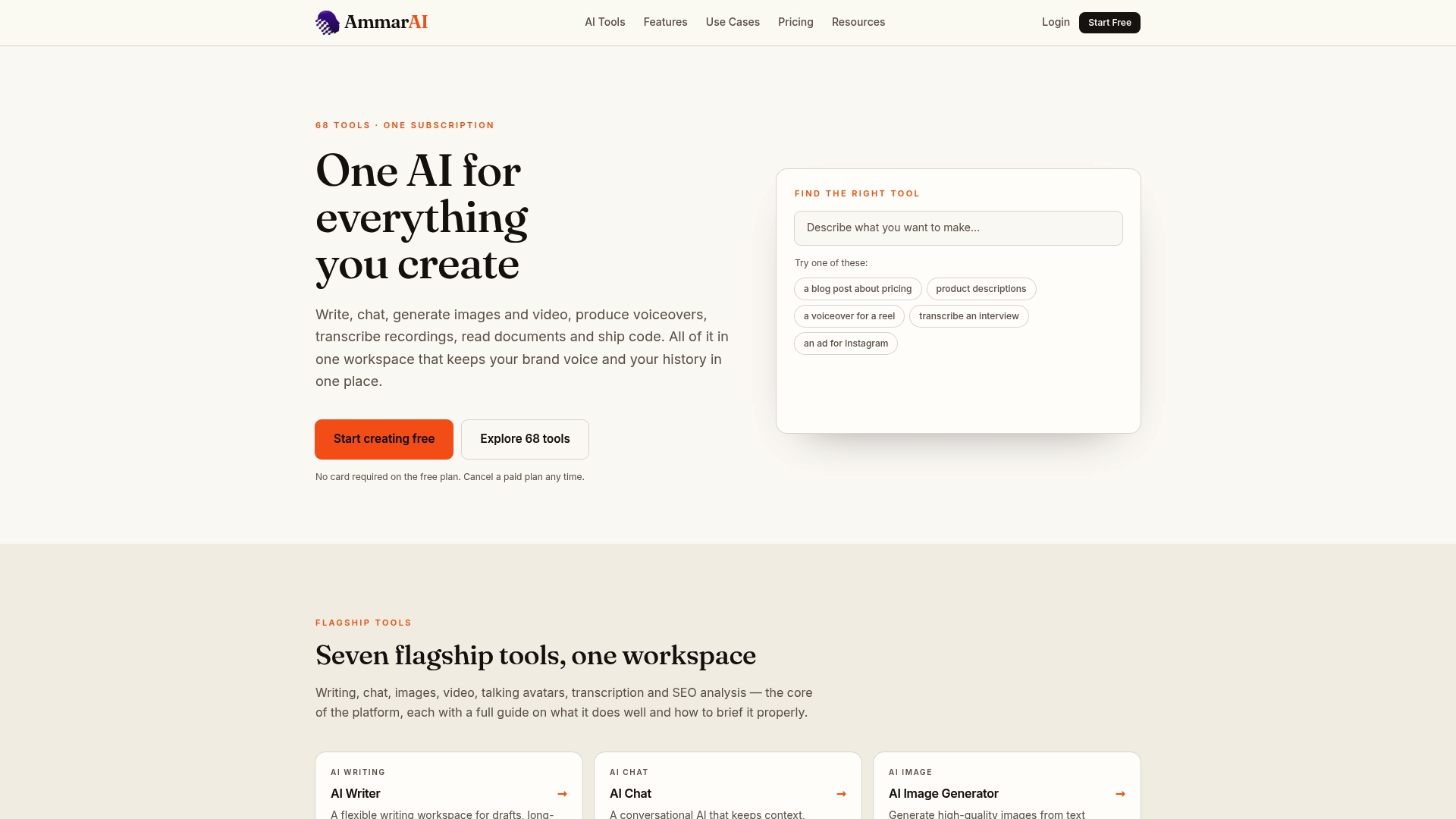
The Free plan costs $0 per month with limited usage, so you can try your first competitor brief without paying. Paid plans are Starter at $9.99 per month, Professional at $29.99 per month and Ultimate at $59.99 per month, with larger generation allowances and more advanced features. See the details on the AmmarAI pricing page. If search is your main battleground, the AI SEO Analyzer lets you score a page, text or keyword, and our overview of AI for marketing teams shows how planning, writing and launching fit together. For a map of tools by job, see our guide to the best AI marketing tools by job.
Common mistakes to avoid
- Too many competitors. Fifteen rivals produce a shallow table. Stay with three to five.
- Asking from memory. If the AI has no source in front of it, it may fill the gap with plausible fiction.
- Stopping at description. A list of what rivals do is not a plan. Insist on implications and actions.
- Copying competitors. The point is to find where you can differ, not to imitate. Look for the claim nobody is making.
- Skipping the date. An undated pricing comparison is a liability by the next quarter.
- Treating estimates as facts. Modeled traffic numbers belong in the brief with an “estimated” label.
FAQ
Sources
- AI for Competitive Analysis: Applications, Benefits, and more (LeewayHertz)
- The AI-Powered Competitive Analysis: 3 Quick Ways to Score Your Brand (Orbit Media)
- Navigating AI tools for competitive intelligence (Product Marketing Alliance)
- How to Perform AI Competitor Analysis in Four Steps (Datagrid)
Recommended
Recommended for you
- AI Marketing Bot: A Practical Broadcast Workflow
Learn how an ai marketing bot drafts, segments, schedules and measures WhatsApp and Telegram broadcasts, with practical checks to prevent costly errors.
- AI Brand Compliance: A Practical Guide for US Marketing Teams
AI brand compliance for US teams: voice, legal disclosure, copyright and provenance checks, plus a review workflow you can start this week.
- AI Brainstorming Prompts That Beat Generic Idea Lists
Copy-ready AI brainstorming prompts, a diverge-then-converge method, and the mistakes that make AI ideas bland. Includes templates for content, products and campaigns.
Tools to try next
- AI Marketing Bot
Broadcast marketing messages to your WhatsApp and Telegram audiences — written by AI, segmented, scheduled and measured.
- AI Agent Builder
Build agents that run real workflows on a schedule or trigger — reading, deciding and acting without you.
- AI Social Media Agent
An agent that plans, writes, schedules and adjusts a month of social posts across your accounts.