
AI Writing15 min read
Publish Faster in One Workspace: 7 Step AI Blog Writing for Marketers
Scale SEO ready posts with a 7 step AI blog writing workflow in one unified workspace. Keep human edits, copyright logs, and Google friendly quality.

Publish Faster in One Workspace: 7 Step AI Blog Writing for Marketers
AI reliably speeds up drafting, outlining, and SEO grunt work, but it does not replace a publishing process. The posts that actually rank and convert come from a structured workflow: keyword research, an AI-assisted outline, a drafted post, a human edit pass, and an SEO polish before anything goes live. Skip the human steps and you get generic, forgettable content; keep them and AI becomes a genuine speed advantage.
TL;DR:
- Use AI for outlines, section drafts, metadata, and repurposing; brief each prompt with audience, goal, structure, keywords, tone, and section length.
- Verify every statistic, date, and factual claim, then add at least one original example, data point, or opinion before publishing.
- Place the primary keyword in the H1, opening paragraph, one heading, and URL slug; add image alt text and two or three relevant internal links.
- Check search intent and top ranking pages before outlining, draft one section at a time, and refresh posts that stall after a few months.
- AI text alone is not automatically copyrightable; meaningful human authorship through structure, editing, and original insight is required, and teams should disclose substantial AI assistance.
Table of Contents
- When to Use AI in Your Blog Process
- A Step-by-Step AI Blog Writing Workflow You Can Use Today
- How to Write Prompts and Templates That Produce High-Quality Blog Drafts
- SEO and Quality Control for AI-Written Blog Posts
- Copyright, Legal, and Disclosure Guidance for AI-Assisted Blogging
- Practical Proof: How We Use AI to Publish Better Blogs
- Editorial Perspective: How AI Changes Scale but Not Strategy
- How AmmarAI Speeds Up Blog Teams
- FAQ
- Sources
When to Use AI in Your Blog Process
AI is excellent at the parts of blogging that are mechanical and repetitive. It can turn a keyword list into a dozen outline options in minutes, draft a full first version of a post, write five variations of a meta description, or summarize a 40-minute webinar into blog-ready bullet points. Where it struggles is anywhere a post needs something only a human has: a client story, a contrarian opinion backed by real experience, or original data from your own business.
The clearest returns show up in three scenarios. High-volume publishing, where a team needs 10 to 20 posts a month and can’t hand-write every one from scratch, benefits enormously from AI-assisted drafting. Repurposing existing assets, like turning a webinar transcript or a customer case study into a blog post, is another strong fit because the raw material already exists. SEO-first drafts, where the goal is covering a keyword cluster thoroughly rather than telling a unique story, also play to AI’s strengths.
The failure mode is overuse: feeding AI a thin prompt and publishing whatever comes back. That produces posts that read like every other AI-generated post on the same topic, with the same structure, the same hedged claims, and no reason for a reader to trust them over a competitor’s page. Practical AI workflows that go from keyword to outline to draft to edit are effective for speed, but they still require human edits and original insight before anything is publishable.
Keep these boundaries in mind when assigning work:
- Let AI handle outlines, first drafts, metadata variations, and repurposing existing content into new formats.
- Reserve original research, client anecdotes, and strategic opinions for your writers.
- Watch for hallucinated statistics or confidently wrong claims, since AI models will state incorrect facts without any signal that they’re guessing.
- Avoid publishing a draft unedited; even a strong first pass needs a human read for voice and accuracy.
A Step-by-Step AI Blog Writing Workflow You Can Use Today
This is the sequence that turns a keyword into a publish-ready post without sacrificing quality. Each step has a clear AI task and a clear human checkpoint.
- Pick the keyword and map intent. Decide whether the searcher wants a quick answer, a comparison, or a how-to, since that decision shapes everything that follows. Check the top-ranking pages for the term to see what format and depth are already winning.
- Generate an outline with AI, then edit it by hand. Ask for a structure that covers the keyword’s subtopics, then add or remove sections based on what you know about your audience that a generic outline tool won’t. This is also where you decide which claims need real sources.
- Draft each section with a targeted prompt. Rather than asking for the whole post at once, prompt section by section so you can control depth, tone, and specific details for each part. Step-by-step guidance on combining AI drafts with human edits shows how this section-by-section approach reduces generic phrasing compared to one giant prompt.
- Edit for accuracy, voice, and originality. Read every factual claim and verify it, cut anything that sounds like filler, and add at least one detail, example, or opinion AI couldn’t have generated on its own.
- Run the SEO polish pass. Confirm your primary keyword appears in the title, the opening paragraph, and at least one heading; write a meta title and description; add alt text to images; and link to two or three relevant internal pages.
- Check structure for featured snippets and schema. Make sure headings read as real questions or clear statements, and add FAQ or article schema where your CMS supports it.
- Publish and track. Note the publish date, watch early ranking movement, and flag the post for a content refresh if it stalls after a few months.
Pro Tip: Draft your outline and your first section in separate prompts. Mixing structure generation with content generation in one request is the most common cause of a bloated, generic-sounding draft.
This sequence works whether you’re writing one post a week or twenty. The time AI saves comes almost entirely from steps 2 and 3, the outline and the first draft, which means steps 4 through 6 are where your editorial standards actually get enforced. Teams that skip the edit pass to save time end up publishing the same shallow post every other AI user is publishing on that keyword. Practitioner workflows consistently point to the same lesson: throughput goes up, but only verification and added insight turn that throughput into results.
A useful habit is keeping a lightweight editorial log for each post: which prompts you used, what you changed, and what sources you added. It takes two minutes and pays off twice, once when a teammate needs to pick up the post later, and again if you ever need to show the human effort behind a piece.
How to Write Prompts and Templates That Produce High-Quality Blog Drafts
A vague prompt produces a vague draft. The fix is giving the model the same brief you’d give a freelance writer: who the post is for, what it needs to accomplish, how it should be structured, which keywords matter, what tone to use, and roughly how long it should run.
Six fields belong in almost every blog prompt:
- Audience: who’s reading this and what they already know about the topic.
- Goal: whether the post should inform, convert, or rank for a specific term.
- Structure: how many sections, and whether you want lists, examples, or a specific format.
- SEO keywords: the primary term and two or three related phrases to work in naturally.
- Tone: casual, formal, technical, or matched to an existing brand voice sample.
- Length: a rough word count per section, not just for the whole post.
Three reusable templates cover most blog work. An outline generator prompt takes a keyword, audience, and search intent, and returns a heading structure with a one-line summary of what each section should cover. A section expander prompt takes one heading from that outline plus a target word count and tone, and returns a drafted section rather than a whole post. A metadata writer prompt takes the finished title and a one-sentence summary of the post, and returns several meta title and description options within character limits.
Iteration matters more than the first prompt you write. If a draft comes back too generic, add a constraint: a specific example to include, a statistic to reference, or a point of view to argue. If it comes back too repetitive, lower the requested length per section so the model doesn’t pad. Chaining prompts, outline first, then sections, then metadata, consistently outperforms asking for a finished post in one shot, because each step gives you a checkpoint to redirect before errors compound.
Pro Tip: When a draft feels flat, add one constraint at a time rather than rewriting the whole prompt. A single added detail, like “include a common mistake beginners make,” often fixes a generic section faster than a longer prompt.
SEO and Quality Control for AI-Written Blog Posts
A technically correct draft still needs an SEO pass and an editorial check before it’s ready to publish. These are two different jobs, and skipping either one shows up in rankings or in reader trust.
On the SEO side, confirm the primary keyword appears in the H1, the opening paragraph, one heading, and the URL slug, then let related terms carry the rest of the piece naturally. Write a meta title and description that match search intent rather than just repeating the keyword, add descriptive alt text to every image, and link to two or three relevant pages on your own site where the topic naturally connects. A six-step workflow for aligning AI content with SEO walks through how these elements work together for generative search visibility specifically, since AI Overviews and chat-based search tools weigh structure and clarity even more heavily than traditional rankings did.
On the editorial side, run through a short checklist before anything publishes:
- Verify every statistic, date, and factual claim against a real source.
- Add at least one original example, data point, or opinion the model couldn’t have generated.
- Read the post aloud or through a tool like Hemingway Editor to catch stiff, robotic phrasing.
- Confirm the tone matches your brand voice guide rather than the model’s generic default.
- Check for hallucinated details, like a named study, person, or statistic that doesn’t actually exist.
Hallucinations are the most dangerous failure because they read as confident and specific. A model might cite a “2024 survey” that doesn’t exist or attribute a quote to the wrong person. The only reliable fix is to treat every specific claim in an AI draft as unverified until you’ve checked it yourself.
A large majority of content marketers now use AI for blogging, but only a small share report strong results from their content, according to Orbit Media’s 2026 survey of 1,042 content marketers. That gap is the clearest evidence that adoption alone doesn’t produce performance, and that the editorial steps above are what separate a post that ranks from one that doesn’t. Strategies for earning citations in AI Overviews reinforce the same point: generative search tends to reward content with a clear, specific point of view over content that reads like a summary of what’s already ranking.
Copyright, Legal, and Disclosure Guidance for AI-Assisted Blogging
AI-generated text alone is not automatically copyrightable. The U.S. Copyright Office has made clear that copyright protection requires human-authored expressive elements, and simply typing a prompt is not enough to claim authorship over what comes back. Protection applies to the human choices layered on top: how you structure the argument, which details you add, how you edit the language, and what original insight you bring.

This has a practical consequence for any team publishing AI-assisted content regularly: document your editorial involvement. A short log noting the prompts you used, the edits you made, and the sources you added is the clearest evidence of human authorship if copyright ever becomes a question.
A few habits support this:
- Keep a brief editorial log per post: prompts used, sections rewritten, sources added.
- Treat substantial human rewriting, not just light proofreading, as the standard for every AI-assisted draft.
- Save source material and fact-checks separately so claims can be traced back to something real.
- Disclose AI assistance where it played a substantial role in generating content, in plain, simple language.
On disclosure, Google Search Central’s guidance on helpful content recommends transparency about automation when it played a substantial role in producing a page, and explicitly warns against using automation mainly to manipulate rankings. Being upfront about how AI assisted in a post isn’t just a compliance step. It builds reader trust and keeps you aligned with how search systems evaluate automated content.
Practical Proof: How We Use AI to Publish Better Blogs
Our own workspace reflects the workflow above because we built it for exactly this process. AmmarAI combines outline generation, section drafting, metadata writing, and brand voice consistency in one place, so a team can move from keyword to draft without switching between five different tools and losing context each time.
A functioning blog team using this workflow typically assigns multiple roles to handle writing, prompt management, fact-checking, and SEO editing. Keeping a shared editorial log, even a simple shared document, lets the team track what was AI-drafted versus human-written at each stage.
For teams ready to put a structured workflow into practice, our AI Blogger Agent automates the research-to-draft stages described above, and our guide to creating content with AI covers the broader workflow beyond blog posts specifically.
Editorial Perspective: How AI Changes Scale but Not Strategy
AI removes friction from the parts of blogging that were always mechanical: outlining, first drafts, metadata. What it hasn’t changed is which posts actually perform. Orbit Media’s 2026 data shows that original research and strong editorial workflows remain the clearest differentiators between content that ranks and content that blends into the noise, and teams that reinvest the time AI saves into research, collaborations, and measurement keep a real edge over teams that just publish faster.
My honest read is that most teams get this backward. They use AI to publish more often, then wonder why performance doesn’t follow. The better move is using AI to publish the same volume in a third of the time, then spending the freed-up hours on the one survey, the one partnership, or the one original chart that nobody else in your niche has. Speed without a strategic use for that speed is just more noise, faster.
— Ahmed
How AmmarAI Speeds Up Blog Teams
If the workflow above sounds right but assembling multiple separate tools to run it sounds exhausting, that’s the exact problem we built AmmarAI to solve. Instead of separate tools for outlining, writing assistance, and SEO checking, our workspace puts outline generation, section drafting, metadata writing, and brand voice consistency in one place with a unified history and billing system.
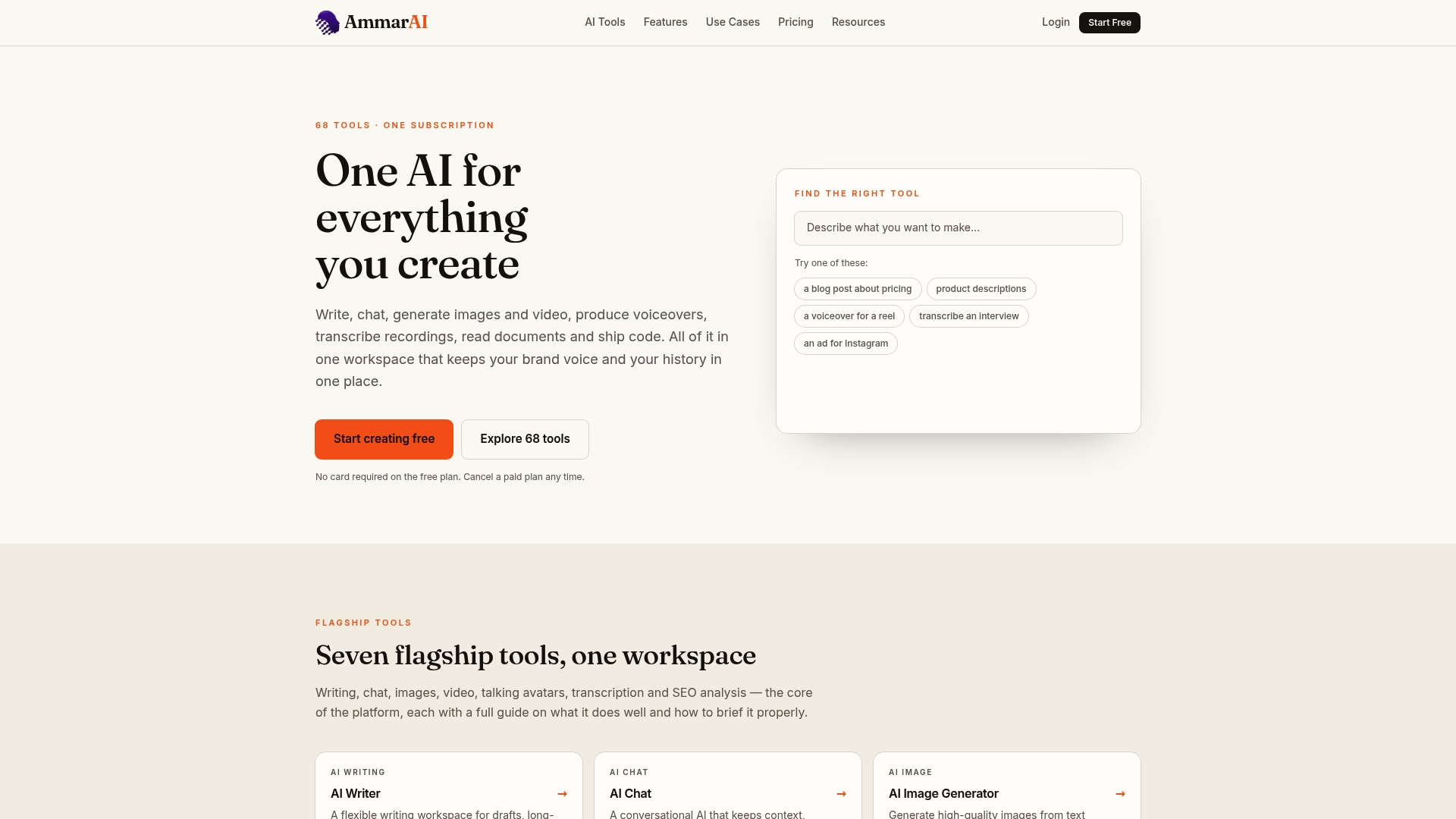
Our AI Blogger Agent runs the research-to-draft stages of the workflow described in this piece, and bulk generation lets a small team produce a month of outlines or drafts in one sitting instead of one post at a time.
- Start with a free plan to test the outline and drafting flow on a real post.
- Check current pricing if your team is ready to scale past a handful of posts a month.
- Pilot the AI Blogger Agent on one upcoming post before committing it to your full editorial calendar.
See what a full workflow looks like on our pricing page.
FAQ
Are blogs still a thing in 2026?
Yes, blogging remains a standard part of content marketing, with content marketers averaging posts of around 1,312 words and roughly 3 hours 20 minutes of writing time. The format has shifted toward AI-assisted production, but the underlying channel is still widely used.
Which AI is best for writing a blog?
There’s no single best tool for every team: the right choice depends on whether you need a standalone drafting assistant or a full workspace that also handles outlines, metadata, and brand voice. A unified workspace like AmmarAI suits teams that want one consistent voice and one bill across the whole blogging process rather than juggling separate subscriptions for each step.
How to tell if a blog post is written by AI?
AI-written posts often show generic phrasing, repetitive sentence structures, and claims that lack specific sources or named examples. Google’s guidance on helpful content notes that content created primarily to game rankings, rather than to help people, tends to read as hollow regardless of whether a human or a model wrote it.
Is it illegal to publish a story written by AI?
Publishing AI-assisted content is not illegal, but the U.S. Copyright Office has clarified that content generated solely by AI, without meaningful human authorship, cannot be copyrighted. Adding substantial human editing, structure, and original insight is what allows a piece to qualify for copyright protection.
Sources
- Blogging Statistics 2026: What 1,042 Content Marketers Told Us About What Works New Research
- NewsNet Issue 1060 | U.S. Copyright Office
- Creating helpful, reliable, people-first content | Google Search Central
- Using AI to write blog posts (Shopify blog)
Recommended
Recommended for you
- 90 Days to a Workflow for AI Copywriting for Ads for Small Teams
Learn a workflow first approach to AI copywriting for ads: generate, review, and test ad assets in 30 day pilots while keeping brand voice.
- How to Set Up an AI Brand Voice
Build an AI brand voice that stays consistent. Gather source copy, define clear rules, test real prompts, and correct drift with a repeatable review process.
- 6 Prompts That Make AI YouTube Scripts Film Ready for Creators
Turn AI drafts into film-ready YouTube scripts with time codes, read-aloud timing checks, and a 6-item prompt checklist creators can paste into any AI tool.
Tools to try next
- AI ReWriter
Rewrite existing text in a different tone, length or reading level while keeping the meaning intact.
- Brand Voice
Define how your brand sounds once, and have every writing tool follow it.
- AI Editor
A long-form document editor with AI help built into the page, for drafting and revising in one place.