
AI Business14 min read
Stop Tool Shopping: 8 Step AI Content Workflow Pilot for Marketers
Practical guide for marketers: run an 8 step AI content workflow pilot. Set orchestrator and agent steps, enforce governance, and track KPIs.

Stop Tool Shopping: 8 Step AI Content Workflow Pilot for Marketers
An AI content workflow is a repeatable pipeline that combines automated agents and human review to produce consistent, brand-aligned content faster and at scale. It covers research, drafting, editing, publishing, and repurposing, with an orchestrator coordinating specialized tools and people checking the output at defined points. Done well, it cuts production time without sacrificing accuracy or voice, as long as governance keeps pace with speed.
TL;DR:
- An effective AI content workflow relies on clear decision gates such as outline approval and final sign-off, not just automated generation.
- Embedding a strong brand voice guide and defining “good” quality criteria upfront prevents drift and repeated rework.
- Pilot projects should focus on a single content format and include measurable metrics like time-to-draft and fact-check flags to identify bottlenecks.
- Human review gates at key points, especially for fact-checking and tone, significantly reduce errors and editors’ workload during scaling.
- Governance practices including source verification, bias review, privacy checks, and logging are essential for responsible AI use throughout the pipeline.
Table of Contents
- The core components of an AI content workflow
- How to build a step-by-step AI content pipeline
- Tools, roles, and orchestration patterns that keep workflows reliable
- Running an 8-step AI content workflow pilot
- Applying the NIST AI RMF to content workflows
- Measuring ROI with the right KPIs
- Common pitfalls and how to avoid them
- What running these pilots actually teaches you
- How AmmarAI fits into your content workflow
- FAQ
- Sources
The core components of an AI content workflow
Every workflow starts with inputs: a brand voice guide, audience definitions, approved source material, and any proprietary data the team wants reflected in the output. Skip this step and every later stage inherits the gap, producing generic copy that needs heavy rewriting.
From there, specialized tools handle distinct jobs. A research agent pulls facts, competitor angles, and data points. An outline generator turns that research into a structure. A drafting model writes the first pass. An AI editor checks tone, clarity, and brand alignment. A fact-checking pass flags unsupported claims. An orchestrator sequences all of this, and a CMS connector pushes finished output to where it needs to live.

Human review gates sit at the highest-risk points, not at every step. The NIST AI Risk Management Framework treats this kind of staged oversight as a core practice for managing AI risk across a system’s lifecycle, and it applies directly to content pipelines.
A typical component map looks like this:
- Inputs: brand voice guide, audience personas, approved assets, proprietary or first-party data.
- Generation agents: research agent, outline generator, drafting model, image or video tools where needed.
- Quality agents: AI editor for tone and structure, fact-checker for claims and citations.
- Orchestration layer: sequences agents, passes context between steps, and logs decisions.
- Human gates: outline approval, final edit sign-off, and legal or compliance review when required.
- Distribution layer: CMS connector, social scheduler, and repurposing tools for other formats.
The gates matter more than the generation tools. A fast draft that nobody checks is a liability, not an efficiency gain.
How to build a step-by-step AI content pipeline
A workflow only works if it is repeatable, which means writing it down as a sequence with clear decision points rather than a loose set of tools people use however they want. Search Engine Land’s implementation guide recommends working backward from the finished article: define what “good” looks like before generating anything, then build the pipeline to hit that bar.
- Kickoff: Define the quality rubric, audience, and scope for the piece before any tool runs. Assign one owner for final sign-off.
- Research: Run an automated research pass to gather facts, competitor coverage, and gaps in existing content on the topic.
- Outline: Generate a structured outline from the research, then route it through a human review gate before drafting starts.
- Draft: Generate the first draft against the approved outline and brand voice guide.
- AI editor pass: Run an automated edit for tone, clarity, and structural consistency before a human ever sees it.
- Fact-check pass: Run an adversarial fact-check step that flags claims lacking a source, then route flagged items to a human editor.
- Human edit: A human editor resolves flagged issues, tightens language, and signs off on accuracy and voice.
- Publish and repurpose: Push the approved piece to the CMS and generate adjacent formats (social posts, video scripts, email excerpts) from the same source material.
Embedding both an AI editor pass and an adversarial fact-check pass before human review is specifically what reduces the time human editors spend catching avoidable errors, rather than having them start from a raw draft.
Repurposing deserves its own attention rather than an afterthought tacked onto publishing. Turning one article into social captions, a short video script, and an email requires the same brand voice and facts, just reformatted, and that step is where many teams lose the time they saved earlier. A structured repurposing workflow keeps that step from becoming manual rework.
Metrics and automated reporting belong at the end of the pipeline, not bolted on afterward: log time-to-draft, number of edit cycles, and fact-check flags automatically as the piece moves through each stage, so the data is already there when someone wants to review it.
Pro Tip: Build your quality rubric before you touch any generation tool. A pipeline without a defined “good” just automates inconsistency faster.
Tools, roles, and orchestration patterns that keep workflows reliable
Workflow tools fall into a handful of categories, and knowing what to expect from each one prevents the common mistake of asking a single tool to do a job it was not built for. Research tools surface facts and competitive gaps. Generation tools draft text, images, or video. Editing tools check tone, structure, and claims. Connector tools move finished content into a CMS or scheduler.
An orchestrator agent sits above all of this, sequencing the specialized agents and passing context between them. Documented agent responsibilities and clear hand-offs make workflows easier to debug: when something breaks, the team can isolate which agent failed instead of re-checking the whole pipeline. That same documentation lets teams swap or upgrade one step without rebuilding the rest.
Reliable workflows also need clear human roles, not just tools:
- Content owner: sets the brief, scope, and quality rubric, and has final sign-off authority.
- AI operator: runs and monitors the agents, adjusts prompts, and manages the orchestrator’s configuration.
- Editor: resolves flagged issues, enforces brand voice, and makes judgment calls the tools cannot.
- Fact-checker: verifies claims against primary sources before publish.
- Developer or integrator: connects the orchestrator to the CMS, analytics, and other systems.
Smaller teams often combine these roles, but the responsibilities still need to be explicit, or review gates quietly disappear under deadline pressure.
Running an 8-step AI content workflow pilot
A pilot works best as a small, bounded test rather than a full rollout. Pick one content type, one audience segment, and a 30 to 90 day window, and bring together a content owner, an editor, and whoever manages the AI tooling.
- Step 1, define scope: pick one content format and one quality rubric to test against.
- Step 2, load brand context: set up a shared brand voice profile so every generated draft starts aligned.
- Step 3, configure the orchestrator: map out research, draft, edit, and publish steps with an agent builder.
- Step 4, run a bulk test batch: generate a batch of drafts at once to see where the pipeline breaks or drifts.
- Step 5, apply human gates: route outlines and final drafts through the reviewers defined in step 1.
- Step 6, measure: log time-to-draft, edit cycles, and fact-check flags for every piece in the batch.
- Step 7, adjust: fix the weakest step in the pipeline, not the whole system, based on what the data shows.
- Step 8, decide: compare pilot results against the original rubric and decide whether to scale, adjust, or stop.
A shared workspace, brand voice settings, bulk generation, and an agent builder for mapping out the orchestrator steps make this kind of pilot faster to set up, since the team is not rebuilding infrastructure for a test run. Keeping the pilot small also makes it easier to spot where editor workload actually drops, which is often where AI-assisted drafts reach a higher publish-ready state before a human ever opens the document.
Pro Tip: Run the pilot on your lowest-stakes content type first. A pipeline that fails on a blog post is far cheaper to fix than one that fails on a client deliverable.
Applying the NIST AI RMF to content workflows
Governance does not need to be heavy to be real. The NIST AI Risk Management Framework organizes responsible AI practice into four functions applied iteratively across a system’s lifecycle: GOVERN sets policy and accountability, MAP identifies where risk shows up in your specific pipeline, MEASURE tracks whether mitigations are working, and MANAGE responds when something goes wrong.
For a content workflow, that translates into concrete checks:
- Source verification: every factual claim in a draft traces back to a citable source before publish.
- Bias review: sampled output is checked for skewed framing or unsupported generalizations, especially in comparative content.
- Privacy check: no customer or proprietary data enters a prompt without a documented approval.
- Logging: each pipeline run records which agent produced what, and which human approved it.
A practical governance framework gives teams a structure for scheduling these reviews, whether monthly or per campaign, and for recording what was checked, who checked it, and what changed as a result.
Measuring ROI with the right KPIs
Two sets of metrics matter here, and conflating them hides real problems. Operational KPIs track speed: time-to-first-draft, editor hours saved per piece, and overall throughput. Quality KPIs track whether speed came at a cost: number of revision cycles, factual error rate caught before publish, and downstream engagement once content is live.
Generative AI applications in consumer marketing contexts have driven more than an 80% decrease in time to first response, along with an average 4-minute reduction in resolution time. That figure comes from customer response workflows rather than content production specifically, but it sets a useful expectation for how much time automation can realistically return when paired with human oversight.
Common pitfalls and how to avoid them
Most workflow failures trace back to a handful of avoidable habits. Treating the whole program as a prompt-engineering exercise is the first one: a good prompt cannot fix a pipeline with no review gates or quality rubric.
- Hard-code shared context: load brand voice and canonical product descriptions into the infrastructure itself rather than re-prompting every run, which reduces hallucination risk and keeps output consistent.
- Separate mechanical from editorial work: let agents handle data gathering and formatting, and reserve human time for judgment calls on brand fit and nuance.
- Start small: pilot one content type before scaling across every format the team produces.
- Measure before expanding: use pilot data to decide what to fix, not instinct.
Pro Tip: If your “AI workflow” is really just one person pasting better prompts into a chat window, you have a habit, not a pipeline.
What running these pilots actually teaches you
The biggest surprise across pilots is how often the bottleneck turns out to be the review gate, not the generation step. Teams expect the AI to be the weak link and instead find editors drowning in drafts that were never routed through a clear rubric.

The second lesson: brand voice drift happens fast without a hard-coded reference, and it is far cheaper to fix before scale than after. For more on balancing generation speed with oversight, our guide on using AI for content creation and our breakdown of which marketing tasks to automate are worth a closer read before you scale past a pilot.
Start smaller than feels comfortable. The pipeline tells you more in one real batch than any amount of planning.
— Ahmed
How AmmarAI fits into your content workflow
We built our workspace around the exact bottlenecks that slow down a content pipeline: switching between five tools, re-explaining brand voice every time, and losing track of what was approved where. With one shared brand voice setting, we keep every draft, image, and video aligned across the whole team, whether you are running research, drafting, or repurposing.
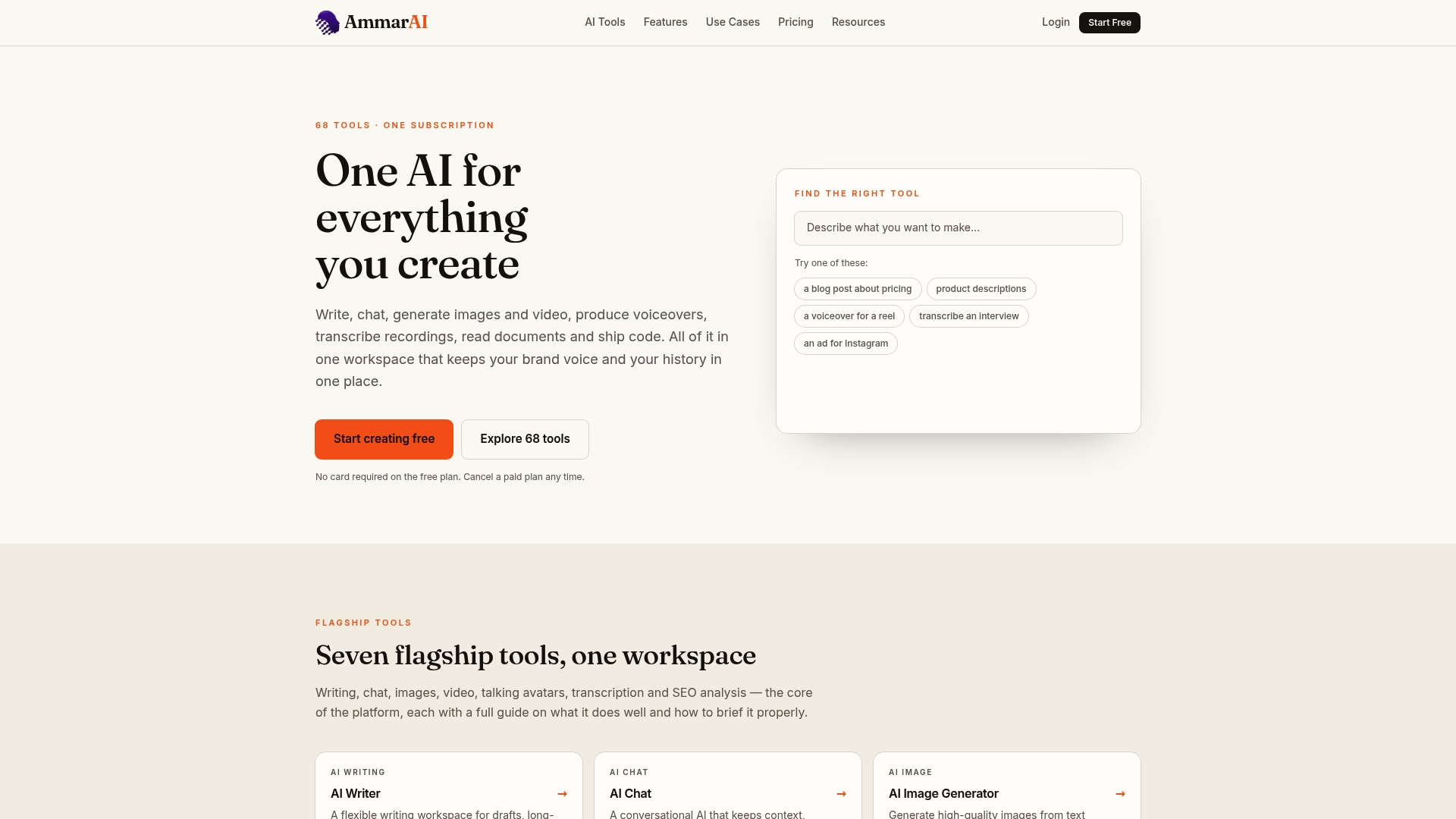
Bulk generation lets you run a full batch of drafts for a pilot in one pass instead of one at a time, and our agent builder lets you map out an orchestrator sequence, research, outline, draft, edit, without hand-coding anything. Shared workspaces mean your content owner, editor, and AI operator work from the same history instead of comparing exports.
If you are planning a pilot like the one outlined above, our pricing page lays out the Free, Starter, Professional, and Ultimate plans so you can match the tier to your pilot’s scope before you commit to anything larger.
FAQ
How do I use AI for content strategy?
Use AI to accelerate research, drafting, and repurposing while keeping humans in charge of strategy decisions: audience priorities, brand positioning, and which topics matter. The strongest results come from pairing automated agents with defined human review gates, which improves oversight compared to letting the tools run unsupervised.
What are the stages of a content workflow?
A typical AI content workflow moves through research, outline, draft, edit, publish, and repurpose, with an orchestrator sequencing each step. Human review gates typically sit at outline approval and final edit, where judgment matters most, as described in practical implementation guides.
What is an AI workflow?
An AI workflow is a documented sequence of automated agents, each handling a specific task, coordinated by an orchestrator and checked by humans at defined points. The goal is repeatability: the same inputs should move through the same steps and produce a consistent, reviewable result.
Can AmmarAI handle an entire content pipeline on its own?
AmmarAI brings research, drafting, editing, image and video generation, and publishing tools into one workspace with shared brand voice and bulk generation, which covers most of the pipeline’s generation steps. Human review gates for fact-checking and final sign-off still belong to your team, as governance frameworks like NIST’s AI RMF emphasize keeping those judgment calls human.
Sources
- How generative AI can boost consumer marketing
- How to build an AI content workflow from the ground up
- AI Risk Management Framework (NIST)
- How to create a brand voice guide for AI tools
- AI agent orchestration patterns and benefits
Recommended
Recommended for you
- Teams: Cut tool sprawl with one AI document analysis workspace
Enterprise teams get practical workflows, token limit workarounds, citation checks, and governance steps for reliable AI document analysis in a single...
- Save Two Hours a Week: AI Business Emails Workflow for Small Teams
Workflow guide for professionals and small teams on AI business emails: prompts, edits, integrations, and how to save two hours weekly.
- Creators: Cut Editing Time with AI B Roll, Polish in 10 to 15 Minutes
Turn transcripts into AI b roll rough cuts and finish with a 10 to 15 minute polish. Includes licensing checklist and AmmarAI workflow tips.
Tools to try next
- Brand Voice
Define how your brand sounds once, and have every writing tool follow it.
- AI Editor
A long-form document editor with AI help built into the page, for drafting and revising in one place.
- AI Agent Builder
Build agents that run real workflows on a schedule or trigger — reading, deciding and acting without you.