
AI Marketing15 min read
Marketing AI Agents: What They Do and How to Start
Marketing AI agents plan and run multi-step work like research, drafting and repurposing. Learn what they handle, where humans stay in charge, and how to start.

Marketing AI Agents: What They Do and How to Start
A marketing AI agent is software that takes a goal, such as “turn this product launch into a week of posts,” and works through the steps on its own: researching, drafting, formatting, and handing the result back for your approval. For most creators, small businesses and marketing teams, the practical way to use one is inside a single workspace that already holds your brand voice, your history and your content tools, with a person reviewing what goes out. That is how we think about it at AmmarAI, and the rest of this guide shows what agents can do, where they fail, and how to set one up without a stack of subscriptions.
TL;DR
- A marketing AI agent plans and carries out several connected tasks toward a goal. A chatbot answers one prompt at a time, and a rule-based automation repeats a fixed sequence.
- Agents suit repetitive, multi-step content work: research, drafting, repurposing, resizing, scheduling and reporting. Fixed, predictable jobs like welcome emails are often better as simple automations.
- Keep a human approval step before anything is published. Fluent text is not the same as accurate text.
- Start small: one workflow, one brand voice, one review step, then measure and widen.
- Our plans run from a free tier to $59.99 per month, so you can start with one workflow and grow.
Table of Contents
- What a marketing AI agent actually is
- What marketing AI agents can handle
- Agent or simple automation: pick the right one
- How an agent works through a content job
- Benefits you can reasonably expect
- Keep a human in charge: guardrails that work
- How to start: a five-step plan
- Measuring whether it works
- Who benefits most
- Our perspective
- Try it on one workflow
- FAQ
- Sources
What a marketing AI agent actually is
The word “agent” gets stretched. Analyst firm Forrester defines AI agents as applications tuned to act on behalf of a company or a person, performing tasks, making decisions and working with data or systems autonomously. For marketing specifically, Forrester’s test has five parts: the agent is marketing-focused, autonomous, responsible (explainable and accountable), goal-oriented, and able to run several tasks in an adaptive workflow.
In plain terms, you can sort the tools you meet into three kinds:
| Tool type | What you give it | What it does | Typical marketing use |
|---|---|---|---|
| Chatbot | One prompt | Returns one answer | Brainstorming headlines, rewriting a paragraph |
| Rule-based automation | A trigger and fixed rules | Repeats the same steps every time | Welcome email sequence, social scheduling, weekly report |
| AI agent | A goal | Plans steps, uses tools, adapts, returns a result | Researching a topic, drafting a post, adapting it for five channels |
The difference matters when you shop. A tool that only generates text from a single prompt is useful, but it is a chatbot. An agent connects several steps, and that is where the time savings come from.
What marketing AI agents can handle
Consulting firm PwC lists the marketing tasks it sees agents managing: brief creation, audience targeting, personalized content, customer journey orchestration and performance analytics, along with wider work such as marketing planning and automating the content supply chain. That is an enterprise view. If you are a creator, a small business owner or a student, here is how it translates:
- Research. Gathering what is already published on a topic, summarizing a competitor’s page, pulling the questions people ask.
- Drafting. Writing a blog post, product description, newsletter or script in your voice.
- Repurposing. Turning one long piece into social posts, a video script, a voiceover and an email.
- Optimization. Checking a page against a target keyword and suggesting edits.
- Production. Generating images and short videos to go with the copy.
- Admin. Transcribing a call, extracting action items, preparing a report.
Notice that most of this is content work. That is why “content AI agents” is a natural way to think about the category: the agent’s job is to move a piece of content from idea to ready-to-review, across formats.
Agent or simple automation: pick the right one
Not every task needs an agent. CMO Tech Asia describes the split this way: rule-based automations fit clear, consistent tasks such as welcome email sequences, lead scoring, social scheduling and regular reporting dashboards, while agents shine in complicated customer journeys, content personalization and creative problem-solving.
A quick test you can use:
- Is the task the same every time? If yes, a fixed automation is enough.
- Does it need judgment, such as choosing an angle, adapting tone for a channel, or deciding what to cut? That points to an agent.
- Does it span several steps and tools? An agent earns its keep when the steps would otherwise mean copying text between tabs.
- Is a mistake expensive or public? Add a human approval step regardless of which you choose.
A worked example: a boutique owner has 40 new products. Writing each description, a social caption and a search-friendly title is the same shape of work 40 times, with small variations. That is a bulk, multi-step content job, and it is a good first workflow. Sending a thank-you email after each purchase is fixed and predictable, so a plain automation handles it.
How an agent works through a content job
A well-designed content workflow follows a loop, and understanding it helps you judge any tool:
- Goal and brief. You state the outcome, the audience and the channel.
- Research. The agent gathers source material.
- Draft in your voice. It writes using your saved brand voice, so output sounds like you rather than like a generic assistant.
- Checks. Length, keywords, links, formatting.
- Human review. You approve, edit or send it back.
- Publish and measure. Only after approval does content go live, and you track what it does.
The step people skip is number five, and it is the one that protects your reputation. Research consultancy McKinsey describes the aim as hybrid human and agent teams in which one marketer supervises agents that handle most of the execution. The word that matters there is supervises.
What an agent needs from you
Agents are only as good as what they can see. McKinsey finds that connecting systems, not the AI model itself, is often the limiting factor, and that marketers need to look after data quality, content metadata and the rules that govern how agents are orchestrated. For a small team that translates into three habits:
- Keep your brand voice written down. Tone, words you use, words you avoid, example posts.
- Keep your facts in one place. Product details, prices, policies, audience. An agent that works from one source of truth repeats fewer wrong claims.
- Keep your work in one workspace. When chat, images, video, voice and writing live in separate tools, every handoff is manual and every tool has its own memory of your brand.
That third point is the reason we built AmmarAI as one workspace with one history, one brand voice and one bill, instead of leaving you to stitch together separate chat, image, video, voice and writing subscriptions.
Benefits you can reasonably expect
IBM’s overview of agents in marketing lists the upside as continuous campaign improvement, context-aware engagement across channels, less complexity from joining tools and data together, and execution at a scale that would otherwise need more headcount. For the readers of this guide, the benefits show up in three ways:
- Speed. A first draft, image set and caption pack in minutes rather than a day of tab-switching.
- Consistency. The same voice across blog, email, social and video scripts.
- Volume. Bulk generation for catalogs, campaigns and multi-channel calendars.
To see how these map to real jobs, our guide to the best AI marketing tools by job walks through each task type, and the use cases by role and industry page shows how creators, students, developers and shop owners put it to work.
Keep a human in charge: guardrails that work
Governance sounds like an enterprise concern, but the principles apply to a solo creator too. IBM points out that agentic systems can make opaque decisions and be exposed to bias, security threats and regulatory gaps, and suggests safeguards such as testing under stress, monitoring, an emergency shutdown and human oversight.
Here is a version sized for a small team or one person:
1. Limit what the agent can do
Start with drafting only. Let it write and produce assets, but do not give it permission to post, email customers or change prices. Widen permissions only after weeks of good results.
2. Require approval before publishing
Every public piece passes through you. Read for accuracy, not just for tone. Well-written text can hide a wrong number, an invented detail or a claim you would never make, and a persuasive paragraph is the easiest kind to wave through.
3. Check facts and claims
Verify every statistic, price, date and legal or health statement. Remove anything you cannot source. If your industry has advertising rules, such as endorsements or health claims, apply them to AI output exactly as you would to your own writing.
4. Protect private data
Do not paste customer lists, contracts or confidential figures into any tool unless you are comfortable with how it is handled. Use anonymized examples where you can.
5. Keep a record
Save the brief, the output and who approved it. When something goes wrong, you can see where. A shared workspace with one history makes this far easier than scattered chats across several apps.
6. Watch for overblown claims
Many products are labeled “agents” that are really prompt templates. Judge a tool by whether it carries out connected steps toward a goal, using the Forrester criteria above, not by the label.
How to start: a five-step plan
Step 1: Choose one workflow. Pick something you repeat weekly that takes more than an hour: a weekly newsletter, product descriptions, a social calendar, a podcast-to-posts routine. Resist starting with everything.
Step 2: Write down your brand voice. Add three to five examples of writing you love, a list of banned phrases and a one-paragraph description of your audience. In AmmarAI the brand voice is saved once and used across the tools, so your blog, captions and scripts share it.
Step 3: Build or select the agent. Define the goal, the inputs, the steps and where it stops for review. If you want to design your own, our tutorials on how to build an AI agent and how to run a social media agent walk through the setup, and the AI agent builder page shows what workflows you can automate. For a broader picture, read the setup guide for business automation.
Step 4: Run it on a small batch. Ten product descriptions, not four hundred. Compare against what you would have written. Note every edit you make, because those edits become instructions for next time.
Step 5: Measure and widen. Track time saved per piece, edits per draft and the performance of the published content. When the agent produces drafts you approve with few changes, add the next workflow.

Measuring whether it works
Pick three numbers before you start and compare them after a month:
| Metric | How to track it | What good looks like |
|---|---|---|
| Hours per piece | Time from brief to approved draft | Falling steadily as your voice and instructions improve |
| Edit rate | Share of the draft you change | Falling, with fewer factual corrections |
| Output performance | Clicks, replies, saves, conversions | Holding or rising compared with your earlier content |
If speed rises but performance falls, the agent is producing volume without insight. Tighten the brief, give it better examples, and put more of your judgment into the angle, the part people respond to.
Who benefits most
- Content creators get one place to script, voice, illustrate and repurpose, rather than five subscriptions. See AI for productivity for clearing a writing backlog.
- Small business owners can produce marketing materials without a design or copy team. The AI for marketing teams page covers planning through launch.
- Marketers and agencies need consistency across clients and channels. Shared workspaces and brand voice help, and the AI for agencies page goes deeper.
- E-commerce sellers can generate listings in bulk with AI for e-commerce and product images with the AI product photo generator.
- Students and developers can use the same workspace for study notes, transcription and documentation drafts, as in AI for developers.
Our perspective
We think the most useful way to see a marketing agent is as a teammate that does the first 80 percent of the repetitive work and hands it to you for the last 20 percent that needs taste.
The trouble we hear about most is not that people lack AI tools. It is that they own too many. One tool for chat, another for images, another for video, another for voice, each with its own login, its own limits and its own idea of what your brand sounds like. Every handoff between them is manual work, and every one is a place where your voice drifts.
That is why we put the tools in one workspace with one history, one brand voice and one bill. An agent is only as consistent as the context it can reach, and a single workspace gives it more of that context than a pile of separate subscriptions can. Bulk generation and shared workspaces then let a team keep that consistency at volume.
We also focus on practical workflows rather than promises of autopilot. Agents work best when a person sets the goal, reviews the output and decides what ships.
Ahmed
Try it on one workflow
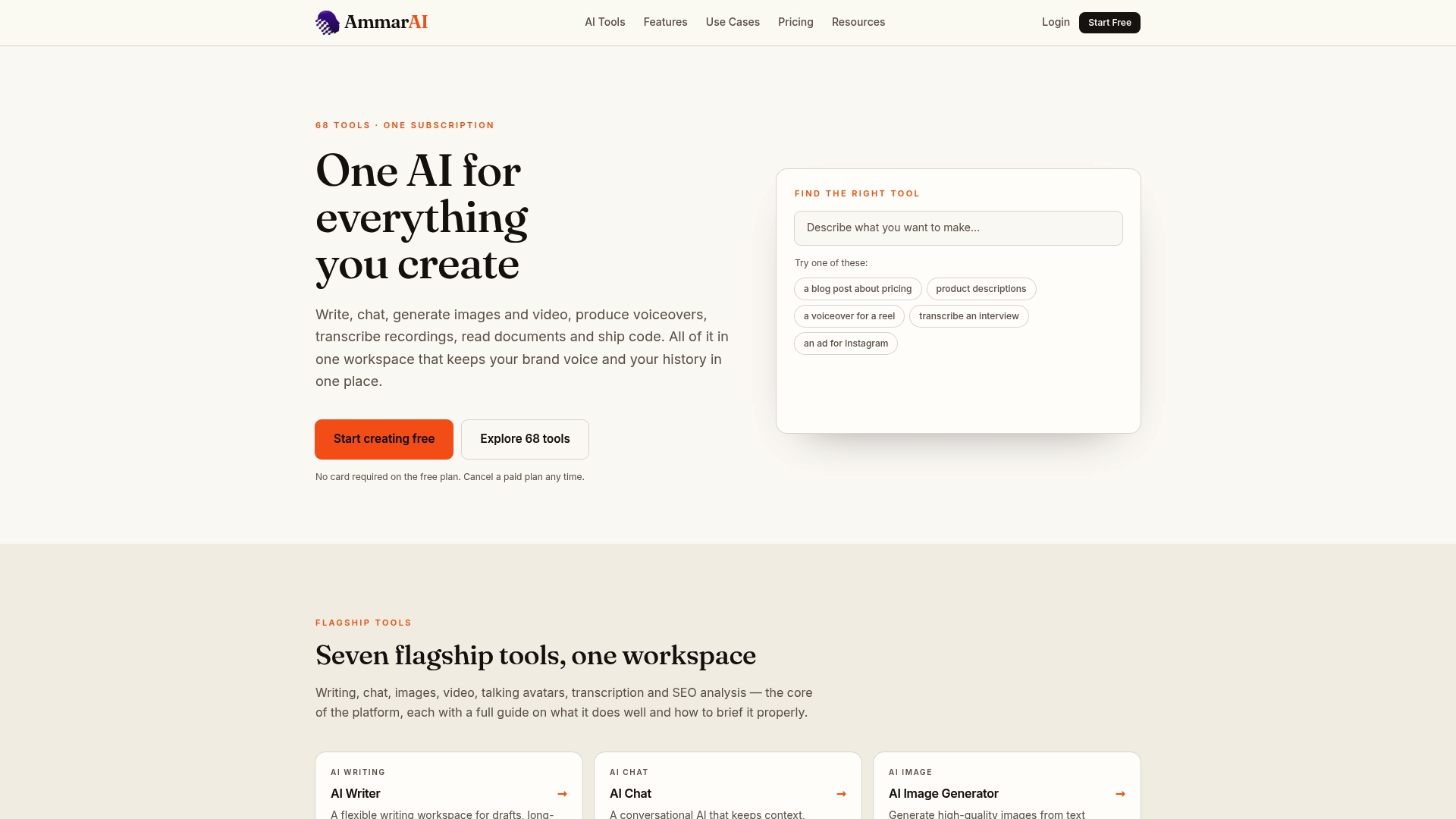
AmmarAI brings writing, image generation, video, voice, transcription and SEO tools into one workspace, with a saved brand voice and agent building on top. You can start on the Free plan at $0 per month and move up when you need more generation. Starter is $9.99 per month, Professional is $29.99 per month and Ultimate is $59.99 per month. Full details are on the pricing page.
If your first workflow is search content, the AI for SEO page and the AI SEO analyzer show how to score and improve a page before you publish.
FAQ
What is the difference between a marketing AI agent and a chatbot?
A chatbot answers a prompt and stops. A marketing agent takes a goal, breaks it into steps, uses tools along the way and returns a finished result for your review. Forrester’s definition also expects it to be goal-oriented and to run several tasks in an adaptive workflow.
Can AI agents replace my marketing team?
They are better treated as a way to take repetitive execution off people. McKinsey’s picture is one marketer supervising several agents, not agents working alone. Strategy, angle, brand judgment and final approval stay with you.
What are content AI agents good at?
They handle research, first drafts in a set voice, repurposing one piece into many formats, SEO checks and production of supporting images or video. These are repeatable, multi-step jobs where a saved brand voice keeps the output consistent.
Do I need technical skills to use one?
Not to begin. You need a clear goal, a written brand voice and a review habit. Our tutorials walk through building an agent step by step if you want to go further.
Where should a beginner start?
Pick one weekly task that takes more than an hour, run it on a small batch, and keep human approval before anything is published. Widen only when the drafts need few edits.
Sources
- Forrester: So You Think You Have A Marketing AI Agent?
- McKinsey: Reinventing marketing workflows with agentic AI
- PwC: Agentic AI for marketing transformation
- CMO Tech Asia: AI agents vs AI automations
- IBM: AI Agents in Marketing
Recommended
Recommended for you
- AI Competitor Analysis: A Step-by-Step Guide for 2026
Learn how to run AI competitor analysis: pick rivals, gather evidence, write prompts that produce decision briefs, and check every claim before you act.
- AI Marketing Bot: A Practical Broadcast Workflow
Learn how an ai marketing bot drafts, segments, schedules and measures WhatsApp and Telegram broadcasts, with practical checks to prevent costly errors.
- AI Brand Compliance: A Practical Guide for US Marketing Teams
AI brand compliance for US teams: voice, legal disclosure, copyright and provenance checks, plus a review workflow you can start this week.
Tools to try next
- AI Marketing Bot
Broadcast marketing messages to your WhatsApp and Telegram audiences — written by AI, segmented, scheduled and measured.
- Brand Voice
Define how your brand sounds once, and have every writing tool follow it.
- AI Agent Builder
Build agents that run real workflows on a schedule or trigger — reading, deciding and acting without you.